
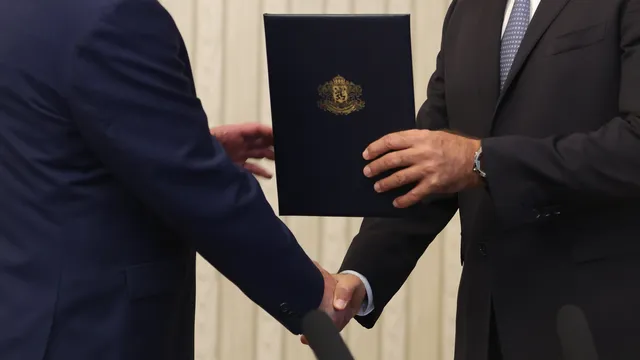
The government of Rosen Zhelyazkov resigned on Wednesday after days of mass protests across the country.
On Monday, Bulgarian President Rumen Radev, in accordance with Article 99(1) of the Constitution, will begin consultations with representatives of the parliamentary groups in Bulgaria’s 51st National Assembly.
The meetings at the presidency will start at 10:00 a.m. Bulgarian time (08:00 GMT) with the largest political force in parliament, GERB–SDS, followed at 11:30 a.m. by talks with representatives of the parliamentary group of Continue the Change–Democratic Bulgaria (PP–DB).
If the party of Boyko Borissov fails to form a government, the mandate will pass to the second-largest political force, Continue the Change–Democratic Bulgaria. Should the second exploratory mandate also fail, the president will select another parliamentary force to attempt to form a cabinet.
If the process leads to the formation of a caretaker government, under the new constitutional rules Radev must open what he himself has called the “house book” of potential prime ministers. First on the list is National Assembly Speaker Raya Nazaryan, followed by Bulgarian National Bank Governor Dimitar Radev and his deputy Andrey Gyurov, who has been removed from the BNB Governing Council due to proceedings by the anti-corruption commission. Other possible candidates include Court of Auditors Chair Dimitar Glavchev, who served as the first caretaker prime minister under the new constitutional rules, as well as Ombudsman Velislava Delcheva and her deputy Maria Filipova.
BGNES recalls that the government of Rosen Zhelyazkov, formed with a mandate from GERB–SDS in a coalition with the BSP and There Is Such a People (ITN), resigned on Wednesday after days of mass protests across the country.
On Thursday, parliament unanimously voted to accept the cabinet’s resignation with 227 votes in favor.
The draft decision on the resignation was presented by GERB–SDS MP Denitsa Sacheva, who said that the Zhelyazkov government would continue to govern until a new cabinet is elected.
During the debate, Bozhidar Bozhanov, co-chair of Yes, Bulgaria, said the government had fallen because of public anger expressed in the streets. He noted that the immediate trigger was the 2026 budget, but argued that the real reasons lay in the deep political crisis caused by the role of Delyan Peevski in politics. “Peevski must be isolated for Bulgarian politics to return to a normal course,” Bozhanov said, adding that this parliament represented squandered opportunities for which the governing coalition bears responsibility. He stressed that responsibility for the budget and its extension lies with the government under the Constitution.
GERB–SDS MP Toma Bikov said governing amid protest tension exceeding normal levels was impossible. He insisted that GERB had never sought to govern “against” public sentiment and had repeatedly demonstrated that power is not an end in itself. Bikov said the party carefully observed the diverse protests and concluded it could not implement its program in such an environment. He added that if the 51st parliament had failed, responsibility was shared by all political forces, and ruled out any future coalition with PP–DB.
PP–DB MP Elisaveta Belobradova said Bikov’s remarks reflected the authentic voice of GERB. She accused the party of lacking an independent position and argued that in recent months decisions had been shaped through DPS–New Beginning rather than through GERB itself.
Continue the Change Chair Assen Vassilev said the debate concerned the resignation of a harmful government that citizens would see off “with relief.” He argued that the protests were not in support of PP–DB but against the existing governance model, developed together with New Beginning, which he said privileged certain MPs above others.
BSP MP Dragomir Stoynev warned that chaos could loom toward the end of 2025. He said a budget was necessary to reassure citizens and cautioned that even a temporary one-twelfth spending formula would be difficult to sustain without revenues. Stoynev argued the fallen government had been necessary for stability and for keeping Bulgaria on its European path.
ITN MP Toshko Yordanov said his party had twice renounced power to demonstrate political responsibility. He recalled that ITN withdrew support from Kiril Petkov’s government in 2022 over policy toward North Macedonia and what he described as irresponsible financial policies, adding that the current cabinet would not have fallen from protests alone had it not resigned.
GERB’s Denitsa Sacheva said the government had been formed to end a cycle of seven elections, secure Bulgaria’s accession to the eurozone, advance the Recovery and Resilience Plan, and enable infrastructure and education projects. She said GERB once again acted as a bridge rather than an obstacle to give the country prospects for future generations.
Assen Vassilev concluded that GERB and PP–DB come from different political “universes,” making cooperation between them impossible. | BGNES