
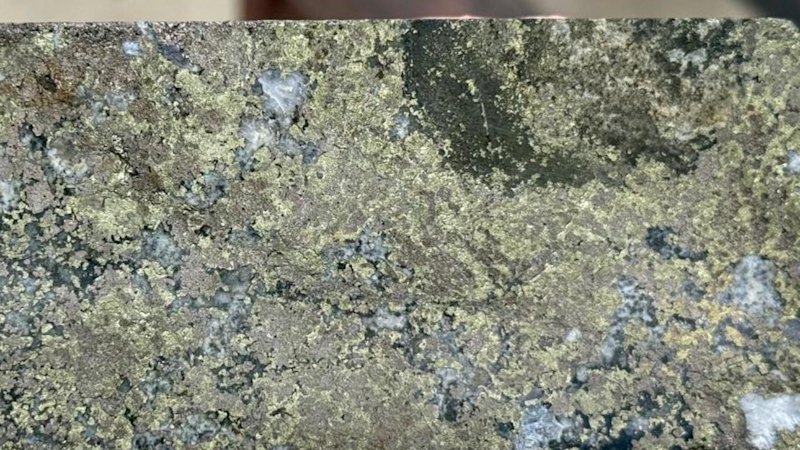
Near-surface mineralisation in the second hole is similarly hosted in green garnet skarn with disseminated chalcopyrite, pyrite and pyrrhotite, including high-grade zones linked to semi-massive pyrrhotite and chalcopyrite.
The latest results confirm and amplify the picture first sketched in early October, when Strickland stunned the market with a monster 191.2m hit grading 0.5g/t gold and 0.5 per cent copper from just 4.8m downhole.
Strickland Metals managing director Paul L’Herpiniere said: “The fact that the mineralisation is outcropping and includes some very wide zones of copper-gold mineralisation, including significant higher-grade zones, makes Copper Canyon an attractive and strategic opportunity for Strickland.”
Together, the company says the results demonstrate excellent shallow copper-gold mineralisation at Copper Canyon. The long intercepts highlight Copper Canyon’s optionality as part of the company’s overall Rogozna development strategy.
Strickland’s rapidly growing and remarkable polymetallic Rogozna project sits in the Raška District of southern Serbia, about 400km south of Belgrade. The project area has good access via regional highways, with local roads and tracks.
Rogozna lies within the Tethyan Metallogenic Belt – a globally significant geological structural complex, which hosts multiple giant, porphyry-related deposits. The Belt is traceable for about 12,000km from Europe’s Pyrenees and Alps through to Anatolia, Iran, Pakistan, the Himalayas and Southeast Asia.
Strickland says its project appears to be a similar large-scale magmatic hydrothermal system characterised by skarn-based gold-copper mineralisation, including zinc, silver and lead.
Covering an area of about 184 square kilometres, Rogozna comprises four exploration licences and hosts a JORC inferred mineral resource of 8.6 million ounces of gold equivalent, comprising 5.2 million ounces of gold, 321,000 tonnes of copper and 32.3 million ounces of silver.
An additional base metal component of the global resource estimate includes 383,000 tonnes of lead and 830,000 tonnes of zinc.
The key prospects within the project are the current flagship deposit at Shanac, while the presently most advanced deposits at Gradina, Medenovac and Copper Canyon all lie within a 5km radius of Shanac.
At least nine other high-quality prospects lie within 10km of Shanac, to the north, west and southwest, all supporting various styles of mineralisation, including epithermal and porphyry-hosted copper-gold deposits.
Strickland believes the project has the potential to become one of the largest undeveloped gold deposits in the world. To test that view, the company is pressing ahead with a 50,000m drilling program across Rogozna, including at its Gradina “gap zone” and other targets.
As the 2025 field season nears completion, the drill program is expected to wrap up by late December, with assays pending for multiple holes. Drilling is slated to kick off again in February 2026 and will ramp up to involve at least eight diamond rigs by the second quarter.
The latest results met with market approval today, rewarding the company with a midday share price spike of 2.6 per cent to 19.5 cents.
Strickland remains in a strong financial position to advance the project, with cash and liquid assets as of 30 September 2025 totalling $41.8 million.
Is your ASX-listed company doing something interesting? Contact: mattbirney@bullsnbears.com.au