
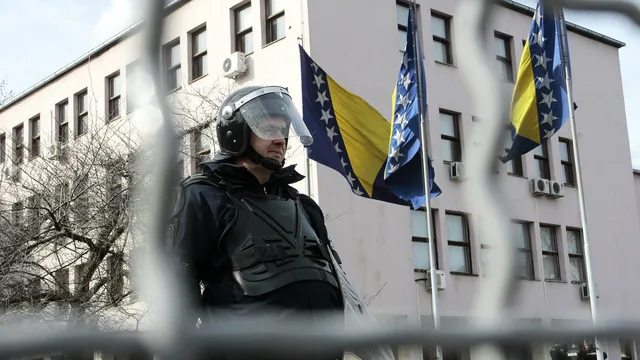
This is a crisis with serious democratic consequences.
Burdened by enormous debts, paralysed by a financing system that has been blocked for years and undermined by political inaction, Bosnia and Herzegovina’s public broadcaster (BHRT) is on the verge of bankruptcy. This is a crisis with serious democratic consequences.
“For years, you have tolerated violations of the law on public broadcasting in Bosnia and Herzegovina by Radio Television of Republika Srpska (RTRS),” condemn BHRT employees, the only state-owned public television station, in a communiqué addressed to key national institutions and representatives of the international community. They point to a debt of over 100 million convertible marks (KM) that RTRS has never paid to BHRT, a situation which they say poses an existential threat to the survival of public media.
After years of trying to get its finances in order, BHRT is now, according to them, in the “final stages of collapse.” The total debt now stands at 60 million KM: around 20 million to the European Broadcasting Union (UER/EBU), 38 million to the tax authorities, plus 9.5 million in unpaid VAT.
The debt accumulated in 2022 to the EBU led to consideration in September 2024 of selling real estate belonging to BHRT. Due to a lack of buyers and opposition from the Bosnia and Herzegovina prosecutor’s office, which contested ownership of these properties, considering them to belong to the state, the procedure was ultimately terminated. However, the EBU warned that it would seek a complete freeze on BHRT’s accounts if the debt was not repaid by the end of February 2026.
In early November, the adoption of the budget by the Parliamentary Assembly gave hope for a way out of the situation. But the funds initially earmarked for repaying the debt to the EBU were ultimately reduced by 22 million KM. In response, on November 27, employees went on a mass strike, accusing the institutions, and in particular the parliament, of jeopardizing the survival of the public service.
Since then, working conditions have deteriorated further: outdated technical equipment, restrictions on movement, inability to replace qualified staff, and years of unpaid social security contributions, which prevent many employees from retiring. BHRT is now struggling to cover its most basic costs, including electricity bills.
Since the Dayton Accords and the 2005 law on public broadcasting, the three public radio and television operators in the country have been financed separately. In the Federation of Bosnia and Herzegovina, the fee is collected by the state-owned company JP Elektroprivreda BiH through electricity bills. According to a June 2025 communication from the Office of the High Representative, around 56% of households in the Federation pay it, with a significant shortfall in payments in the western part of Herzegovina.
In the Republika Srpska, RTRS has been collecting the fee itself since 2017. However, contrary to the provisions of the law — 50% for BHRT and 25% for each of the units’ channels — these funds are not redistributed. The result: nearly 100 million KM have been withheld by the Republika Srpska over the past 8 years to the detriment of BHRT.
In the spring, the Minister of Communications and Transport proposed that the debt to the EBU be covered by the state budget and that a new law be adopted to ensure the collection of fees. None of these measures has been implemented, despite the creation of a working group. The situation worsened further with the increase in the minimum wage to 1,000 KM in January this year, while 65% of BHRT employees had previously been earning less than this threshold.
An increase in the fee is regularly discussed, but this would require a decision by the Council of the Public Broadcasting System, which has never convened: representatives of the Republika Srpska have never responded to invitations.
On RTRS, Minister of Finance and Public Finance Srdjan Amidžić (SNSD) justified the withdrawal of funding for BHRT and other cultural institutions from the state budget. Presented as a “political struggle” that is essential for the Republika Srpska, he said this decision would be a “victory” that would prevent the creation of a “state television station.” He accused the opposition in the Republika Srpska of wanting to derail the budget and equated any challenge to support for the “abolition of RTRS” without explaining how BHRT – the only state television station and a member of the EBU – posed a threat.
Faced with this impasse, BHRT’s editorial teams turned to High Representative Christian Schmidt, calling in particular for a return to a centralized collection system and legal mechanisms to ensure the collection of fees. At the same time, the EBU alerted European Commission President Ursula von der Leyen and Vice-President Marta Kos, expressing the view that the closure of BHRT would not only constitute a violation of press freedom but also a threat to national security with potential regional consequences.
In addition to the dismissal of 780 employees, several international organizations, including the EBU, warn of the consequences of BHRT’s disappearance: a weakening of pluralism, a reduction in the diversity of information, and the opening of a field for partisan media and disinformation.
The crisis could also compromise the country’s European path. In a June 2025 report, the Office of the High Representative recalls that the situation with BHRT is “critical” in terms of the European Commission’s fourteen key priorities, including ensuring the financial sustainability of the public broadcasting system.
The same concern is shared in Brussels. Luigi Sorreca, head of the EU delegation to Bosnia and Herzegovina, expressed “deep concern” and recalled that the political independence and financial stability of public media are fundamental European criteria.
“Preserving BHRT is a test of political maturity,” he warned, stressing that the disappearance of state public television would represent a serious democratic setback and cause lasting damage to the country’s international image. | BGNES
—
By Ombellin Dupraz, analysis for Le Courrier des Balkans.