
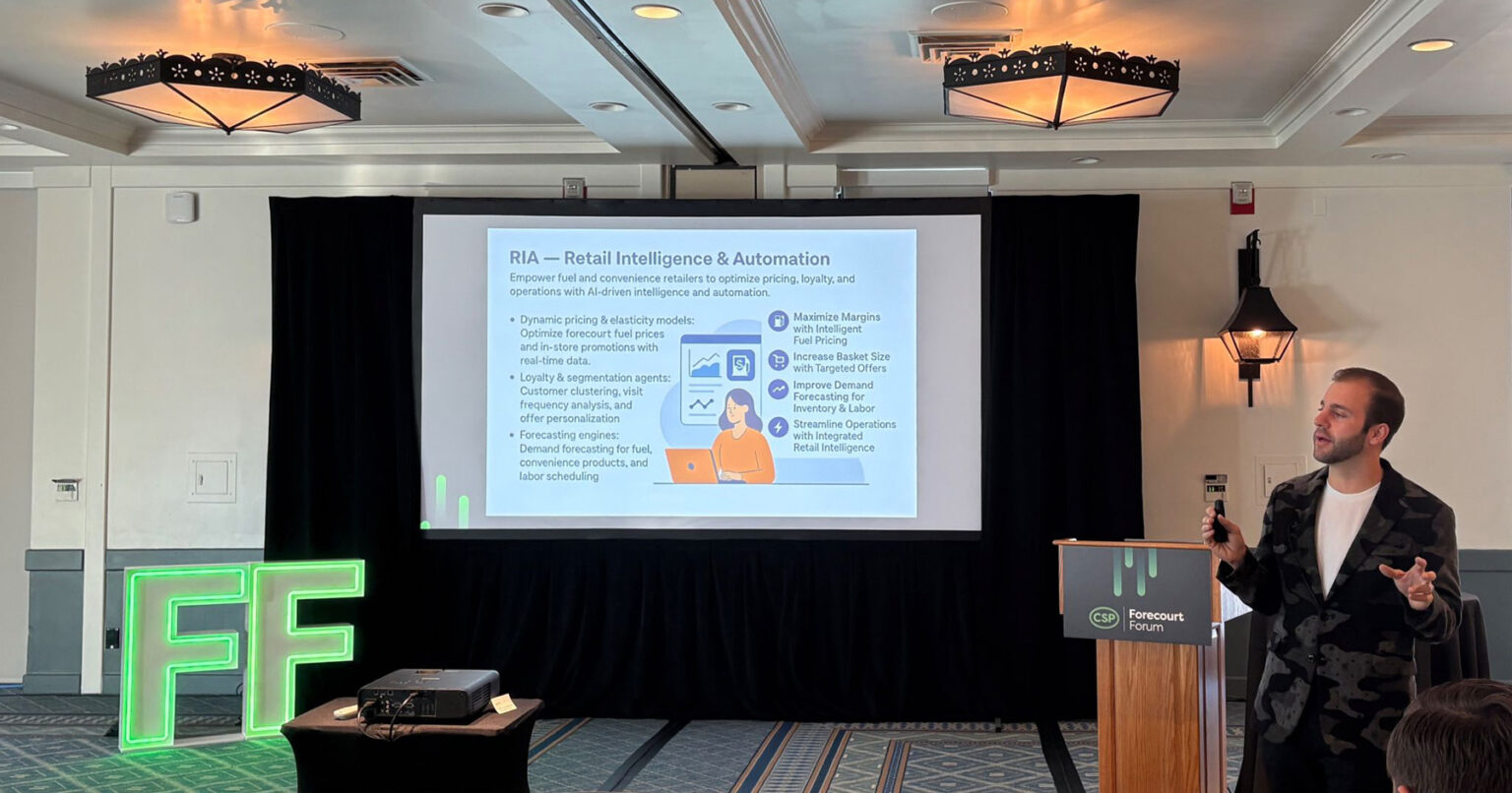
Colin Dornish (pictured) says AI can improve c-store loyalty programs. | CSP Staff
Most existing loyalty programs struggle with meaningful reporting and offer analysis, said Colin Dornish (pictured), managing member at Pittsburgh-based c-store consulting company CSD Solutions, at CSP’s Forecourt Forum, which took place in Scottsdale, Arizona Dec. 1-3. This is especially true with the evolution of data collection, which has grown more complex, he said.
“Everybody in this room probably has a loyalty program that is either OK or subpar at offer reporting and really generating reports around how their loyalty program going,” he said.
Many marketing teams still rely on basic metrics such as total or active users to judge success. Dornish said that this approach overlooks the real value drivers of loyalty programs, including offer effectiveness, redemption behavior and demographic insights, which are critical to understanding what genuinely influences customer loyalty and program performance.
Artificial intelligence (AI) is transforming how loyalty programs work, Dornish said.
Traditionally, loyalty programs rely on generic offers like points, birthday coupons or the same promotions for everyone. With AI, companies can now analyze data at a much deeper level—by individual customer and by individual store—to understand shopping patterns, customer journeys and performance trends, he said.
While most loyalty platforms already segment customers by behavior (daily, weekly, monthly shoppers, top members or target audiences), AI enables “look-alike” modeling, he said. It can identify patterns across stores and regions to find customers with similar buying behaviors, something current loyalty programs can’t do. For example, if one customer buys coffee, bagel and water in one store, AI can find other customers elsewhere with similar habits, allowing for targeted marketing.
Dornish shared an example of abandoned online shopping carts: AI tracks customer behavior over time, learns what incentives actually work (such as discovering that a 30% discount converts when 20% does not) and automatically adjusts future offers based on that history. This level of personalization and learning is something humans can’t realistically do at scale, he said.
Ultimately, AI enables loyalty programs to operate at a micro, highly personalized level, using historical data to drive smarter, more effective marketing. Companies that leverage this capability will stand out, while those that don’t will end up with generic loyalty programs that exist only to “check the box,” he said.
AI also helps companies move from reactive, generic loyalty efforts to insight-driven decision making. For example, warning signs, like declining sales, often go unnoticed, not because the data isn’t there, but because decision makers are overwhelmed by too many reports, Dornish said. AI systems can solve this by automatically flagging issues early.
AI can also analyze point-of-sale (POS) data to uncover small, highly specific “micro-offers” that human teams don’t have the time or capacity to identify, he said. This kind of insight is the “sweet spot” for AI in loyalty programs, because it finds patterns and opportunities that would be nearly impossible for analysts who are already overwhelmed with basic reporting tasks.
Companies need to move beyond simply having a loyalty program and instead assess what they want out of it and take action, he said.
AI used to be very expensive, but its cost is dropping rapidly. The price of AI is tied to computing power, so as more data centers and AI facilities are built across the U.S., the cost of running AI decreases, Dornish said.
“If anybody has been burned by a big AI bill, they know that it’s not fun,” he said. “This technology will continue to become more attainable for all of our platforms and all of our companies.”
While AI can significantly enhance operational efficiency by automating manual tasks such as retrieving documents from websites or file transfer protocols (FTPs), there are areas where human oversight remains essential, he said. For example, fuel pricing is a sensitive aspect of retail operations that might not be safe to fully automate with AI because pricing algorithms could inadvertently share data across competitors, potentially eroding strategic advantages.
Members help make our journalism possible. Become a CSP member today and unlock exclusive benefits, including unlimited access to all of our content. Sign up here.