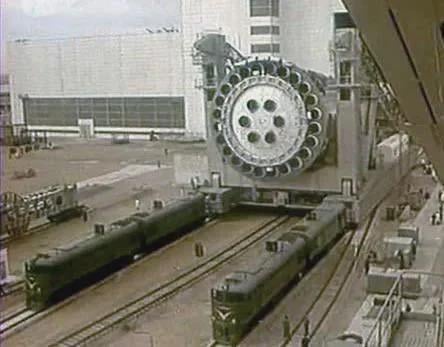
Not a good rocket obviously but nobody will ever convince me that there’s a better way to roll out a rocket than on a train. EXCEPT for on two trains. I mean crawler-transporters are cool I suppose.
P4ris3k on
Five stages, with 30 engines alone for the first stage. No wonder this thing never launched successfully.
I recommend looking at a picture of this thing standing upright. It looks straight up comical.
AtatS-aPutut on
is THAT how big rockets are?
Thhe_Shakes on
Look what the capitalist pig-dogs took from us!
lucidbadger on
It would be nice to see comparison between N1, Saturn V, and Starship
AVeryFineUsername on
Ah the Kerbal Space Program approach
AndrewMT on
Why did that N-1 use that lattice structure between some of the stages?
iskandar- on
God this thing was such a pig of a design, but there is something brutally beautiful about it. A brutality that was indicative of the Soviet space program as a whole.
Meanwhile starship just rolls down on a public road on some converted truck trailers.
Decronym on
Acronyms, initialisms, abbreviations, contractions, and other phrases which expand to something larger, that I’ve seen in this thread:
|Fewer Letters|More Letters|
|——-|———|—|
|[F1](/r/Space/comments/1pne8vm/stub/nu7l9s8 “Last usage”)|Rocketdyne-developed rocket engine used for Saturn V|
| |SpaceX Falcon 1 (obsolete small-lift vehicle)|
|[LOX](/r/Space/comments/1pne8vm/stub/nu7h0xu “Last usage”)|Liquid Oxygen|
|[N1](/r/Space/comments/1pne8vm/stub/nu7easg “Last usage”)|Raketa Nositel-1, Soviet super-heavy-lift (“Russian Saturn V”)|
|[RD-180](/r/Space/comments/1pne8vm/stub/nu7easg “Last usage”)|[RD-series Russian-built rocket engine](https://en.wikipedia.org/wiki/RD-180), used in the Atlas V first stage|
|[SLS](/r/Space/comments/1pne8vm/stub/nu7k0j8 “Last usage”)|Space Launch System heavy-lift|
|[SPMT](/r/Space/comments/1pne8vm/stub/nu7bp1y “Last usage”)|Self-Propelled Mobile Transporter|
|[SSME](/r/Space/comments/1pne8vm/stub/nu7l9s8 “Last usage”)|[Space Shuttle Main Engine](https://en.wikipedia.org/wiki/Space_Shuttle_main_engine)|
|Jargon|Definition|
|——-|———|—|
|[Raptor](/r/Space/comments/1pne8vm/stub/nu7l9s8 “Last usage”)|[Methane-fueled rocket engine](https://en.wikipedia.org/wiki/Raptor_(rocket_engine_family)) under development by SpaceX|
|[methalox](/r/Space/comments/1pne8vm/stub/nu7l9s8 “Last usage”)|Portmanteau: methane fuel, liquid oxygen oxidizer|
|[ullage motor](/r/Space/comments/1pne8vm/stub/nu79gu2 “Last usage”)|Small rocket motor that fires to push propellant to the bottom of the tank, when in zero-g|
Decronym is now also available on Lemmy! Requests for support and new installations should be directed to the Contact address below.
The engine technology they had was far more advanced than anything the US had at the time. The Soviet closed cycle engines far surpassed any western engine in terms of power and efficiency, but they were very complex. Enormously complex. The complexity of a closed cycle system is why the US never even attempted to make one fly until the mighty RS-25 that powered the space shuttle.
The N1 first stage had dozens of NK-15 engines. Still one of the most powerful LOX/RP1 engines ever built, and the most powerful ever built at the time, with efficiency/specific impulse that put it’s western counterparts to shame. But thanks to their complexity, (and the fact that only 1 in 4 engines were tested off the assembly line because they could only be fired once due to having explosively actuated valves,) the rocket never flew past the first stage. Not one single engine that was put on the N1 was ever tested because of the valve design. Only a few from the assembly line were tested, and if those tests went well then the whole batch of engines were deemed acceptable.
It also didn’t help that the N1 used a very complicated thrust differential method of attitude control, rather than simply gimbaling the engines. This thrust differential system was controlled by a complex system of computers, and Soviet computer technology in the 60s was woefully primitive compared to American computers, and was not up to the task of individually controlling the thrust of all 30 engines to control it’s pitch and roll.
All in all, the N1 was a fantastic beast of rocketry and engineering, boasting the most powerful and advanced engines in the world at the time. Unfortunately for the Soviets, they simply did not have the technology to control such a complex machine. The American strategy of using five massive, and much simpler engines on the Saturn V’s first stage was a much more prudent strategy. No need for fancy computers to vector the thrust across the engines. Just a simple gimbal system. And the open cycle system of the F1, while being much less powerful and efficient, was way simpler. And most of all, they didn’t use pyrotechnic valves. So the engines could actually be tested before flying.
Specialist_Fix6900 on
It’s wild how the trains look like toys next to it. My brain refuses to accept this is a thing humans built.

14 Comments
Not a good rocket obviously but nobody will ever convince me that there’s a better way to roll out a rocket than on a train. EXCEPT for on two trains. I mean crawler-transporters are cool I suppose.
Five stages, with 30 engines alone for the first stage. No wonder this thing never launched successfully.
I recommend looking at a picture of this thing standing upright. It looks straight up comical.
is THAT how big rockets are?
Look what the capitalist pig-dogs took from us!
It would be nice to see comparison between N1, Saturn V, and Starship
Ah the Kerbal Space Program approach
Why did that N-1 use that lattice structure between some of the stages?
God this thing was such a pig of a design, but there is something brutally beautiful about it. A brutality that was indicative of the Soviet space program as a whole.
there is some awesome footage out there of the N1 program,
https://www.youtube.com/watch?v=_OoQ72eZs_g
Meanwhile starship just rolls down on a public road on some converted truck trailers.
Acronyms, initialisms, abbreviations, contractions, and other phrases which expand to something larger, that I’ve seen in this thread:
|Fewer Letters|More Letters|
|——-|———|—|
|[F1](/r/Space/comments/1pne8vm/stub/nu7l9s8 “Last usage”)|Rocketdyne-developed rocket engine used for Saturn V|
| |SpaceX Falcon 1 (obsolete small-lift vehicle)|
|[LOX](/r/Space/comments/1pne8vm/stub/nu7h0xu “Last usage”)|Liquid Oxygen|
|[N1](/r/Space/comments/1pne8vm/stub/nu7easg “Last usage”)|Raketa Nositel-1, Soviet super-heavy-lift (“Russian Saturn V”)|
|[RD-180](/r/Space/comments/1pne8vm/stub/nu7easg “Last usage”)|[RD-series Russian-built rocket engine](https://en.wikipedia.org/wiki/RD-180), used in the Atlas V first stage|
|[SLS](/r/Space/comments/1pne8vm/stub/nu7k0j8 “Last usage”)|Space Launch System heavy-lift|
|[SPMT](/r/Space/comments/1pne8vm/stub/nu7bp1y “Last usage”)|Self-Propelled Mobile Transporter|
|[SSME](/r/Space/comments/1pne8vm/stub/nu7l9s8 “Last usage”)|[Space Shuttle Main Engine](https://en.wikipedia.org/wiki/Space_Shuttle_main_engine)|
|Jargon|Definition|
|——-|———|—|
|[Raptor](/r/Space/comments/1pne8vm/stub/nu7l9s8 “Last usage”)|[Methane-fueled rocket engine](https://en.wikipedia.org/wiki/Raptor_(rocket_engine_family)) under development by SpaceX|
|[methalox](/r/Space/comments/1pne8vm/stub/nu7l9s8 “Last usage”)|Portmanteau: methane fuel, liquid oxygen oxidizer|
|[ullage motor](/r/Space/comments/1pne8vm/stub/nu79gu2 “Last usage”)|Small rocket motor that fires to push propellant to the bottom of the tank, when in zero-g|
Decronym is now also available on Lemmy! Requests for support and new installations should be directed to the Contact address below.
—————-
^(10 acronyms in this thread; )[^(the most compressed thread commented on today)](/r/Space/comments/1pjku62)^( has 23 acronyms.)
^([Thread #11979 for this sub, first seen 15th Dec 2025, 19:06])
^[[FAQ]](http://decronym.xyz/) [^([Full list])](http://decronym.xyz/acronyms/Space) [^[Contact]](https://hachyderm.io/@Two9A) [^([Source code])](https://gistdotgithubdotcom/Two9A/1d976f9b7441694162c8)
The engine technology they had was far more advanced than anything the US had at the time. The Soviet closed cycle engines far surpassed any western engine in terms of power and efficiency, but they were very complex. Enormously complex. The complexity of a closed cycle system is why the US never even attempted to make one fly until the mighty RS-25 that powered the space shuttle.
The N1 first stage had dozens of NK-15 engines. Still one of the most powerful LOX/RP1 engines ever built, and the most powerful ever built at the time, with efficiency/specific impulse that put it’s western counterparts to shame. But thanks to their complexity, (and the fact that only 1 in 4 engines were tested off the assembly line because they could only be fired once due to having explosively actuated valves,) the rocket never flew past the first stage. Not one single engine that was put on the N1 was ever tested because of the valve design. Only a few from the assembly line were tested, and if those tests went well then the whole batch of engines were deemed acceptable.
It also didn’t help that the N1 used a very complicated thrust differential method of attitude control, rather than simply gimbaling the engines. This thrust differential system was controlled by a complex system of computers, and Soviet computer technology in the 60s was woefully primitive compared to American computers, and was not up to the task of individually controlling the thrust of all 30 engines to control it’s pitch and roll.
All in all, the N1 was a fantastic beast of rocketry and engineering, boasting the most powerful and advanced engines in the world at the time. Unfortunately for the Soviets, they simply did not have the technology to control such a complex machine. The American strategy of using five massive, and much simpler engines on the Saturn V’s first stage was a much more prudent strategy. No need for fancy computers to vector the thrust across the engines. Just a simple gimbal system. And the open cycle system of the F1, while being much less powerful and efficient, was way simpler. And most of all, they didn’t use pyrotechnic valves. So the engines could actually be tested before flying.
It’s wild how the trains look like toys next to it. My brain refuses to accept this is a thing humans built.
How come the locomotives are ass-to-ass?
Cool looking thing…not fly so good however