
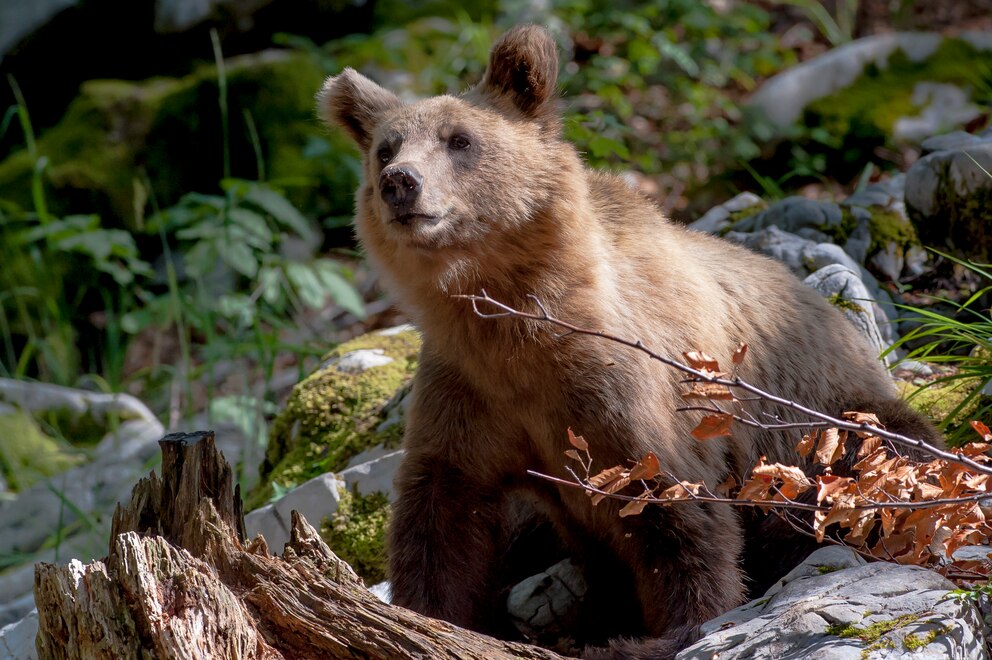
Brown bears are not pets. Yet, a small bear population in the Apennines has shown unusually gentle behavior toward humans for centuries. Now, a genome study reveals: This change is not just habituation–it’s written into their DNA. A look into the genetic makeup of the Apennine brown bears shows how centuries of human-bear interaction have led to a genuine behavioral adaptation. This could also have implications for their conservation.
These Brown Bears in Italy Are Smaller and “Tamer”
The Apennine brown bear, also known as the Marsican brown bear, is a subspecies of the brown bear. It is found only in the Abruzzo region of central Italy. With an estimated population of only about 50 animals, it is one of the most endangered bear populations in Europe. Centuries of deforestation, agriculture, and targeted hunting have increasingly isolated these bears from the rest of their range. The result: a massive genetic bottleneck and noticeable differences from other brown bears, including smaller body size, different skull features, and notably calm behavior.
Previous studies had already shown that the Apennine brown bears are genetically impoverished. This is generally a bad sign for the survival of a species. Yet, surprisingly, this bear population has maintained a surprisingly high diversity in vital survival genes. It was also suspected that their unusual peacefulness toward humans might not only be due to learned behavior but also genetically influenced. An international research team wanted to verify this assumption. They aimed to determine whether human influence might have selectively affected the bears’ behavior.
How Humans Influenced the Evolution of a Bear Species
The study, published in the journal “Molecular Biology and Evolution,” was conducted by a team led by Giulia Fabbri (University of Ferrara, Italy). It shows for the first time through comprehensive genome analyses how humans unintentionally influenced the evolution of a bear species.
At the center is the tiny, isolated population of the Apennine brown bear (Ursus arctos marsicanus). These bears have lived in close contact with humans for millennia. The genetic traces of this coexistence are profound–and could provide important insights for species conservation.1
How Do the Brown Bears in Italy Differ from Other Populations?
The researchers first decoded the complete genome of a female Apennine brown bear using particularly precise methods. Additionally, they examined the genomes of a total of 20 other bears–12 from Italy and 8 from Slovakia. They compared these with already known genes of North American brown bears. Their goal was to find out how these bears differ in their genetic diversity, whether they are particularly closely related (inbreeding), how many harmful genetic mutations they carry, and whether certain traits–such as their behavior–have been altered by natural selection.
They used modern computer analyses to show how genes have changed over many generations. They focused particularly on genes related to behavior and brain development. They not only examined changes in the genes themselves but also the areas between them, as important switches can be located there. These switches influence how genes are read. All investigations were conducted without harming the animals, using either existing samples or only minimal interventions.
Population Suffers from Inbreeding and Mutations
The Apennine brown bears exhibit extremely low genetic diversity, with over 66 percent of their genomes in so-called “Runs of Homozygosity” (ROH)–areas of identical genetic material. This is a typical sign of strong inbreeding. Compared to the brown bears from Slovakia, the bears from Italy show a significantly higher genetic burden due to harmful mutations.
At the same time, the researchers discovered clear evidence that certain behavioral traits in the Apennine brown bears have been altered by natural selection. Genes that influence behavior and brain development showed noticeable changes. Among them were genes like “DCC” and “SLC13A5,” which are also associated with tamer behavior in other animal species–such as pets.
Bears Show Genes for Particularly Pronounced Friendliness
Overall, the researchers found 17 genes whose special variants are particularly common in the Apennine brown bears. Many of these variants are not directly in the gene itself but in adjacent sections that influence how the information in the gene is read and processed.
Interestingly, some of these genes are also associated with a syndrome in humans characterized by particularly pronounced friendliness and openness (Williams-Beuren syndrome). It is therefore quite possible that these genetic peculiarities have contributed to the unusually low aggressiveness of the Apennine brown bears in Italy–perhaps as a result of humans selectively killing particularly aggressive animals over many generations.
Genetically “Tamer” Bear Could Have Advantages but Also Risks
This study provides robust evidence for the first time that a wildlife population responds to the lasting influence of humans not only through behavioral adaptation (learning) but also through genetic changes. The combination of an extreme genetic bottleneck, high inbreeding, and simultaneous selective preservation of behavior-relevant genes presents a complex picture of evolutionary adaptation.
The results suggest that humans–through centuries of persecution of aggressive individuals–unintentionally contributed to the genetic consolidation of gentler behavior in the brown bear population. This evolutionary change may have reduced conflicts and thus supported the survival of the animals despite their genetic erosion. These findings are also crucial for future conservation measures and possible reintroductions: A genetically tamer bear could bring both advantages and risks in new areas.
Whether There Are Truly “Genetically Tame” Bears Is Not Definitively Proven
The study is methodologically outstanding, combining state-of-the-art sequencing techniques with comprehensive bioinformatic analysis. The data is solid due to the combination of new and previously published genomes, especially given the rarity of the Apennine brown bears. By directly comparing with other brown bear populations, the study can reliably attribute differences.
However, there is a limitation in the small sample size. Also, the interpretation of gene functions is largely based on analogies to other species (e.g., humans, dogs, cattle), which brings certain uncertainties. Additionally, environmental and learning factors as influences on behavior are not completely excluded. The assertion that reduced aggressiveness has been genetically fixed is strongly supported–but not definitively proven.
Despite Gentleness, There Are Still Incidents
Even though this population of brown bears in Italy is considered “tame,” there have been occasional incidents in the past where animals were shot. In September 2023, a well-known brown bear named “Amarena” was shot. The bear had repeatedly stayed in villages in the Abruzzo region and was never a problem for humans, as reported by the South Tyrolean news magazine “Rai News.” The incident caused much discontent–also because the loss of any animal poses a threat to the already small population.
But not only shootings, accidents also threaten the Apennine brown bears. In January 2023, Italy’s “Naschbär” was hit by a car and killed, as reported by the Austrian broadcaster “orf.” The brown bear, known as Juan Carrito, became a star on social networks with his wanderings in the mountain village of Roccaraso in the central Italian Apennine region of Abruzzo. He did not–as is usually the case–hibernate and was fatally injured by a car near a tunnel.
Conclusion: Genetic Adaptations Could Contribute to More Peaceful Coexistence
The Apennine brown bears are an impressive example of the unintended role of humans as an evolutionary factor. The new study shows that their DNA contains clear traces of selection on behavioral traits–presumably triggered by human persecution of aggressive animals. These genetic adaptations could have contributed to a more peaceful coexistence and demonstrate how deep human influence on wildlife extends. For species conservation, this means: Behavioral genetics should be more strongly considered–especially in such small and endangered populations like the ABB.
The post These brown bears in Italy have become “tame” due to human interaction appeared first on PETBOOK.