
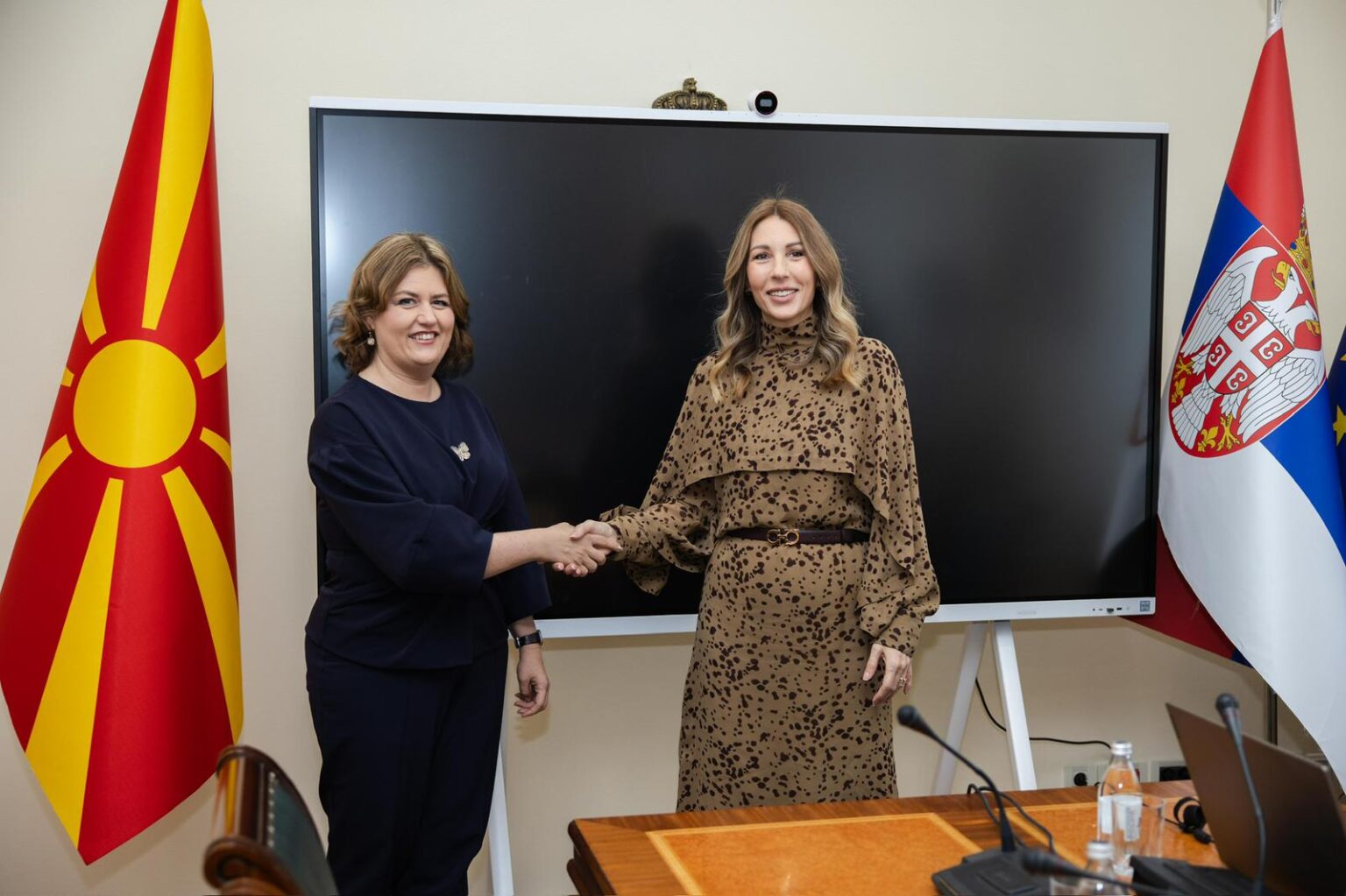
A Macedonian delegation, led by the Macedonian Minister of Energy, Mining and Mineral Resources Sanja Božinovska, met with Dubravka Handanović Đurović, Serbian Minister of Mining and Energy, to discuss the gas interconnector between the two countries. While discussing the key steps for continuing the construction, the meeting also addressed other matters.
The pipeline, with a total length of approximately 67 kilometres (23 km in North Macedonia and 44 km in Serbia), will connect the gas systems of the two countries. On the Macedonian side, with a connection at Klečovce, and in Serbia, with the network near Vranje. It is planned to run along the Orljane-Leskovac-Vranje state border route, and the planned capacity is around 1.5 billion cubic meters.
The construction is expected to be completed in 2027, with the first gas expected to flow in 2028. The interconnector is also intended to be ready for future hydrogen transport.
There is an interest from the World Bank and other commercial banks in financing the interconnector.
“The interconnector with Serbia is the key project that will open our country to new sources of gas and strengthen regional energy stability,” Božinovska stressed. “But this is also one of the most important infrastructure links for the entire region – significant not only for North Macedonia and Serbia, but also for the whole of Europe.”
“With the support of Transport Gas Serbia and Nomagas, we will create a new energy axis of stability between the two countries,” said Handanović Đurović. “We agreed on intensive regular meetings, for the interconnector to become a reality as soon as possible.”
“For about 144 kilometres of gas pipeline on the territory of Serbia, the investment value is estimated at around 153 million euros, and part of the funds are also foreseen in the budget for 2026,” Đedović Handanović added. “The plan is to obtain a construction permit in mid-2026 and to start construction immediately after that.”
Serbia continues to diversify its supply routes
Đedović Handanović said that Serbia, after building a gas interconnection with Bulgaria, continues to diversify its supply routes, where one of the priorities is the construction of a gas pipeline to North Macedonia.
“The capacity of the gas interconnection with Bulgaria is 1.8 billion cubic meters per year, and with the completion of the interconnection with North Macedonia, as well as the planned interconnection with Romania, whose capacity will be between 1.6 and 2.5 billion cubic meters, we will have a fully diversified gas supply in the next few years,” she said. “The goal is to have as many options for gas supply as possible, not to depend on just one supplier, and to have greater security and a better negotiating position in terms of prices and capacity.”
Oil derivatives from North Macedonia
One of the topics of the meeting was the supply of oil derivatives, where the possibility of covering part of the needs, primarily for southern Serbia, from North Macedonia was discussed, which would also provide logistical support in road and rail transport.
“I hope that the Russian partners will find an acceptable solution for NIS to continue operating, for crude oil to arrive in Serbia and be processed in our refinery. We have set a deadline of 15 January, and the state will take matters into its own hands if that does not happen,” said Đedović Handanović.
Request a postponement of CBAM
They also discussed cooperation and joint action within the Energy Community, especially on the topic of introducing the Cross-Border Carbon Price Adjustment Mechanism (CBAM).
“We have agreed to act in a coordinated manner on this issue and to request a postponement of the introduction of CBAM,” she stated. “We believe that there are justified reasons for this, which have also been recognised by European operators. The energy markets in the region are not yet connected to the European ones, and there are also ambiguities when it comes to transit energy and emission factors. Letters from all contracting parties to the Energy Community will be sent next week, to continue the dialogue with the European Commission, which is important for Serbia and North Macedonia, but also for other contracting parties.”