
Italy does Christmas very well, but there are a few traditions that may seem confusing or downright bizarre to the uninitiated.
Here are ten of the key ingredients for a truly Italian festive season, explained.
The holiday season is marked by two very specific dates
Whereas in the US and the UK, where there is no official start to the festive season, Christmas in Italy begins and ends on very specific dates – December 8th and January 6th, respectively.
Italians get into the Christmas spirit starting on December 8th when they celebrate the Immaculate Conception. A fun fact to bring out at holiday parties is that this festival actually marks the conception of Mary rather than that of Jesus, as God intervened to absolve Mary of original sin while she was still in the womb.
READ ALSO: Christmas calendar: All the Italian holiday traditions you won’t want to miss
December 8th is when many Italian homes and towns first put out their decorations, while a cannon is fired from Rome’s Castel Sant’Angelo to mark the start of the celebrations.
The season continues until Epiphany on January 6th, when the Three Wise Men are said to have arrived in Bethlehem, something which is reenacted by horsemen in Rome’s Piazza Navona.
Advent is a big deal in Italy, with special services in churches around the country on the Sundays leading up to Christmas.
And the nine-day period before Christmas, known as the Novena, is when Italians remember the journey of the shepherds to the baby Jesus’ manger. In rural areas in particular, children go from house to house dressed as shepherds and performing Christmas songs or poems during this time, often in exchange for money or sweets.
Saint Nicholas isn’t always the one who brings presents…
Santa Claus or Father Christmas (Babbo Natale in Italy) is common across Italy today, but traditionally, others brought the gifts, and many regions still practice their traditions.
The most famous gift-giver in Italy is La Befana, a witch who visits children on the Epiphany, falling on January 6th. Similar to children hanging up stockings for Santa Claus on Christmas Eve in the UK, Italian children hang up their stockings on the eve of Epiphany in anticipation of Befana’s gifts.
READ ALSO: What’s on in Italy: 14 events not to miss this December
In some regions, particularly in the north, Santa Lucia is seen somewhat like Santa Claus. In parts of Veneto and Lombardy, especially Verona, Crema, Cremona and Bergamo, the saint has become a sort of Father Christmas figure, visiting in the night to bring children gifts.
On December 13th, the patron saint of Syracuse, Sicily – who’s also the saint of the blind – is commemorated with La Festa di Santa Lucia. Festive markets and light shows in honour of the saint pop up across the country, and families gather for a feast. On the night of December 12th, she’s said to leave gifts for children who leave out a letter and treats for her and the donkey she rides.
Other places in Italy, such as South Tyrol, traditionally say that it’s actually baby Jesus himself who brings children gifts.
Advertisement
A pagan witch visits on January 6th
More discussion is deserved for the topic of La Befana, the most famous character of Italian Christmas.
She’s as scary a witch as you’d see around Halloween, with a black cape, broomstick, and warty nose. But she’s actually a pleasant sight for children – as long as they’ve been good.
READ ALSO: La Befana: How Italy celebrates a witch on January 6th
The old woman visits nice girls and boys on Epiphany Eve, leaving toys and treats in their calze della befana (La Befana stockings). Like the Father Christmas tradition, La Befana leaves coal (or onions and garlic) for the naughty children.
Legend has it that the Three Wise Men came to her house and invited her to join their search for Christ. She was too busy with housework so declined, but later changed her mind, and to this day is still searching for the child, leaving presents for any good children she comes across.
The Christmas ‘ceppo’
Enter an Italian home around Christmas time, and you’re likely to see an ornate display of gifts in the shape of a pyramid.
The ceppo is a wooden vertical structure displaying presents amongst candles, greenery, candy, fruit and other decorations.
It’s sometimes considered an ancient ancestor of the modern Christmas tree, and is believed to have started in Tuscany.
Advertisement
The word ‘ceppo’ is sometimes attributed to another Christmas tradition, known in English as the Yule Log. In Italy, like other parts of the world, il ceppo di Natale is a log of wood set to burn through the days leading up to Christmas, warming the home and making spirits bright.
It’s a rarely practiced custom these days. Much more popular is indulging in an edible version of the Yule Log – tronchetto di Natale (Bûche de Noël), which is often served on Christmas Day.
Unlike in the UK and US, the most important date of Italian Christmas is Christmas Eve (la Vigilia), though the exact order and kind of celebrations vary between regions and individual households.
Bagpipes and bingo?
In Italy, Christmas has retained its religious roots more than in many other countries, so you’ll hear celebratory church bells on Christmas Eve to mark Jesus’s birth, but there are a few more recent and somewhat bizarre traditions.
In southern Italy and Rome, bagpipe-playing shepherds, or zampognari, perform tunes in piazzas, normally dressed in traditional sheepskin and wool cloaks. The pipers usually travel in pairs down from their mountain homes – it’s quite a spectacle.
Advertisement
And across the country, though again particularly in the south, it’s very common to play tombola, an Italian game similar to bingo, throughout the winter holiday.
READ ALSO: Why is bingo so popular in Italy at Christmas?
Not your usual nativity
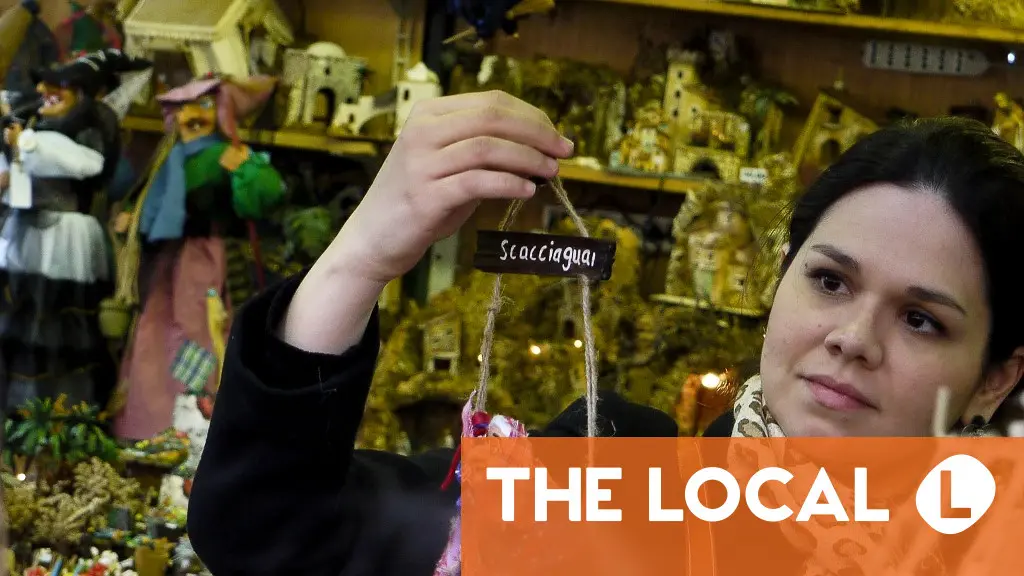
You’re probably already familiar with the idea of a Christmas nativity scene. But Italians go all out with their nativities (presepi). You’ll find them in every church as well as other public areas and family homes, often depicting the entire town of Bethlehem in painstaking detail.
READ ALSO: Italy’s best ‘presepi’: 11 Christmas nativity scenes you need to see
Sometimes there’s a modern twist with contemporary characters introduced, such as a pizza-maker, favourite footballers or politicians.
In Rome, an annual exhibition displays 100 different presepi from all over the world, including minuscule versions carved into nuts, and all kinds of materials – even pasta.
But it’s Naples that’s the true home of the presepe: the street Via San Gregorio Armeno is sometimes called Christmas Alley as its shops all sell figures for the cribs, from the wacky to the traditional.
Seafood feast
Food is obviously an integral part of Italian culture, and that’s more true than ever at Christmas. December 24th was traditionally a day of fasting before Christmas for Catholics, with festivities starting only after the evening mass.
This is still observed in some families, and the evening meal is usually based on seafood rather than meat.
READ ALSO: Panettone or pandoro: Which is the best Italian Christmas cake?
On Christmas Day, the food that makes up the cenone (literally meaning ‘big dinner’) varies from region to region, but meat is normally back on the menu, often accompanied by pasta.
The meal is followed by panettone, a sweet bread loaf originating from Milan, and other desserts filled with nuts, which were historically a symbol of fertility for the coming year.
Advertisement
Midnight traditions, from Mass to skiing
After filling up on a feast of fish, many families head to midnight Mass. In Rome, you can even have midnight Mass led by the Pope at the Vatican.
Another less traditional way to ring in Christmas Day is with a cheeky ski. In northern Italy, particularly in the Dolomites, torchlit processions of skiers fly down the mountain as the clock strikes midnight.
Boxing Day? More like St. Stephen’s Day
The day following Christmas, December 26th, is also a public holiday in Italy. Originally a religious holiday, December 26th is called St. Stephen’s Day (Santo Stefano) in commemoration of the first Christian martyr.
Today, it’s celebrated by continuing to relax and spend time with loved ones, snacking on leftover panettone.
You might also go to the movies on this day to watch cinepanettoni – a particularly Italian genre of festive film timed for release over the holidays.
Advertisement
Lucky thirteen
One part of Christmas that’s eagerly awaited by many workers is ‘the thirteenth’ – a festive ‘bonus’ (technically part of their salary) amounting to an extra month’s wages, just in time for gift shopping. It was first introduced under Benito Mussolini’s Fascist regime to reward factory workers, which was later extended to all employees.
The bonus will come as a welcome surprise to Brits or Americans, whose bonuses in their home countries are usually linked to performance, but the custom exists in other countries, including Germany and Brazil. Unfortunately, though, a growing number of companies, especially small ones, are finding it hard to pay the Christmas bonus.