
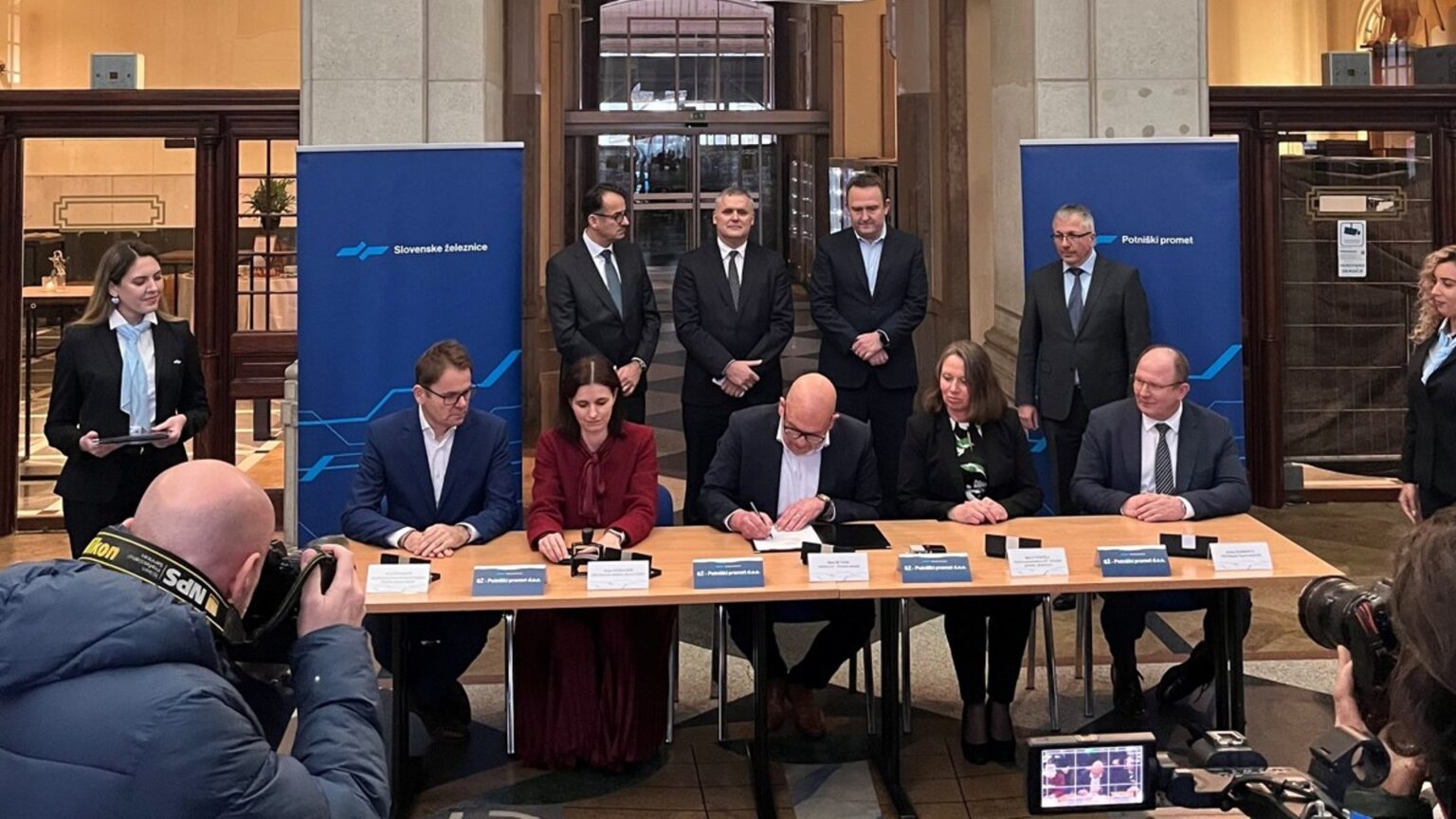
 Slovenia’s national railway operator, SŽ Potniški promet, has signed two contracts for the purchase of passenger rolling stock, a project that supports the goal of increasing the quality, reliability, and competitiveness of passenger rail transport.
The two contracts are worth a total of EUR 97.7 million (including VAT) and were signed with Magyar Vagon and Siemens Mobility. The funds allocated for the purchase of new locomotives and carriages for international passenger rail transport are provided for in the Climate Change Fund budget at a level of EUR 43.9 million (including VAT), covering 48% of the total net value of the investment.
The contract signed with Magyar Vagon is worth EUR 71.85 million and involves the delivery of 20 passenger carriages, of which 15 are classic seat-type carriages and 5 are multifunctional carriages, intended for both domestic and international services. All carriages will enter into operation in the second half of 2028.
The multifunctional carriages will offer three seats for people with reduced mobility, space for 12 bicycles, an information point, and a bistro area with tables, which will enhance the travel experience through comfort and the opportunity to socialize in a relaxed setting. All carriages will also be adapted for visually impaired and blind passengers and passengers with hearing impairments. As the new carriages will be compatible with the existing ones, it will be possible for trains with a “classic configuration” (locomotive and carriages) to include at least one multifunctional carriage equipped with a platform for access by people with reduced mobility.
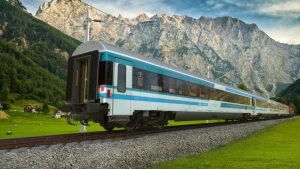 The new carriages will allow speeds of up to 200 km/h and will ensure a high level of comfort. They will be air-conditioned and equipped with modern seats for comfortable long-distance travel, Wi-Fi connection, passenger information system, LED displays, reservation system, as well as electrical outlets and USB-A/USB-C connections at each seat. A passenger counting system and real-time display of seat occupancy, bicycle spaces, and wheelchair areas will also be integrated.
At the same time, SŽ Potniški promet has signed a contract worth EUR 25.8 million with Siemens Mobility for the supply of four Vectron interoperable electric locomotives, which will be delivered in April–May 2027.
The purchase of the new locomotives will increase the company’s autonomy in operating international services, enable travel at speeds of up to 200 km/h without changing locomotives at the border, and reduce electricity and maintenance costs. This will improve the competitiveness of services and strengthen the company’s role in international rail transport.
These locomotives will be equipped with ETCS and will be able to operate in eight countries without the need to change locomotives at the border. The maximum speed of 200 km/h will enable faster and more efficient connections between countries.
The contract is “a particularly important step for us, as we have clear objectives – to become a major transit hub in international transport between South-Eastern Europe and Western and Northern Europe. With the new vehicles, we will be even more competitive on the international market,” said Miha Butara, director of SŽ – Potniški promet. He also said that in 2026 the company will purchase 45 new trains, an investment that will significantly contribute to increasing the attractiveness of its services.
The new passenger rolling stock will be able to operate on the railway networks of Slovenia, Austria, Croatia, Hungary, Serbia, Germany, the Czech Republic, and Italy, up to Trieste, enabling direct international connections without transfers, as well as higher reliability and availability of services.
Slovenia is focusing on the development of rail transport, the most environmentally friendly mode of transport, and to this end, “the Climate Fund is providing EUR 126 million in financing for the purchase of trains from Stadler, and another EUR 43 million is being allocated to international trains – for locomotives and carriages – so that cross-border connections are faster, more reliable, and more competitive,” explained Minister of the Environment, Climate, and Energy Bojan Kumer.
Share on: 


