
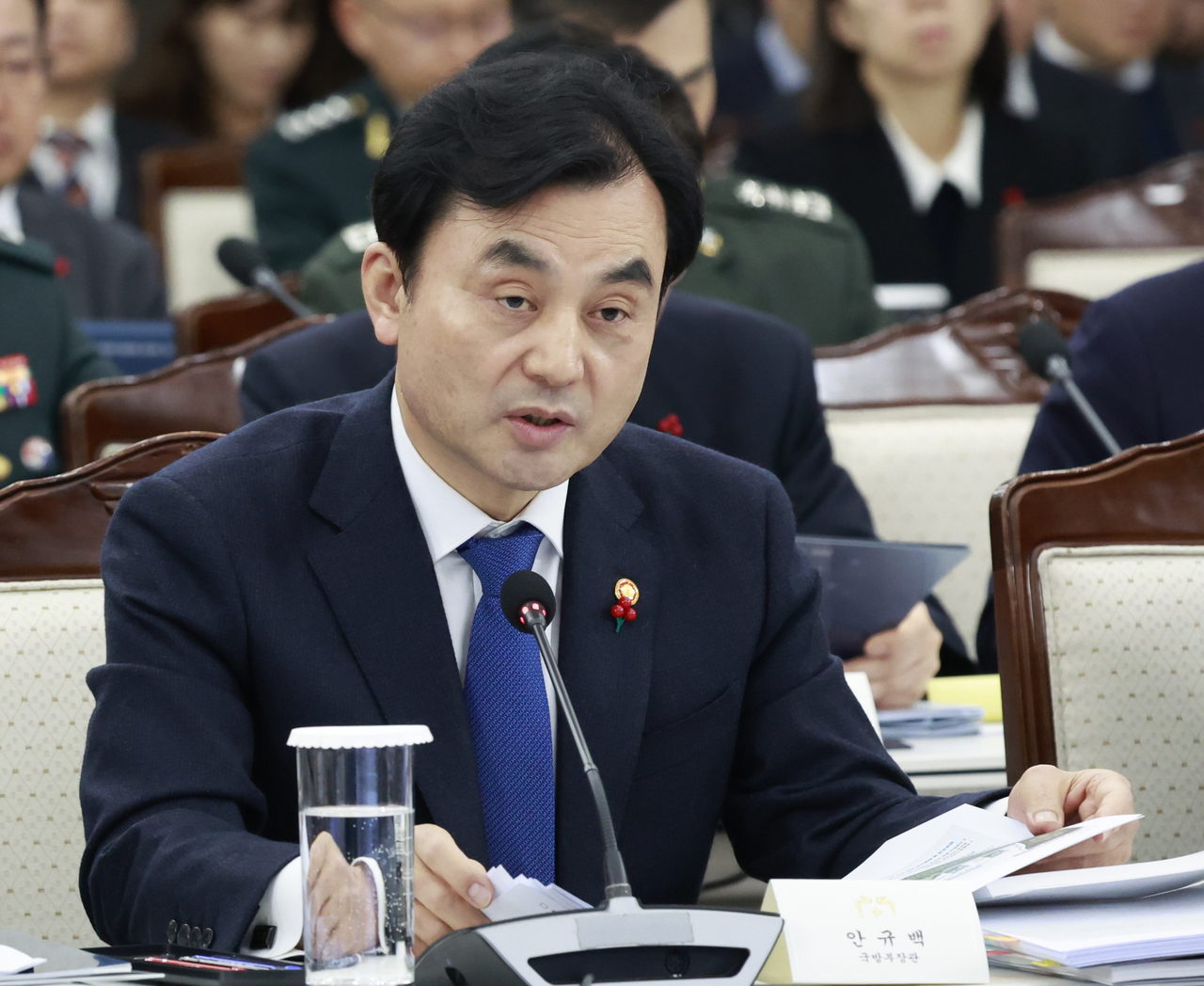
 Defense Minister Ahn Gu-back speaks during a policy briefing to President Lee Jae Myung held at the defense ministry in Seoul on Thursday. (Yonhap)
 The defense ministry said Thursday it will hold discussions with the United States to secure fuel for South Korea’s plan to develop nuclear-powered submarines, aiming to complete negotiations within two years.
The ministry outlined the plan during a policy briefing to President Lee Jae Myung, as it looks to follow up on Washington’s recent approval of South Korea’s push to develop the strategic asset amid North Korea’s persistent threat.
Under the plan, the ministry will draw up a detailed blueprint next year covering South Korea’s principles for developing nuclear-powered submarines, construction plans and its stance on nuclear nonproliferation.
It also plans to establish a pangovernment body to designate the project as a national strategic initiative, while preparing safety regulations and ordinances related to the use of nuclear reactors in submarines.
Seoul has been pursuing its own nuclear-powered submarines after US President Donald Trump approved the plan following his summit with Lee on the sidelines of the Asia-Pacific Economic Cooperation summit in Gyeongju in late October.
Securing fuel for the envisioned submarines could require a separate agreement with Washington, as the existing bilateral nuclear cooperation pact covers only Seoul’s peaceful use of nuclear energy.
The ministry also vowed to make progress in Seoul’s push to retake wartime operational control from the United States, which the Lee administration seeks to achieve before the end of its five-year term in 2030.
The South Korean military aims to complete the second part of a three-stage program to assess Seoul’s capabilities to lead the allies’ combined forces by the next annual defense chiefs’ meeting between the two countries, scheduled for November 2026.
During last month’s Security Consultative Meeting in Seoul, Defense Minister Ahn Gyu-back and US Defense Secretary Pete Hegseth agreed to seek certification of “full operational capability” — the second stage of the assessment — next year and to develop a road map to expedite the OPCON transfer.
South Korea handed over operational control of its troops to the US-led UN Command during the 1950-53 Korean War. It was then transferred to the two allies’ Combined Forces Command when the command was launched in 1978. Wartime OPCON still remains in U.S. hands, while Korea retook peacetime OPCON in 1994. (Yonhap)