
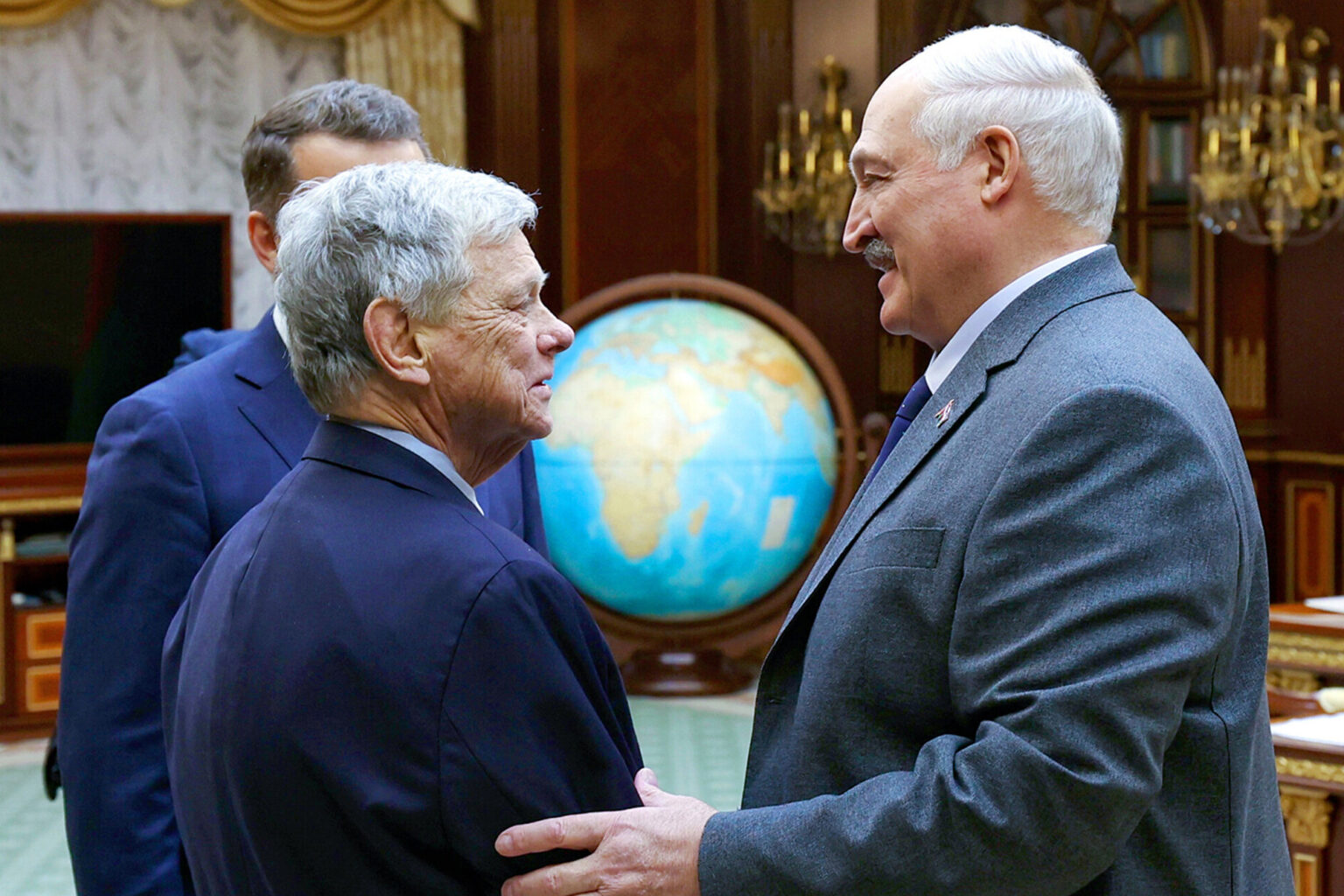
When Donald Trump returned to the White House, few expected Belarus to be an early testing ground for his foreign policy. Yet within months, Alyaksandr Lukashenka was receiving high-level Western visitors in Minsk even as Russian and Belarusian troops rehearsed war games on NATO’s doorstep—with American observers in attendance. Meanwhile, a US presidential envoy brokered the largest prisoner release since Lukashenka’s 2020 crackdown. Most recently, Belarus freed 123 political prisoners in exchange for Washington lifting sanctions on potash, a key ingredient in fertilisers of which Belarus is the third largest global producer.
Of course, this sudden thaw has not changed the basic reality: Belarus remains a repressive Russian ally and a launchpad for Putin’s war against Ukraine. More than 1,000 political prisoners remain behind bars, and the mechanisms of repression that led to their imprisonment remain fully in place—in fact, recent releases were followed by new arrests, as documented by human rights groups.
Yet, Trump’s moves to turn Minsk into a laboratory of transactional diplomacy has become a critical pressure point for both Moscow and Brussels.
The thaw’s dividends
Since 2020, Belarus has become a crucial cog in Russia’s war economy. It hosts Russian troops and tactical nuclear weapons, while hundreds of Belarusian state enterprises have been repurposed to supply Russia’s war machine. Meanwhile, the country is kept afloat by Russian loans, subsidised energy and access to the Russian market. Lukashenka is not necessarily happy with this—he has long preferred to play the West and Russia against each other to gain some sort of autonomy.
With Trump back in power, Minsk has been trying to carve out some wiggle room. For example, Lukashenka has every incentive to see a peace deal reached in Ukraine sooner rather than later. The longer the war drags on, the more Belarus becomes entangled with Russia’s military and economy, the tougher Western sanctions become, and the higher the risk Belarus gets dragged into direct combat—something no one in Belarus wants. Lukashenka’s ideal outcome is a deal that preserves his power, lifts some sanctions and freezes the front line. This would stabilise his rule while keeping Russia’s security umbrella in place.
In this context, the Belarusian leader has invested in Trump’s push to strike a deal with Moscow—and Trump has welcomed the overture. After all, America stands to gain from a slightly more autonomous Belarus.
First, every concession extracted from Lukashenka chips away at Russia’s exclusive grip on a key ally whose territory, industry and logistics Russia relies on for its war against Ukraine. Second, Trump’s outreach to Belarus fits his long-standing goal of shifting the European security burden onto Europe itself—if he can claim to have “stabilised” Belarus, he could argue for reduced US commitments in the region. And third, any diplomatic achievement in Belarus can be cast as proof of Trump’s dealmaking abilities, showcasing a leader who can talk to “strongmen” that others shun, all while claiming progress on Ukraine without large financial or military commitments.
Taken together, these moves amount to a series of calibrated tests: how far can Lukashenka go without crossing Moscow’s red lines? It is one thing to make symbolic gestures about prisoners or “neutrality”; these do not challenge Russia’s core interests in Belarus as a military hub. On the other hand, restrictions on Russian troop deployments, limits on joint command structures, or any attempts to reorient its defence policy, energy supply and strategic industries away from Russia would be unacceptable for the Kremlin. Minsk cannot fundamentally pivot away from Moscow without risking regime collapse.
Europe in a bind
Trump’s outreach to Belarus really puts Europeans in a tough spot. On one hand, they know that Lukashenka cannot truly distance himself from Russia. When it comes to hard security, Minsk acts within frameworks defined in Moscow. Even when Belarus uses migration pressure against Poland or Lithuania, these operations rely on Russia’s logistical and political backing. And while Trump may have leverage over Russia, it has become clear over the past year that he is not exactly keen to use it for the sake of European interests.
On the other hand, the EU does not have much room for manoeuvre with Washington either. If the United States were to press Europeans to ease sanctions on Belarus as part of a broader deal with Moscow, especially one framed as contributing to a ceasefire in Ukraine, Brussels would be under a lot of pressure to comply.
Each minor concession is a reminder that Lukashenka is still bargaining with the West and has not yet been fully annexed.
With such a complex geopolitical knot, it might be safer for the EU to align with US-led engagement, trying to shape the outcome in the small areas it can, rather than pursuing a visibly distinct set of instruments.
Yet, it would be a mistake for the EU to view Belarus as lost for good. Each minor concession is a reminder that Lukashenka is still bargaining with the West and has not yet been fully annexed. The space created by Trump’s outreach to Lukashenka remains narrow and unstable, but it opens a small glimpse into an alternative future for Belarus. The EU could use this opportunity to define a values-based Belarus policy that neither confronts nor fully subordinates itself to America.
The EU’s priority currently should be to protect Belarusians who are finding refuge in its territory, including the political prisoners released as part of negotiations with the US. The EU should also invest in the Belarusian democratic movement, supporting its exile media and networks with long-term funding mechanisms rather than one-off project grants. At the same time, the EU should maintain targeted pressure on regime-linked entities that are involved in military cooperation with Russia. Fortunately, it seems that the EU is heading in this direction: as America eases selected measures, the EU is debating new sanctions in response to Belarus’s role in hybrid attacks and Russian military activity.
The EU should seek a middle-ground between waiting passively for regime change and displeasing Washington. This approach will not deliver quick breakthroughs, but it will contribute to shaping the balance of forces that will matter when opportunities for change arise.
With Trump normalising a Russia-backed Belarus, the fate of Belarusian dissidents in Europe and the continent’s security are now even more intertwined. This reality demands that the EU avoids becoming locked in a transactional logic that undermines either one. Instead, it should adopt a strategy that protects its values, recognising that a stable and future democratic Belarus is not just an ideal but a crucial component of its security.
The European Council on Foreign Relations does not take collective positions. ECFR publications only represent the views of their individual authors.