
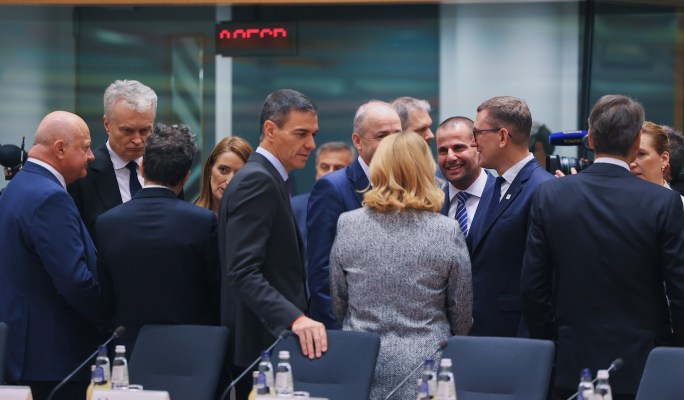
EU leaders did an all-nighter in Brussels but failed to agree on using Russian assets to finance a €90 billion loan for Ukraine, instead settling on joint debt.
The leaders will raise €90 billion in joint debt to fund Ukraine for the next two years after talks for an unprecedented reparations loan hit a brick wall.
The loan provided to Ukraine will be interest-free and will be paid back by Kyiv using reparations cash from Moscow. There is no guarantee Russia will ever pay reparations for its invasion and the loan is likely to become a grant in the future.
The failure of EU leaders to agree on using frozen Russian assets to back a reparations loan for Ukraine is considered a setback for German Chancellor Friedrich Merz and European Commission President Ursula von der Leyen who had presented the plan as the best option for the bloc. In the run-up to the summit, leaders had suggested there was no plan B and doubled down on efforts to issue a reparations loan backed by the Russian Central Bank’s immobilised assets.
But Belgium refused to budge on its demands to obtain unlimited guarantees before tapping into the immobilised Russian assets, the vast majority of which are hosted in the country.
After the summit, which ended in the early hours of Friday following what were described as tough negotiations, von der Leyen, accompanied by Danish Prime Minister Mette Frederiksen, said the primary goal had been achieved—funding Ukraine.
“The bottom line, after today, is that our support for Ukraine is guaranteed,” Frederiksen told reporters.
Still, the principle of making Russia pay for the damage inflicted on Ukraine did not materialise. European member states will borrow in financial markets and pay interest on it. The plan was floated by Hungary, Czechia and Slovakia, although they were granted an opt-out and will not participate in the scheme.
The summit conclusions state: “Any mobilisation of resources of the European Union’s budget as a guarantee for this loan will not have an impact on the financial obligations of the Czech Republic, Hungary and Slovakia.”
Hungary’s Viktor Orban, who has been a staunch critic of the EU’s support for Ukraine, told reporters after the summit that “it looks like a loan, but the Ukrainians will never be able to pay it back”.
“It is basically losing money. And those who are behind that loan will take the responsibility and the financial consequences of that,” he added.
Leaders including Merz, French President Emmanuel Macron and European Council President António Costa said the loan represented the fastest and most efficient way to keep Ukraine’s financial needs covered at a critical time for the country.
Belgian concerns
The debate on Thursday initially centred on the reparations loan and appeasing the concerns expressed by the Belgian government. Belgian Prime Minister Bart De Wever had insisted ahead of the summit that he would not accept a bad deal that would leave his country exposed to Russian retaliation.
De Wever demanded to be offered “uncapped guarantees” to protect Belgium and Euroclear, the depository holding the bulk of the Russian assets, which proved unpalatable for the rest.
At the end of the meeting, De Wever said the word “uncapped” guarantees had made his European colleagues “nervous” and vindicated his country’s position.
“Today, we proved that the voice of small and medium-sized member states also counts. Decisions in Europe are not simply driven by the biggest capitals or institutions. They are collective,” he said in a thinly-veiled reference to Germany. “We avoided stepping into a precedent that risks undermining legal certainty worldwide.”
De Wever insisted the Russian assets should be kept away from Moscow’s hands and be used to reconstruct Ukraine, but only after the war has ended.
Malta satisfied with agreement
Meanwhile, in a statement following the summit conclusions, the Maltese government said it maintained its stance in favour of “political and financial support” for Ukraine that “conforms to international and European Union law”.
The statement quoted Prime Minister Robert Abela saying: “Our country has always been clear and consistent in its support for Ukraine through instruments that conform to international and EU law, and which respect the country’s constitutional neutrality.”
Abela added he was satisfied with the agreement reached, which respected the principles underscored by Malta.
Malta had been among the members states opposed to the reparations loan using seized Russian assets with sources familiar with the talks having told MaltaToday the guarantee the country would be expected to issue under that arrangement would have been to the tune of €170 million.
Malta, along with several other member states, had asked the Commission and Council to continue examining different approaches that comply with EU and international law whilst addressing Ukraine’s financial requirements.