
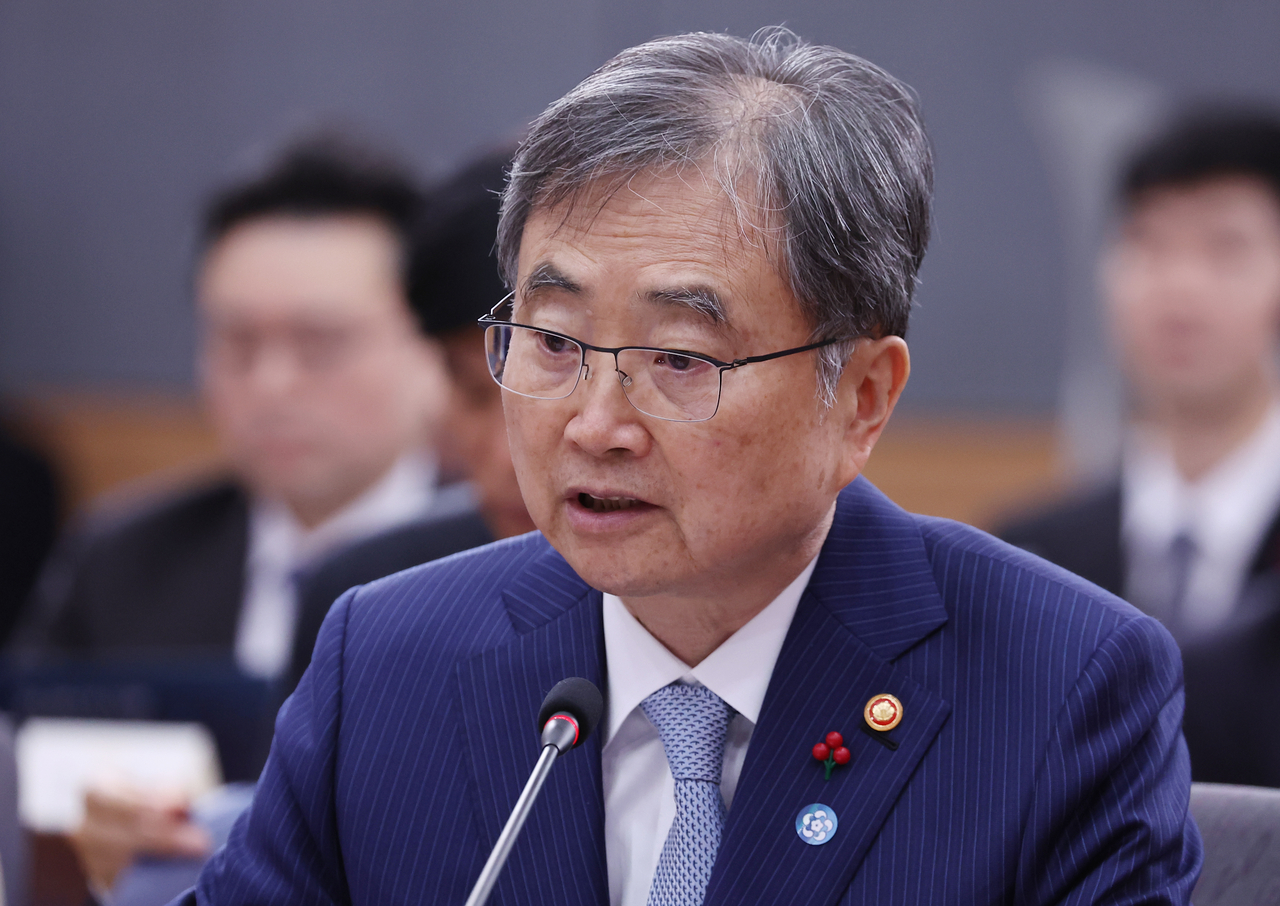
 Foreign Minister Cho Hyun speaks a policy briefing to the president at the Foreign Ministry headquarters in Seoul on Friday. (Yonhap)
 Foreign Minister Cho Hyun said Friday that the government would work to arrange a state visit to China early next year, while also preparing another summit with the US to assess progress on key bilateral agreements.
Cho outlined the diplomatic road map during a policy briefing to the President Lee Jae Myung at the Foreign Ministry’s headquarters in Seoul.
“We will pursue the president’s state visit to China in the early part of next year,” Cho said.
Washington is also expected to intensify high-level engagement with China next year, with US President Donald Trump reportedly considering a visit to China in April. Observers say Seoul may be seeking to stabilize ties with Beijing in advance, as strategic competition between the United States and China continues to deepen.
Cho said the government also plans to hold another South Korea-US summit next year to review how much progress has been made on commitments agreed upon by the two leaders, particularly in areas where security and industrial cooperation overlap.
“We will ensure tangible progress, especially in nuclear-powered submarines, nuclear energy cooperation and shipbuilding,” Cho said.
His remarks suggest Seoul will continue to link its defense modernization goals with broader industrial collaboration, including nuclear propulsion technology, next-generation nuclear power such as small modular reactors, and maritime defense industries.
The foreign minister added that the government would pursue a multi-track diplomatic strategy alongside its alliance with Washington. Relations with Japan will be managed through continued “shuttle diplomacy,” while trilateral cooperation among South Korea, the United States and Japan will be maintained in parallel with efforts to expand three-way cooperation involving China and Japan.
Cho said Seoul will also keep necessary channels of communication open with Russia, while strengthening economic diplomacy in emerging and middle-power countries.
As part of its trade strategy, the government reiterated its intention to seek accession to the Comprehensive and Progressive Agreement for Trans-Pacific Partnership (CPTPP), a multilateral free trade pact spanning Asia, the Pacific and the Americas. Cho said joining the pact would help broaden South Korea’s economic partnerships and strengthen supply chain resilience, particularly in the absence of a bilateral free trade agreement with Japan.
In addition, the Foreign Ministry plans to pursue bilateral economic partnerships with countries including Thailand, the United Arab Emirates and Egypt, he said.
Cho also announced plans to overhaul South Korea’s operations of diplomatic missions, shifting toward a hub-based structure organized by region and sector, while reforming performance evaluation mechanisms to better support economic and strategic diplomacy.
mkjung@heraldcorp.com