
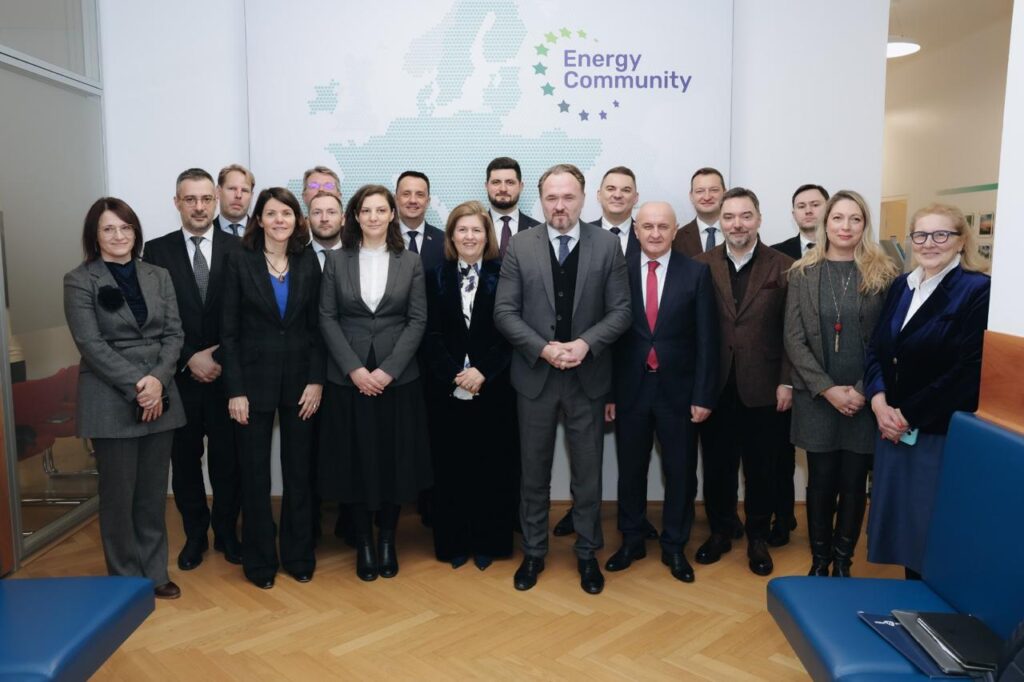
The Republic of Moldova reaffirms its strong commitment to building a secure, competitive, and integrated regional energy market. The message was conveyed by Minister of Energy Dorin Junghietu, who participated alongside counterparts from Energy Community member states at the Energy Community Ministerial Council. Officials discussed key priorities such as energy security, market integration, climate policies, and environmental protection, reconfirming a common direction between the European Union and Contracting Parties for the future of Europe’s energy.
Amid profound changes in the energy sector, officials underscored that integration with the EU energy market prior to accession has become essential to ensure a common, secure, and sustainable energy future.
“The energy landscape has changed fundamentally. Early integration with the EU energy market is no longer an option but a necessity,” stated Artur Lorkowski, Director of the Energy Community Secretariat.
In his speech, Junghietu reaffirmed the country’s strong commitment to the Energy Community and to building a secure, competitive, and integrated regional energy market.
“The results obtained by the Republic of Moldova this year demonstrate remarkable progress and create a solid foundation for the next stage. This stage means implementation and integration: the full operation of markets, deepening regional coupling, strengthening interconnections, and turning reforms into tangible benefits for citizens and the business environment,” the minister stated.
A central topic of the meeting was energy supply security, particularly in the context of the European Union’s efforts to phase out gas imports from the Russian Federation. Ministers adopted EU obligations regarding natural gas storage within the Energy Community, thus extending the European rules for preparation for the cold season and crisis response to the Contracting Parties. This decision strengthens regional coordination and will contribute to maintaining a predictable gas supply despite the risks posed by Russia’s aggression against Ukraine.
Moreover, several Contracting Parties are approaching a decisive stage in integrating electricity markets before accession to the EU, after having fully or almost fully transposed the Electricity Market Integration Package. Subject to compliance verification by the European Commission, these progressions can pave the way for coupling electricity markets with the EU’s internal market before accession. Serbia has already entered the verification stage, and the Republic of Moldova has completed the full transposition of the package.
Ministers reaffirmed their commitment to advancing a coherent and predictable framework that supports the integration of electricity markets while also creating the necessary conditions for the transition to clean energy. In this regard, Contracting Parties will develop national carbon pricing models tailored to the domestic context while maintaining coordination to ensure consistency with the EU Emissions Trading System (EU ETS).