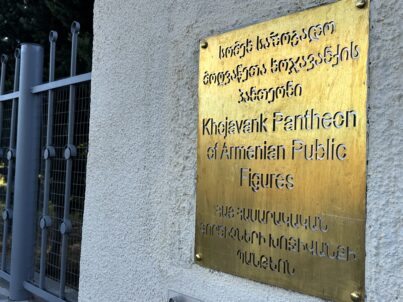
TBILISI, Georgia—High on a hill, in the Avlabari district of Georgia’s capital, Tbilisi, a quiet memorial invites visitors to recall an earlier era when ethnic Armenians dominated this city.
The Khojavank Pantheon of Prominent Armenian Public Figures sits next to Tbilisi’s Holy Trinity Cathedral, which at 87 meters ranks among the world’s tallest Eastern Orthodox churches. Here, preserved above the ruins of a cemetery that once held more than 90,000 graves, are the remains of 48 important Armenians including playwright Hakob Melik Hakobyan (known by his pen name, Raffi) and poet Serob Stepani Levonyan, known as Kousan Jivani.
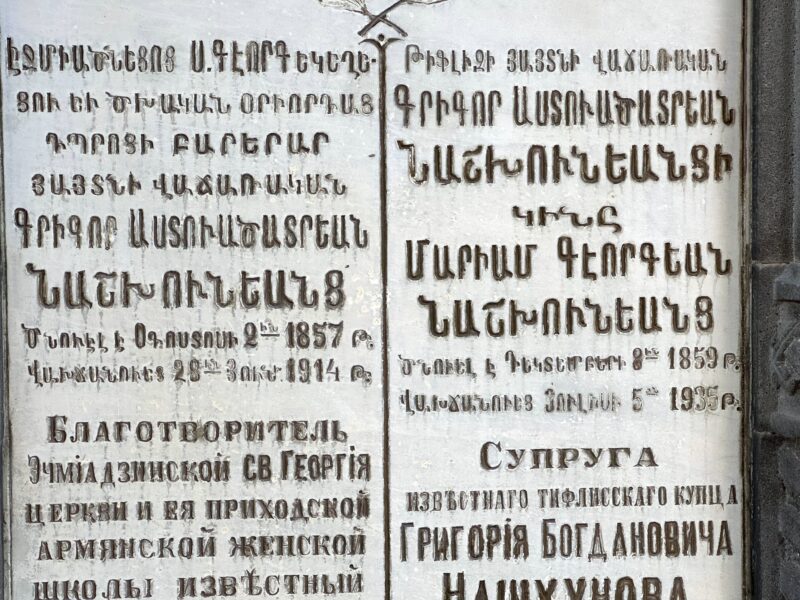 Elaborate marble tombstone in Armenian and Russian script at the Echmiadzin Church in Tbilisi, Georgia (photo Larry Luxner)
Ten minutes’ walk from this solemn place — just off Ketevan Tsamebuli Square — is St. George [Gevorg] of Echmiadzin Church, built between 1806 and 1808. Renovated numerous times since then, most recently from 2006 to 2010, the cathedral belongs to the Armenian Apostolic Church and is one of only two remaining Armenian houses of worship in Tbilisi (at one time there were 29).
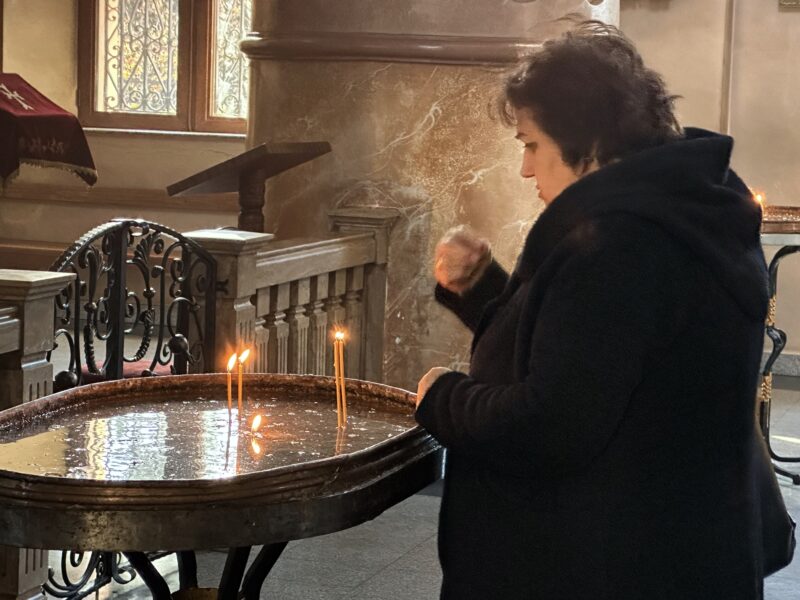 A woman lights candles at the Echmiadzin Church in Tbilisi, Georgia (photo Larry Luxner)
The other is St. George’s Church, a 13th-century Armenian cathedral located at the southwestern corner of Vakhtang Gorgasali Square, under the shadow of the ruins of Narikala fortress. Its most recent renovation — financed by Russian-Armenian businessman Ruben Vardanyan and former Georgian Prime Minister Bidzina Ivanishvili, among others — was completed in 2015.
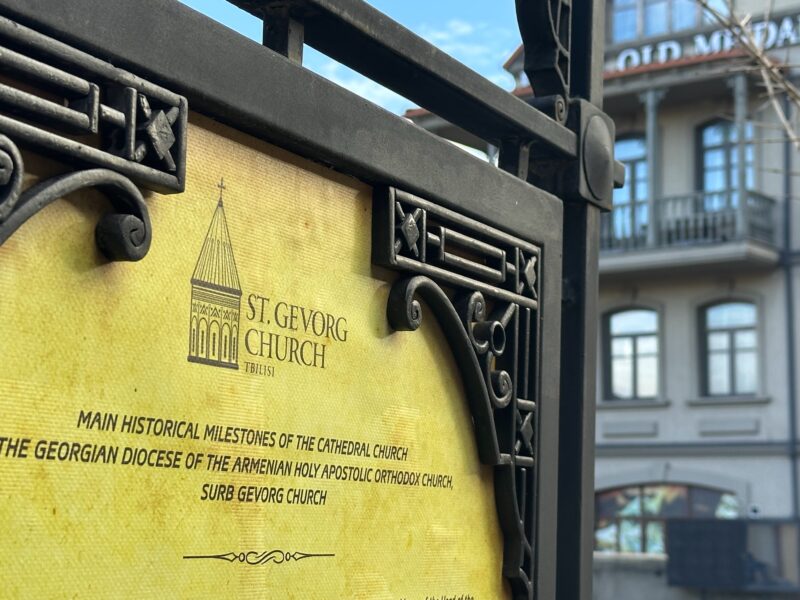 Entrance to St. George Church in the Meidan district of Tbilisi’s old city (photo Larry Luxner)
Given its location in the heart of the Caucasus, it’s no surprise that the Republic of Georgia is home to some 220,000 people of Armenian origin. That includes 50,000 in Abkhazia, a Georgian territory bordering the Black Sea that’s been under Russian military occupation since 2008.
That gives Georgia the world’s fourth-largest Armenian diaspora community after Russia itself (1.9 million), the United States (500,000) and France (300,000) — and way larger than Armenian communities in Ukraine, Canada, Argentina, Lebanon, Turkey and Syria.
At the time of the Soviet collapse in 1990, an estimated 400,000 Armenians lived in Georgia. But with the rise in Georgian nationalism, most of them emigrated to Russia, France and Armenia itself. Yet even today, ethnic Armenians represent at least 5% of Georgia’s population.
Unlike the case with nearly every other Armenian diaspora, those in Tbilisi did not come as a result of the 1915 genocide. Rather, they’ve been living in the Georgian capital since medieval times. For much of the city’s history, Armenians comprised the majority of Tbilisi’s inhabitants; in fact, most of its mayors have historically been ethnic Armenians.
“Tbilisi was the main cultural center of the eastern Armenians,” said historian Levon Chidilyan. “As such, it was here in Tbilisi that the idea of an independent state of Armenia was born.”