
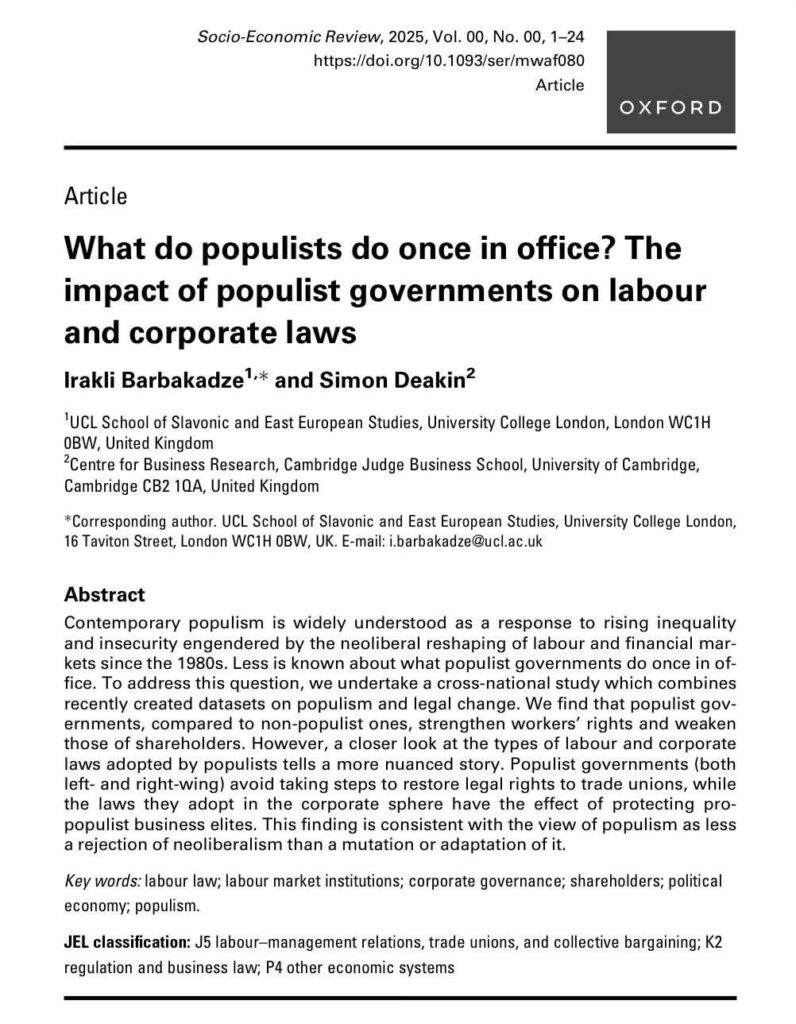
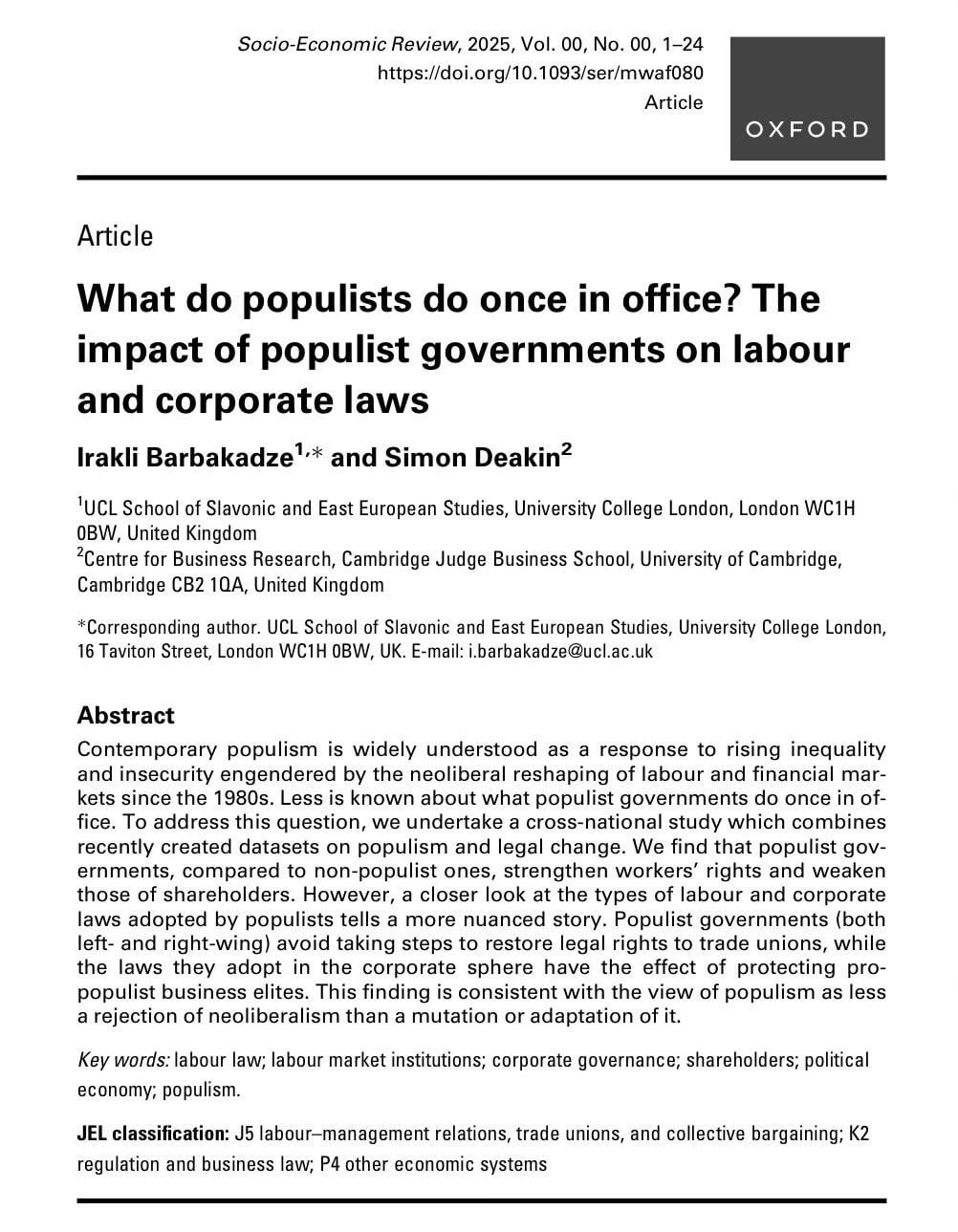
An article published this year, using Türkiye as one of the case studies, examined populist governments. The article examines labor law data in 59 countries and corporate law data in 31 countries between 1970 and 2020, and analyzes the laws by scoring them using the leximetric method. In addition, by classifying political leaders according to their discourses, they mathematically test how much the election promises match the legal actions of the government. In this test, the authors use the ‘Two-Way Fixed Effects’ method, removing global crises and country-specific cultural factors from the equation; Thus, they prove that legal change does not result from external factors, but directly from the preferences of the political power, and thus establish causality. The results reveal how populist governments instrumentalize the legal system.
TL;DR The government does not reject neoliberalism, it "mutate" It hurts. In labor law, it de-unionizes the worker (destroys collective rights) and makes him/her individually dependent on the leader with social benefits. In company law, it violates the rights of small investors and legalizes partisan capital transfer by bending the rules such as Mandatory Takeover Offer.
1 – "Populists Are Enemies of the Market" The Decay of His Legend
According to the article, populists preserve the core of neoliberalism (low taxes, financial openness). However, in order to maintain the system, they make tactical changes in low-hierarchical institutions such as Labor and Corporate Law. This is mentioned in the literature "Mutation Thesis" It is said. In other words, the process we are experiencing is not a breakdown of the system; redesigning the system to work this way.
2. Labor Law: Modern Slavery and Unorganized Labor
The article shows that while populist governments increase individual rights (severance pay, partial social rights), they systematically hinder collective rights (union, strike).
According to the data, the areas of greatest strength are non-standard forms of employment such as temporary work, part-time and contract work. Türkiye’s example is the Private Employment Agencies (Hired Labor) law enacted in 2016. article this "The populist mutation of neoliberal flexibility" defines it as. The aim is to remove the worker from being a class-conscious, unionized collective subject; to transform into an individual who is insecure and grateful to the leader. Unions are excluded because they are seen as power centers rivaling the government.
3. How is Partisan Capital Created?
This is the most critical point. The article found a strong correlation between the weakening of the Mandatory Tender Tender rule and Crony Capitalism. The mechanism is as follows: The obligation of the person purchasing a company to purchase the shares of the small investor at the same price is relaxed. This obligation is something that normally protects small investors. In Türkiye, exemptions to this rule were made with CMB communiqués. For example, in the sale of Doğan Media, the call that should normally be made to small investors was not made/was relaxed. As a result, shareholder democracy was weakened, allowing capital groups close to the government to close down strategic companies (media, energy) cheaply.
In other words, Türkiye, as stated in the article, is neither fully neoliberal nor post-neoliberal.
In Türkiye; A state-centered authoritarian neoliberal system that creates non-unionized, government-dependent capital prevails.
https://i.redd.it/o0ddwlx4ib8g1.jpeg
Posted by m_erdem7
3 Comments
[Makale](https://academic.oup.com/ser/advance-article/doi/10.1093/ser/mwaf080/8379782?login=false)
[Makaleyle ilgili bir diğer analiz (X/Twitter)](https://x.com/i/status/2001047152966164523)
**Veri Seti:** CBR Labour Regulation Index (LRI) & Shareholder Protection Index (SPI).
tüm bunlara bi geçiş süreci olarak bakmak lazım, mutasyon tanımlamasını çok aceleci buldum
Türkiyenin geriye evrimi; Devolution