As a person from one of the red countries, it blows my mind how a chair can have a gender
cougarlt on
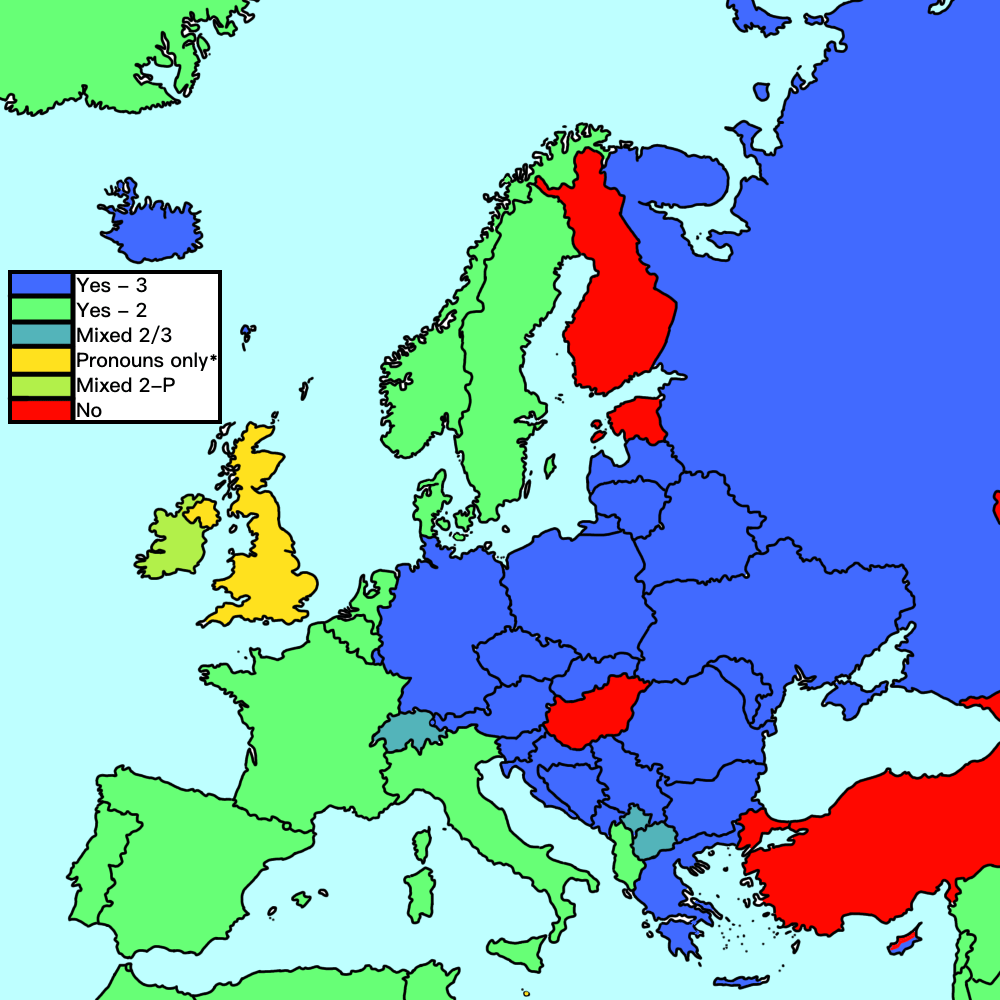
Lithuanian has 2 grammatical genders (masculine and feminine) for the most part. The neutral gender is preserved only in some adjectives. So it should be in the category “mixed 2/3”.
No-Finance-8975 on
Norway has three in both bokmål and nynorsk. You can choose to use only two in bokmål I believe but most use three.
-usagi-95 on
I’m Portuguese and it’s a struggle to explain to people that for us “table” is feminine object 🤣😭
axismundi00 on
Norway should be “mixed 2/3”, as it depends on dialect. It even has two formal, official written standards, one that supports 3 genders and another that supports just 2.
FatMax1492 on
Romanian has three grammatical genders on paper, yes
however, the neuter behaves masculine in the single form and feminine in the plural form, making the language have two genders in practice.
ridley_reads on
Baltic languages do not have a third gender. Even the odd exception follows either masculine or feminine patterns.
mageta621 on
Why are there so many similar shades? I hate you 😭
alatennaub on
Spain needs to be mixed. Both Spanish and Asturian have neuter, however, in Spanish the endings have merged with the masculine and only a handful of words distinguish (but, like, English is marked differently for distinguishing in pronoun-only situations).
Asturian has a more robust neuter, as every adjective has five forms: “altu” (m.s.), “alta” (f.s.), “alto” (n), “altos” (m.pl.), “altes” (f.pl.).
Basque has two-ish. It has an animate/inanimate distinction and has a gendered allocutive informal form, but that’s quite minimal.
gottahavethatbass on
This color scheme is useless for color blind people
zwarty on
Polish has 5 grammatical genders 😀
PrincDios on
Turan strong and based as always 💪
Appropriate-Sound169 on
What does 2P mean for Eire?
Max_FI on
As someone from a red country, I don’t get why gendered grammar and pronouns are even a thing in the first place.
SK1418 on
I always struggled learning German, mainly because of gendered words. Both German and my language (Slovak) have 3 genders, but they are not the same genders for specific words, so it was harder to remember when to use “Der” “die” and “das”
For example, the word “chair” would be feminine in my native language, but masculine in German. If I were to use the logic in my own language, it would be “die Stuhl” which is wrong according to Germans. So I would have to learn genders for each word manually because they were usually a different gender than what I was used to 😭
KhadraThunderborn on
In Danish there are two it’s true, but they aren’t female/male
mad_marshall on
its kinda funny that all the latin speaking countries decided to just abandon the neutral gender when latin did have it
Accomplished-Run-375 on
Another language map that ignores Cymraeg, shock, horror
shlancet on
So Finnish and Turkish don’t have gendered pronouns? Wow
Didzeee on
Latvian has only 2 genders
Micah7979 on
Belgium should be mixed too, German is an official language in some places.
Jok3r609 on
Swahili enters the chat ….
24benson on
If you have Ireland as mixed because there are two official languages, why not do the same for Spain (basque has no grammatical gender) and Romania (Hungarian)?
Emergency_Meringue41 on
Swedish has two but they aren’t necessarily linked to gender, atleast not nowadays
azhder on
WTF is mixed?
TheMillionthSteve on
In Czech and some other Slavic languages, there’s different case endings (in some cases) for masculine animate versus masculine inanimate; can we count that as 4?
vnixned2 on
Dutch should be under “its complicated” cause we do still have three grammatical genders, especially in formal speech and writing.
T3chno_Pagan on
In Polish, sometimes 2 additional genders for plural nouns are included, one is for male persons and the other for the rest of nouns in plural. I wonder if that’s the case in other Slavic languages
ScurrilousSquawk on
Could you explain how Sweden use grammatical gender? We do have ”en” and ”ett” yes, but those have nothing to do with genders? There is nothing masculine or feminine about them.
Brave-Two372 on
Estonia being like
“no sex, no future”.
SuKharjo on
Super common uralic and türkic W
MisterXnumberidk on
Dutch is also a mixed 2/3
They are officially still distinguished in references, but not in pronouns
And some dialects never lost the distinction to begin with
ShamBez_HasReturned on
Map is false – Latvian has only 2 genders
qthorust on
Luxembourg should be mixed as French is one of three official languages. And most heavily used.
Beor_The_Old on
Luxembourg should be mixed 2/3
Perklorsav on
Make it 3.5 for Czech Republic. (for Slovakia also I presume)
ZookeepergameOdd5926 on
Interesting that only the “non-european” languages are not gendered- Turkish is an Altaic language (together with several other Asian languages like Japanese and Korean) and Finnish and Hungarian are of Uralic origin.
Cluster_Unavailable on
you could have made it orange or purple or black but you decided to make it a different shade of green
Eos_Tyrwinn on
It feels wrong to say Ireland’s main language is Anthony but English. Yes Irish is also official but the vast majority of Irish people speak only English and I’m not sure if there’s anyone who speaks Irish and doesn’t also know English
losorikk on
As a person from a blue country, currently learning the language of another blue country, I get a little disoriented when a word with feminine article in my language takes a masculine article instead.
Spozieracz on
There is no way irlandic can be called one of the main languages of Ireland.
JKN2000 on
Depending on the definition, Polish can be described as having either 5 or 2/3 grammatical genders (and it can even be stretched to 7 or 8). In the singular, there are 3 genders (one of which is divided into three subtypes): masculine (which is divided into inanimate, animate, and personal), feminine, and neutral. In the plural, there are 2 genders: masculine (personal) and non-masculine (personal). Masculine, feminine, and neutral in the singular are not the same categories as masculine and non-masculine in the plural, since one word can be masculine in the singular and non-masculine in the plural (for example, dog: “ten pies” (singular masculine animate) and dogs: “te psy” (plural non-masculine personal)). So, singular and plural genders definitly should be classified independently, and overall Polish definitely does not have only three genders.
PornBotsHackedMe on
Gendered pronouns are not the same as grammatical gender.

44 Comments
Wait, Dutch has grammatical genders?
As a person from one of the red countries, it blows my mind how a chair can have a gender
Lithuanian has 2 grammatical genders (masculine and feminine) for the most part. The neutral gender is preserved only in some adjectives. So it should be in the category “mixed 2/3”.
Norway has three in both bokmål and nynorsk. You can choose to use only two in bokmål I believe but most use three.
I’m Portuguese and it’s a struggle to explain to people that for us “table” is feminine object 🤣😭
Norway should be “mixed 2/3”, as it depends on dialect. It even has two formal, official written standards, one that supports 3 genders and another that supports just 2.
Romanian has three grammatical genders on paper, yes
however, the neuter behaves masculine in the single form and feminine in the plural form, making the language have two genders in practice.
Baltic languages do not have a third gender. Even the odd exception follows either masculine or feminine patterns.
Why are there so many similar shades? I hate you 😭
Spain needs to be mixed. Both Spanish and Asturian have neuter, however, in Spanish the endings have merged with the masculine and only a handful of words distinguish (but, like, English is marked differently for distinguishing in pronoun-only situations).
Asturian has a more robust neuter, as every adjective has five forms: “altu” (m.s.), “alta” (f.s.), “alto” (n), “altos” (m.pl.), “altes” (f.pl.).
Basque has two-ish. It has an animate/inanimate distinction and has a gendered allocutive informal form, but that’s quite minimal.
This color scheme is useless for color blind people
Polish has 5 grammatical genders 😀
Turan strong and based as always 💪
What does 2P mean for Eire?
As someone from a red country, I don’t get why gendered grammar and pronouns are even a thing in the first place.
I always struggled learning German, mainly because of gendered words. Both German and my language (Slovak) have 3 genders, but they are not the same genders for specific words, so it was harder to remember when to use “Der” “die” and “das”
For example, the word “chair” would be feminine in my native language, but masculine in German. If I were to use the logic in my own language, it would be “die Stuhl” which is wrong according to Germans. So I would have to learn genders for each word manually because they were usually a different gender than what I was used to 😭
In Danish there are two it’s true, but they aren’t female/male
its kinda funny that all the latin speaking countries decided to just abandon the neutral gender when latin did have it
Another language map that ignores Cymraeg, shock, horror
So Finnish and Turkish don’t have gendered pronouns? Wow
Latvian has only 2 genders
Belgium should be mixed too, German is an official language in some places.
Swahili enters the chat ….
If you have Ireland as mixed because there are two official languages, why not do the same for Spain (basque has no grammatical gender) and Romania (Hungarian)?
Swedish has two but they aren’t necessarily linked to gender, atleast not nowadays
WTF is mixed?
In Czech and some other Slavic languages, there’s different case endings (in some cases) for masculine animate versus masculine inanimate; can we count that as 4?
Dutch should be under “its complicated” cause we do still have three grammatical genders, especially in formal speech and writing.
In Polish, sometimes 2 additional genders for plural nouns are included, one is for male persons and the other for the rest of nouns in plural. I wonder if that’s the case in other Slavic languages
Could you explain how Sweden use grammatical gender? We do have ”en” and ”ett” yes, but those have nothing to do with genders? There is nothing masculine or feminine about them.
Estonia being like
“no sex, no future”.
Super common uralic and türkic W
Dutch is also a mixed 2/3
They are officially still distinguished in references, but not in pronouns
And some dialects never lost the distinction to begin with
Map is false – Latvian has only 2 genders
Luxembourg should be mixed as French is one of three official languages. And most heavily used.
Luxembourg should be mixed 2/3
Make it 3.5 for Czech Republic. (for Slovakia also I presume)
Interesting that only the “non-european” languages are not gendered- Turkish is an Altaic language (together with several other Asian languages like Japanese and Korean) and Finnish and Hungarian are of Uralic origin.
you could have made it orange or purple or black but you decided to make it a different shade of green
It feels wrong to say Ireland’s main language is Anthony but English. Yes Irish is also official but the vast majority of Irish people speak only English and I’m not sure if there’s anyone who speaks Irish and doesn’t also know English
As a person from a blue country, currently learning the language of another blue country, I get a little disoriented when a word with feminine article in my language takes a masculine article instead.
There is no way irlandic can be called one of the main languages of Ireland.
Depending on the definition, Polish can be described as having either 5 or 2/3 grammatical genders (and it can even be stretched to 7 or 8). In the singular, there are 3 genders (one of which is divided into three subtypes): masculine (which is divided into inanimate, animate, and personal), feminine, and neutral. In the plural, there are 2 genders: masculine (personal) and non-masculine (personal). Masculine, feminine, and neutral in the singular are not the same categories as masculine and non-masculine in the plural, since one word can be masculine in the singular and non-masculine in the plural (for example, dog: “ten pies” (singular masculine animate) and dogs: “te psy” (plural non-masculine personal)). So, singular and plural genders definitly should be classified independently, and overall Polish definitely does not have only three genders.
Gendered pronouns are not the same as grammatical gender.