
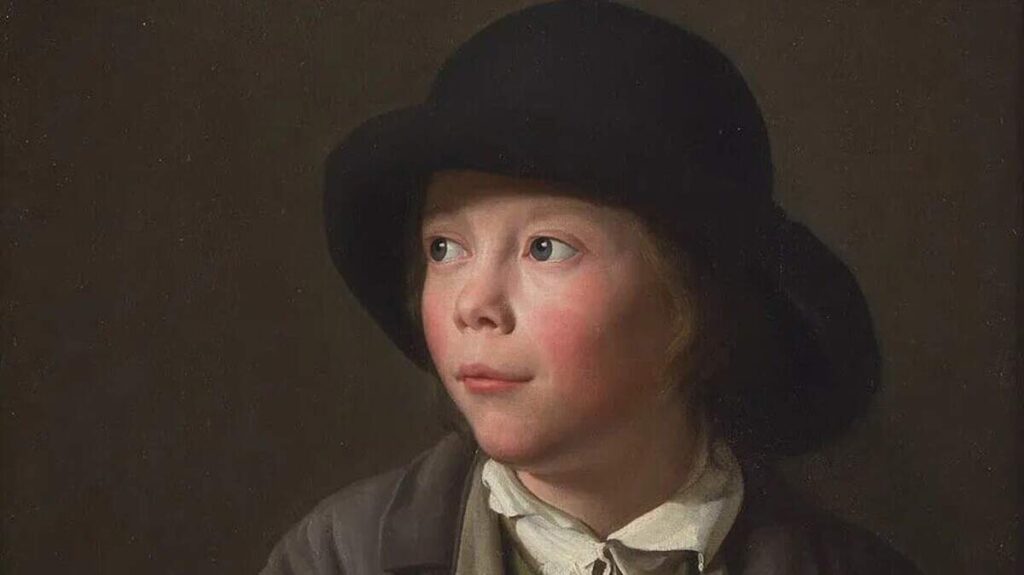
Luxembourg’s national museum has acquired a famous painting by Swiss artist François Ferrière and could put it on display as early as 2026.
Portrait of a Boy Wearing a Hat and Holding a Frame will be displayed in Luxembourg’s National Museum of Archaeology, History and Art in the country’s capital.
“It will enrich our department so much,” Ruud Priem, the head of the museum’s fine arts department, told the Luxemburger Wort.
Priem secured the portrait, which was painted in 1783, at an auction in Philadelphia at the beginning of November.
Despite being in the art world for 30 years – with a career also spanning across the Netherlands – Priem described bagging the Ferrière portrait as “lucky”. The price of the painting remained well below the estimate and the museum’s original budget.
In 2017 a private collector acquired the painting for almost $90,000 (€76,500) at Christie’s auction house in New York.
But when it appeared in 2025 with a low starting bid at a Philadelphia auction house, Priem immediately noticed, especially as it can be harder for the museum to acquire such artworks at bigger auction houses where people bid with a lot more money.
“We have a relatively flat organisational structure and unlike very large museums we can make a purchase decision much more quickly,” he said.
“Of course, we don’t have their budgets either and we work with taxpayers’ money – so we have to budget very carefully and make the most of the opportunities. But being able to act quickly worldwide is our advantage,” Priem said.
Ruud Priem is responsible for the fine arts department at the National Museum of Archaeology, History and Art. © Photo credit: Anouk Antony
Priem used a few tricks to secure the painting, including trying to “remain as anonymous as possible”. He bid online for the painting while sending acquaintances to view the painting in person.
He secured the painting for less than a third of the price it sold for at Christie’s, he said. This did not include the auction house’s mark-up and other costs.
“This is a great success,” he said.
Why is this portrait so special?
Ferrière was born in Geneva in 1752 and this comparatively large-format work is an exception to his usual style of painting miniatures.
“This is one of the most interesting paintings by this master, who was trained in Paris and travelled internationally, but was primarily known as a miniature painter,” Priem said. “It is not only very well preserved in terms of quality, but also makes a very modern impression.”
It is not expected that the museum will need to do extensive restoration work on the painting.
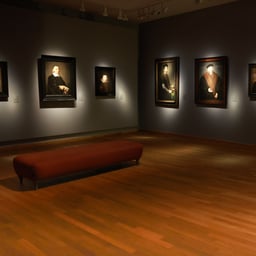
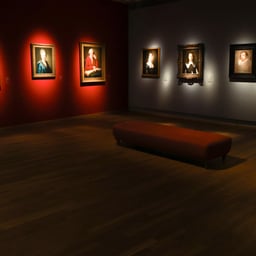
The painting – described by Priem as a “window into the past” – differs from many of the works in the museum’s portrait room which are mainly of rich aristocrats and rulers.
The museum is also considering using the portrait as part of temporary exhibitions in which it would also add a wider range of portraits, such as photographs, to explore how self-portrayal and artistic representation were used in different periods.
New winter magic thanks to foundations
Special new additions are already on display at the Villa Vauban. Its collection of Dutch landscapes from the 17th to 19th centuries will receive two strong winter paintings, which will be presented to the public for the first time in the cabinet exhibition Pleasures on Ice until 17 May 2026.
The popularity of the winter landscape genre in Dutch “Golden Age” painting (17th century) is closely linked to the Little Ice Age (ca. 1500 to 1850), which brought long, frosty winters and caused rivers and lakes to freeze over. All social classes came together at the Ijspret, or ice fun.
Jacob Esselens (16261-1687): “Paysage hiver” (around 1660) © Photo credit: Villa Vauban / René Gerritsen
Thanks to the donor Claude Lebrun and the help of the Focuna, a special glimpse into this period is now possible: Jacob Esselens’ misty landscape is the only known winter painting by the painter and captures the icy cold of Holland. It is characterised by a reduced, tonal colour palette of brown, beige and grey tones, which lend depth to the frosty atmosphere.
A second winter landscape, this time from the 19th century, is by Andreas Schelfhout and was purchased thanks to a donation from the Amis des Musées. Schelfhout (1787-1870) is considered an important representative of the Hague School and Dutch Romanticism. His works, also known as Schelfhoutjes, are known for their richness of detail and atmospheric mood and often depict skaters at the foot of a windmill.
Andreas Schelfhout (1787-1870): “Paysage d’hiver patineurs” (1851) © Photo credit: Villa Vauban
But that’s not all: two paintings by Andries Vermeulen (1763-1814), recently acquired by the museum and painted around 1800, are now on display. The artist specialised in winter landscapes in the style of his time. More about the cabinet show at www.villavauban.lu.