
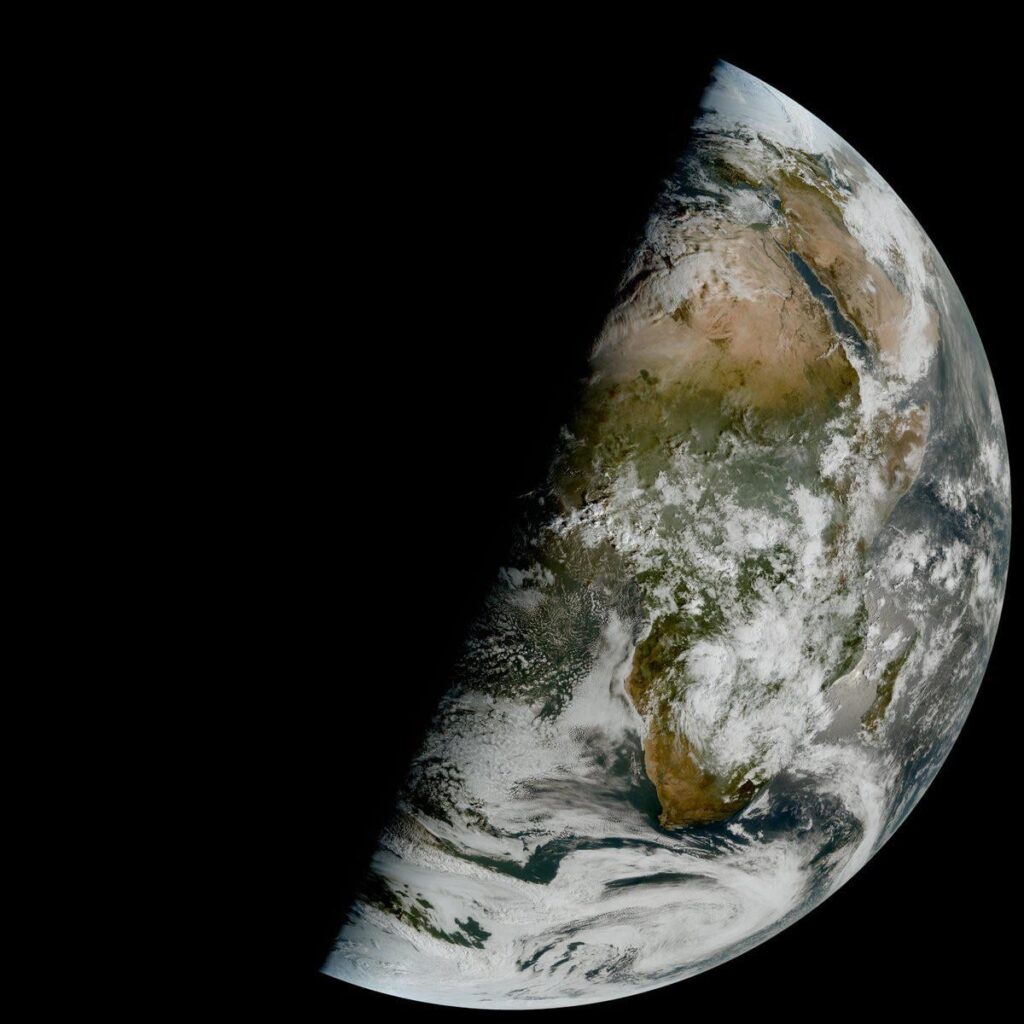
Probably the most stupidest question anyone can ask but: I recently saw this photo from the ESA (European Space Agency) but was a little confused on why the other side of Earth is pitch black. This isn’t the first time I’ve seen this but every time I’ve seen an example it’s bugged me. Is it just an edit, or something else?
https://i.redd.it/5qzyd2f30m8g1.jpeg
37 Comments
Sun MUCH MUCH brighter than street lights.
I assume it’s because the city lights are actually very faint compared to the reflected sunlight, so you have to do two exposures and combine them to get the ‘typical’ photo showing both.
The lights from human settlements aren’t bright enough to compete with the sunlight, it’s a camera dynamic range issue ultimately.
Exposure settings are set for daytime imaging. If you wanted to see city lights, the day side would be overexposed and just a bright blob.
> why the other side of Earth is pitch black.
The sunlit side is *wildly* brighter than street lighting, and the camera’s exposure settings and dynamic range can’t capture both at once – and for this shot it was configured for the day side.
Exact same reason you can’t see the road when someone’s high-beaming you with crazy LED headlights.
It could be reconfigured for the night side, and then the day side would just be a white blur with heaps of bloom.
A trillion manmade lights are less than a spark before the fury of the sun
To be able to show detail in the bright side, the exposure has to be turned down, darkening the dark parts. If you wanted the camera sensitive enough to see city lights, the illuminated side would be completely blown out.
Exposure.
If you expose this photograph to pick up light on the dark side of the Earth, the sun let side of the earth will be completely and utterly washed out.
you would have to take a bracketed exposure HDR image composite to show the really dark areas. Film and camera sensors dont have enough range in a single exposure to show the very bright sunny side and the considerably darker city lights on the dark side at the same time
Simple terms, the settlements do not emit nearly the same level of light as the illuminated side reflects. A single photo cannot capture both, the correct exposure for one side will either over or under expose the other. Shots that show both are composites of at least two shots with the proper exposure of each side stitched together.
It is an edit and its about what they’re trying to highlight – the Earth’s tilt at various times in the year.
https://www.instagram.com/p/DShdU8ADHwE/?img_index=1
> On 21 December 2025 at 16:03 CET, Earth will reach the December solstice. This is the moment when the terminator – the line between day and night – tilts to its maximum angle relative to the equator.
> That tilt, about 23.5° (the same as Earth’s axial tilt), brings:
> – the shortest day of the year in the Northern Hemisphere
> – and the longest day in the Southern Hemisphere
> The December solstice marks the start of winter in the north and summer in the south.
> Swipe to journey back five hundred twenty-five thousand minutes… give or take through the key turning points of Earth’s orbit, and explore:
> – 19 December 2025 (two days before the solstice)
> – September equinox (2025)
> – June solstice (2025)
> – March equinox (2025)
> – December solstice (2024)
> 📸 @eumetsatmedia, processed by @europeanspaceagency
(edit: opening this up in a photo editor, there doesn’t appear to be any data in the dark half of the image)
The same reason you can’t see stars in Apollo photos from the lunar surface. Too short exposure time to not overexpose the daylight.
So two things, first is that the sunny side of earth is way brighter than any city lights. The second thing is im fairly sure the landmass we’re looking at is Africa, so most of the night side we can see is the Atlantic ocean.
Stand close to a street light at night and look up and try to see the stars behind the street light.
It’s not a great example, but something similar is happening in the image as well. The sun’s light is much brighter than all the lights on the side of the earth.
If you can’t see stars in the day time, you’re certainly not going to be able to see streetlights next to the daytime side of the earth.
The only way to get a pivot a picture of both would be a composite image.
Cameras have to deal with something called Dynamic Range. Basically the day side of Earth is many times brighter than the city. If you tried to set the camera exposure to see cities, the Day side would be almost completley bright white. And therefore vice versa, the cities disappear in this shot.
The human eye has a far better dynamic range than almost any camera.
You will sometimes see photos with both, but these have been stitched together in editing.
The same reason that the stars are absent in the Apollo missions. You have to understand how film and digital camera processing works.
There is a dynamic range where some lights are too dim to see in relation to other bright lights.
You may be familiar with concepts like under or over exposure. This is the period that light is collected. If you haven’t a dim light next to a bright light the bright light will overwhelm the image making the dim light invisible. The same thing with under exposure, to balance the photo a shorter exposure is used that doesn’t allow the dim light to register.
So many photos that include both dim and bright objects are composites with masks to block out the bright portions. They are beyond the dynamic range of the photo medium so you need to have a capture for the dim lights and a separate for the bright lights.
Some times pictures from far off stellar objects are exposures that occur over days instead of fractions of a second. If you were to take an exposure over many days of the earth it would be streaks in the dark and solid white in the lit area.
Your eyes have a higher dynamic range than most photo mediums. That’s why it takes extensive processing to get photos of similar quality in dim conditions in addition to longer exposures.
Hopefully I’ve provided some key words to help you search for more information.
Photography question. The daytime side is far too bright so the lens needs to be stopped down. If the lens were opened wide enough to capture point light sources from the nighttime side, the daytime side would be completely washed out.
Same reason why photos of the moon are difficult to capture the lit portion and the unlit portion, which our eyes can partially discern.
Because earth is bright.
It’s the same reason you can’t see stars in most pictures of the moon. In order for the earth/moon to be properly exposed, the camera can’t get the dim stars and the bright moon/earth.
Most likely those images where you see the street lights are composite images where different exposures are combined into one.
In Photography its called bracketing. You take the same image multiple times at different exposures levels, letting very little light into the camera so the bright parts of the image are still visible and then continuously letting more light into the camera for every successive image so the darkest parts become visible (the bright parts become over exposed and turn into a white blob then). Then combining these images you can the show both the very dark parts (streetlights, stars) and the very bright parts (day side of earth) on a single image.
Down here on earth you usually use bracketing to keep the sky and the ground detailed and visible on landscape photography for example.
“Space” is far too vague. You can easily see surface lights from the ISS, which is technically space. However from the above distance, the lights are FAR too faint to appear in an image composed in sunlight.
It’s kind of the opposite. You could use photoshop to create pictures showing the lights by combining two different images. In an image like this the light side is orders of magnitude brighter than any artificial lights on the dark side. If the exposure was high enough to show lights on the night side then the day side would just be completely over exposed and white.
Isn’t the Atlantic ocean covering most of the night side in this picture?
Also like everyone else is saying, city lights are getting washed out by the reflection of the sun.
One thing I think these comments are missing, is that most human settlements are actually really small when you think in terms of land use.
The vast majority of what you might call “settled” or “developed” land is farmland, and you absolutely can see that from space during the day.
Cities are the other hand, take up a pretty small amount of land when you zoom out to planetary level. Just go to NYC in google earth and start zooming out. At a certain point it becomes basically indistinguishable from the surrounding area.
The ones where you see both daylight and the night lights are composite images, not single photos.
Camera sensor dynamic range limitation
You can’t get sunlit ground and streetlights showing up in the same photo with the same exposure settings. Would need to take two photos at different settings and stitch them together
Aside from the brightness of the sun, the picture is showing the Persian Gulf and Aside
Africa, so much of the darkened ares is ocean until you’re close to the edge of where you expect the globe to be the North American coast is positioned at the edge of the globe.
Switch on your street lights during a sunny day. Do they have any effect? No.
I get from a camera perspective why this is the case, but to the naked human eye in space would they be able to see the human lights on the dark side concurrently?
Think about it like this: when you go inside a house after being outside for a while it seems overly dark because your eyes adjust to the bright sunlight. That’s what’s going on in this picture.
The exposure levels required to have daylight not completely wash out the image are way too low to also see city lights at night.
You’re not going to be able to see if a tiny LED is turned on in bright sunlight. If you turned the camera exposure up enough to be able to tell if the LED is on, everything will be washed out beyond recognition.
Camera shots are tuned for what they are trying to capture.
For shots trying to capture lights/cities, they are tuned to that. For shots like this, they are tuned to that as well. It’s difficult/impossible to get both.
For something like this though, they could get two cameras tuned to different things, and stitch the two images together pretty easily.
Physics!
Any photographer knows the reason.
But basically it gets cut out due to the dynamic range of the sensor, aperture, and exposure level/time
Because space isn’t real man.
Put a tea light candle next to your cars headlights and take a picture. The candle won’t show up.
Same reason the pictures taken during the moon landing don’t show any background stars; the lit up part of the image is so bright that the faint part has too little light to be noticeable
You could build an HDR image to compensate for that, where HDR is stacked images taken at different shutter speeds and then merged together to see details inside the black, but most pictures are not taken that way, they rather are taken using a single shutter speed which favors the brightest part of the image.