
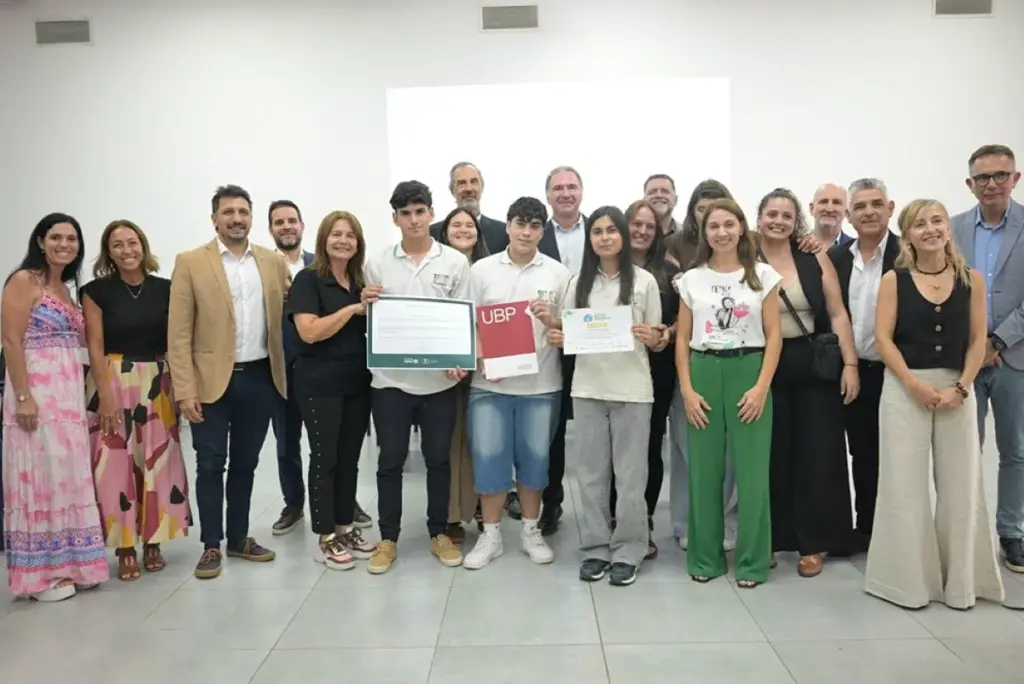
Three schools in the province of Córdoba were distinguished in the Sustainable Schools contest, an initiative that promotes climate action from the educational and community sphere. The recognition highlights the role of educational institutions as drivers of environmental and social transformation.
The award ceremony was held at the Auditorium of Plaza Cielo Tierra, with broad participation from public and private actors. The call brought together 150 secondary, technical, and oriented schools from across the province with proposals aligned to five priority areas: energy, water, soil, biodiversity, and circular economy.
After a process of technical evaluation and citizen participation, ten finalist projects were selected. Among them, three initiatives stood out for their innovation, territorial impact, and ability to be replicated in other communities.
The contest reaffirms that environmental education is a key tool to face the climate crisis. From the classrooms, concrete solutions to local problems are built.
 Córdoba promotes climate action from the classrooms, recognizing three technical schools for their environmental projects. Government of Córdoba.
Awarded projects that transform waste into sustainable solutions
The first place went to I.P.E.T. No. 232 “Prof. Enrique A. Flores”, from Ciénaga del Coro. Their circular economy applied to mining project reuses waste from quarries and granite sawmills. From these materials, cobblestones, tiles, decorative elements, and cleaning products are made.
The second recognition went to I.P.E.T. No. 71 “Luis Federico Leloir”, from Hernando. The proposal developed agglomerates from agro-industrial and urban waste. The approach combines technological innovation with waste reduction and the use of local resources.
The third highlighted project was from I.P.E.T. No. 430 Instituto Técnico Industrial. The initiative proposes an automatic control system for inactive electrical devices. The goal is to reduce energy consumption and promote responsible habits in school environments.
Prizes, support, and institutional collaboration
The winning institution received the installation of a photovoltaic solar system. Additionally, the finalist projects accessed technical mentorships to strengthen their continuity and scalability. These actions aim for the ideas not to remain only in the classroom but to grow in the territory.
The contest is jointly driven by service companies and provincial organizations. Areas related to education, environment, energy, infrastructure, and youth participate. The initiative consolidates a public-private cooperation model with strong local anchoring.
Throughout the process, educational communities went through interdisciplinary evaluation stages. Public voting was also promoted, strengthening citizen participation. The scheme allowed balancing technical rigor, social commitment, and project visibility.
 environmental education
Benefits of the initiative and the importance of environmental education
The Sustainable Schools contest generates concrete environmental, social, and educational benefits. It promotes efficient resource use, waste reduction, and the incorporation of clean energies. Additionally, it strengthens the sense of belonging and community commitment of students and teachers.
Fostering environmental education allows for the formation of critical and responsible citizens. From an early age, values related to caring for the environment and sustainable development are incorporated. The school thus becomes a key space for building collective ecological awareness.
These experiences demonstrate that education is a central tool in the face of climate change. Integrating environmental content with real practices enhances meaningful learning. In the long term, initiatives like this lay the foundations for a provincial network of schools committed to the planet.