
Two hundred years ago, in April 1825, Mikiel Anton Vassalli opened the first School of Maltese at the University of Malta in what is now known as the Valletta Campus.
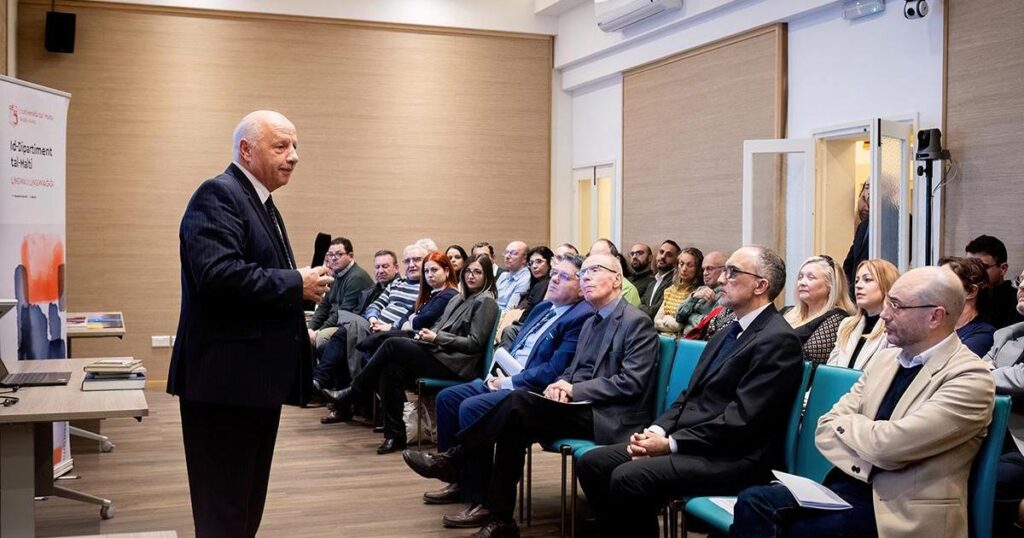
During a commemoration of this historic event on December 16, David Agius Muscat and Olvin Vella presented new historical documentation on this important episode in the history of the university. This documentation includes the programme of lectures, with the days and times, as well as the content of the lessons. It represents the first detailed reference of the teaching of Maltese at University.
In his opening address, University rector Alfred Vella said that as a national institution, the University of Malta must safeguard the central role of Maltese as the national language.
While acknowledging and promoting the international dimension of University and the importance of the use of English in administration and teaching, Vella recalled that the university is the only tertiary institution that requires Maltese students to hold a qualification in Maltese at undergraduate level.
The rector insisted that, through his presence at this commemoration, he wished to reaffirm this position, because any change to it would cause “serious − and possibly irreparable − damage” to the study of Maltese.
Agius Muscat is a senior lecturer in the Department of Maltese at the Junior College and has just completed his PhD with research on the historical development of Maltese in the first half of the 19th century. He is the author of a biography of Fortunato Panzavecchia and a publication on new findings related to Mikiel Anton Vassalli.
It was among the papers of Panzavecchia, the secretary of the University Council, that he discovered this new documentation. In his talk about ‘Vassalli and the First School of Maltese at the University in 1825,’ he announced that he is about to publish a booklet that contains this new information related to the teaching of this first Maltese course at the University.
Vella, senior lecturer in the Department of Maltese at the University, who coordinated the academic contributions presented during the commemoration, has long been involved in initiatives aimed at publishing research carried out by various scholars on Vassalli.
In his contribution entitled ‘Vassalli and the Researchers’, he spoke about the work of Mgr Karm Sant, Frans Ciappara, Ġużè Cassar Pullicino, Alain Blondy and David Agius Muscat in shedding light on the lesser-known aspects of Vassalli’s work. He noted the strong spirit of collaboration that has long existed among researchers and how, thanks to their efforts, there is a substantial body of knowledge about this key figure in the history of Malta and of the Maltese language.
The other two speakers were Frans Ciappara, a leading historian of the second half of the 19th century, and Sergio Grech, president of the Akkademja tal-Malti (Maltese Language Academy).
Ciappara is the author of an authoritative biography entitled Mikiel Anton Vassalli: An Enlightened Maltese Reformer (Department of Maltese and Midsea, 2014). In his talk on ‘Vassalli and Education’, Ciappara focused on the teaching of Maltese in the light of the Progetto, through which Vassalli sought to emancipate his people by means of education and the use of Maltese as the national language − a mission he continued to pursue after returning from exile in 1820. He gave an overview of the historical and cultural context needed to properly assess Vassalli’s contribution and referred to his guiding principle that the Maltese language deserved to become the language of the law, the language used by the Church to communicate with the people, and a core subject in schools.
Grech, editor of the series Bejn Storja u Miti and author of several biographies, who has recently worked on the history of the Department of Maltese at the University, gave a talk entitled ‘Ġużè Aquilina and the Birth of the Department of Maltese’, in which he examined the 40-year career of the professor who established the chair of Maltese at the University in 1937. In addition to building the various fields of the department on solid foundations, Aquilina was a prominent figure at University and in public life in Malta and abroad, and thus a worthy heir to Vassalli.
In the closing address, ‘Two Hundred Years after Vassalli’, Adrian Grima, head of the Department of Maltese, spoke about the influence of Vassalli’s personality and work on the department today. Vassalli was the first expert on Maltese, but he also studied semitic languages and Romance languages such as Latin, Italian and French, a background that greatly assisted him in studying and teaching Maltese − a language he considered fundamental to the spread of education among the entire population. While Vassalli was the first person to describe Malta as a nation, he was also an internationalist who wanted his country to benefit from the advances taking place abroad, where he spent a total of 20 years of his life.
At the end of the commemoration, the Department of Maltese presented the rector with a number of books related to Vassalli published by the department.
The event was organised by the Department of Maltese in collaboration with the Akkademja tal-Malti. The organisers will make recordings of the presentations available on malti.mt and akkademjatalmalti.org.