
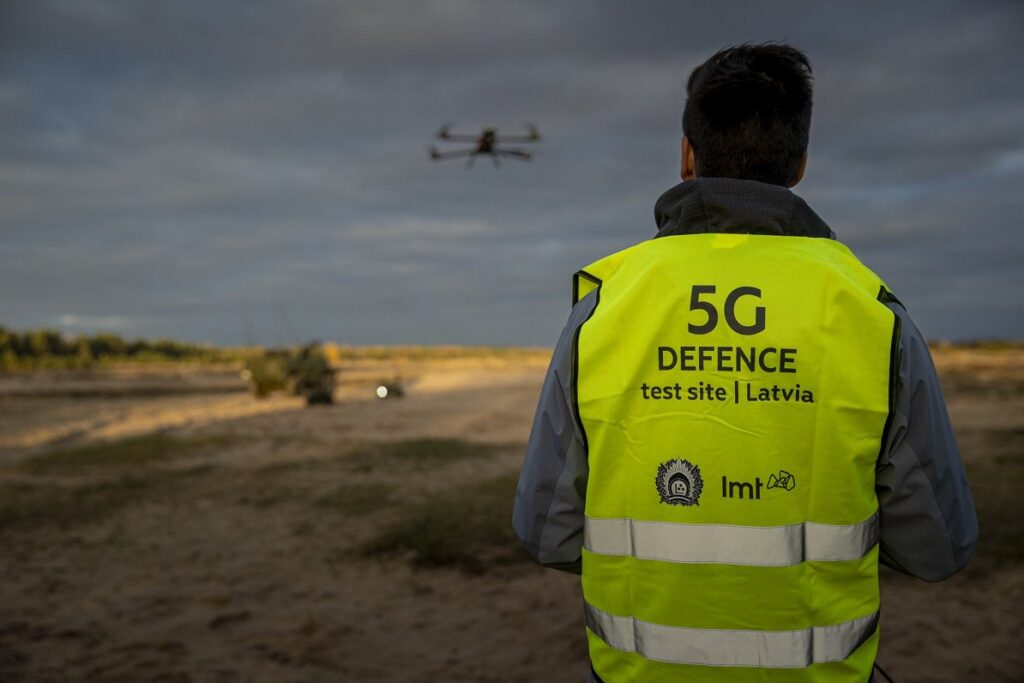
The project is led by the Latvian company SIA Latvijas Mobilais Telefons (LMT), with a total project budget over three years amounting to just under €11 million.
The goal of the Vantage system is to develop a modular, long-endurance vertical take-off and landing (VTOL) unmanned platform to perform combat support missions. The initiative is based on experience from the war in Ukraine, ensuring that the system developed will meet the requirements of the modern battlefield. At the same time, Vantage will make a significant contribution to achieving the objectives of the Latvia-led Drone Coalition, as well as strengthening Europe’s overall defence capabilities, it is hoped.
This is one of the most significant Latvia-led projects to receive support from the European Defence Fund, not only providing new opportunities for Latvia’s defence industry, but also increasing its competitiveness, and facilitating integration into international supply chains.
The project is being implemented by a consortium of eight partners from six countries: Latvia, Estonia, Belgium, France, Romania, and Spain. It brings together industry companies and research organizations to create a modern, resilient, and multifunctional unmanned aerial system platform to meet Europe’s security and defence needs.
The majority of the project costs—€10.09 million—will be covered by co-financing from the European Commission. The project is also supported by the Ministry of Defence, as well as the defence ministries of several other European Union member states. Latvia’s Ministry of Defence will provide the necessary national co-financing to fund LMT’s participation in the project.
Overall, LMT will participate as a partner or coordinator in six projects selected in this year’s European Defence Fund (EDF) call.
“The success of a single company in six European Defence Fund projects simultaneously is unprecedented for Latvia’s technology industry. This achievement is strategically significant in that it strengthens Latvia’s defence capabilities and innovation capacity and reinforces the country’s position within the European defence technology sector,” said LMT Vice President Ingmārs Pūķis.
The European Defence Fund projects involving LMT are focused on developing practically applicable products, enhancing critical defence capabilities such as secure and uninterrupted communication networks, 5G integration and interoperability for military missions in various environments, 5G extended reality solutions for defence technology needs, and unmanned and command-and-control systems.
LMT will act as the consortium leader for the Vantage project and as a partner in five other projects:
- Orqestra – integration of post-quantum cryptography capabilities for defence needs;
- Auriga – development of a next-generation armoured infantry fighting vehicle;
- iMugs2 – advancement of unmanned ground systems and the use of 5G technologies in autonomous military solutions;
- 5G Compad 2.0 – delivery of advanced capabilities including sensor networks, precise positioning services, automatic network configuration, non-terrestrial networks, and spectrum sharing;
- Readymed Europe – development of a military medical training platform for medical personnel, paramedics, and other user groups, including military instructors and system administrators.
Four Latvian companies and two research institutions involved
The European Defence Fund has awarded funding to 62 collaborative research and development projects. Over 600 organisations from all EU member states and Norway are involved in these projects, including small and medium-sized enterprises, universities, research institutes, and large industrial stakeholders.
The Fund has also allocated financing to nine new European Defence Fund development and research projects involving four Latvian companies and two Latvian research institutions.
Across these nine innovation projects, Latvian companies are collectively applying for €7 million in European Commission co-financing, while national co-financing of approximately €1.2 million is required.
In terms of secured funding, as far as European Defence Fund projects are concerned, 2025 has been Latvia’s most successful year to date, with the country achieving a 50% increase in funding compared to 2024.
Minister for Defence Andris Sprūds has previously stressed that European Commission funding will provide new opportunities for Latvian businesses by helping them to strengthen their expertise, competitiveness, and integration into international defence supply chains. According to Sprūds, “Each successful participation in a European Defence Fund project—be it as a consortium member or subcontractor—can open additional opportunities for future innovation cooperation. Therefore, the growing ability of Latvian companies to assume leadership roles in cross-border project management is highly commendable.”
Grant agreements have already been signed with two Latvian companies leading major European Defence Fund technology development projects. One is the aforementioned Vantage project led by LMT. The other is SIA Exonicus R&D, which will lead the development of the Readymed Europe medical training simulator.
The Ministry of Defence notes that the approval of these projects and the signing of contracts underline the competitiveness of Latvia’s industry and its contribution to the European defence ecosystem, while concurrently strengthening the European Union’s defence capabilities and technological readiness.
Medical training platform for European armed forces
Under the leadership of Latvian military medical startup Exonicus R&D, the consortium will develop a medical education platform for European armed forces under the aegis of the Readymed Europe project. The project has been allocated total funding of €11 million, combining European Defence Fund and member state financing.
Readymed Europe plans to integrate various technical solutions for military medical education with the goal of training personnel to prolong high-quality casualty care on the battlefield. The platform’s main task is to provide armed forces training operators with a single access point—via a secure internet connection—to a range of European-developed medical training solutions designed to simulate care scenarios before a casualty reaches a hospital. This enables soldiers and medics to train flexibly, rapidly, and cost-effectively in virtual, augmented, and mixed reality environments. As a result, based on specific algorithms, trained personnel must be able to provide the longest high-quality care possible to casualties until such time as they reach a medical facility.
The Readymed Europe platform will combine various virtual and mixed reality and secure connectivity solutions offered by 12 European defence industry companies from eight EU member states.
Readymed Europe is a continuation of the VireTS project, which developed a trauma simulator for virtual training of multinational military medical teams with basic medical education and limited experience in providing medical support during combat operations and mass-casualty incidents. In 2021, the Exonicus R&D–led consortium received €2.24 million in funding under the auspices of the European Defence Industrial Development Programme to develop this virtual trauma simulator.
Latvian companies contributing to European security
In recent years, European Defence Fund financing has been awarded to 17 Latvian organisations, including 10 businesses. A total of 24 projects overseen by these organisations have received €15 million in funding. For example, last year Latvian military technology company Origin Robotics secured €4.5 million in European Defence Fund financing.
In 2021, the Exonicus-led consortium also received €2.24 million in funding under the aegis of the European Defence Industrial Development Programme to develop a virtual trauma simulator. The goal of the Latvian-led VireTS project is to create a trauma simulator for virtual training of multinational military medical personnel teams with basic medical education and limited experience in providing medical support during combat operations and major incidents.
8% of funding allocated to ‘disruptive’ innovations
European Defence Fund financing for all 62 collaborative research and development projects supported this year amounts to nearly €1 billion. The total EDF budget for the 2021–2027 period is approximately €9.45 billion. This funding is intended to provide for the development of new innovative products and technologies and the improvement of existing ones. The European Defence Fund places particular emphasis on disruptive innovation, allocating up to 8% of its total funding to breakthrough technologies and innovative equipment.
It is envisioned that EDF funding for innovative defence product development will foster cross-border industrial cooperation, as well as the involvement of researchers in advancing the defence industry sector.
The Ministry of Defence stresses that, from Latvia’s perspective, the initiative’s support for small and medium-sized enterprises as innovation drivers is particularly important, because it helps to balance competitiveness within the European market and facilitates integration into supply chains. Combined with cross-border cooperation, this creates opportunities for SMEs to participate in the development of European defence industry products.
The preparation of the article was funded by the European Regional Development Fund under the aegis of the project Development of Innovative Entrepreneurship for SMEs.