
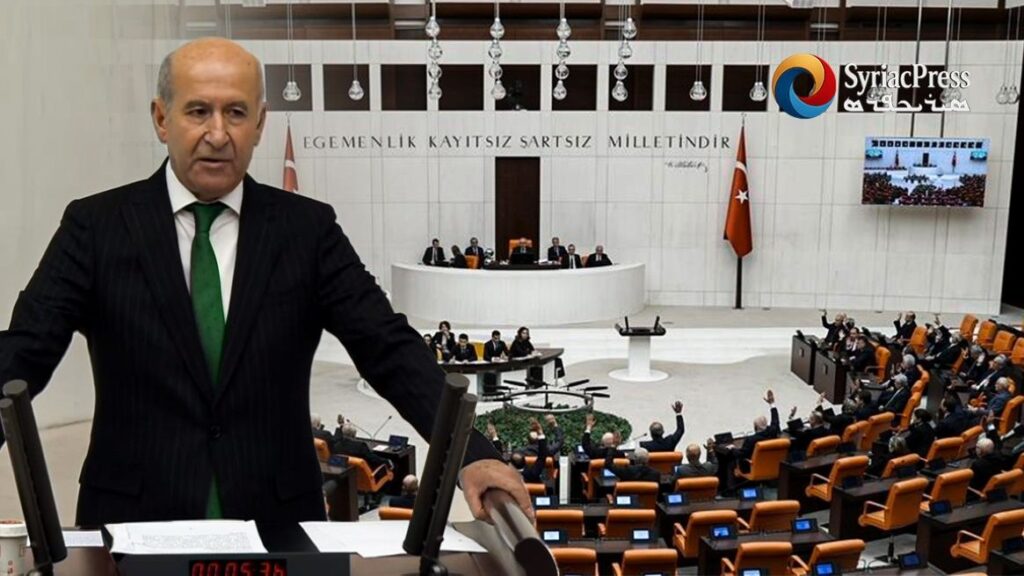
ANKARA — Syriac member of Turkish Parliament George Aryo has introduced legislation that would designate 25 December, Christmas Day, as an official public holiday, Armenian newspaper Agos Gazetesi reports. Aryo cites the country’s multicultural heritage and the principle of equal citizenship as fundamental reasons for declaring Christmas as an official holiday.
George Aryo (state-imposed Turkish surname Aslan) is a lawmaker for the DEM Party and represents the southeastern province of Merde (Mardin). He submitted his proposal to the Grand National Assembly of Turkey (TBMM) this week. The bill seeks to amend Turkey’s Law on National and General Holidays to formally recognize Christmas, which commemorates the birth of Jesus Christ and is one of Christianity’s most significant religious observances.
Turkey’s official calendar currently recognizes Islamic religious holidays, including Eid al-Fitr, and Eid al-Adha, as nationwide public holidays. No Christian religious holiday, however, is observed at the national level, despite the presence of historic Christian communities in the country.
In the proposal’s explanatory memorandum, Aryo emphasized Turkey’s long-standing identity as a country shaped by multiple faiths and cultures. He argued that policies adopted since the founding of the Republic in 1923 have weakened that pluralistic character.
“Populations that once numbered in the millions, including Greek, Armenian, and Syriac Christian communities, have declined to fewer than one hundred thousand today,” the justification stated, referring to demographic shifts over the past century driven by migration, political upheaval, and social pressure.
Christians today are estimated to make up less than one percent of Turkey’s population, concentrated mainly in Istanbul and parts of southeastern Anatolia, including Merde, a province historically known for its religious diversity.
Aryo also pointed to Turkey’s central role in early Christian history. He cited Antakya (Antioch), where followers of Jesus were first called Christians, and İznik (ancient Nicaea), where the First Ecumenical Council convened in 325 A.D., laying foundational doctrines of the faith.
The proposal argues that recognizing Christmas as a public holiday would be a symbolic step toward strengthening the sense of belonging among Christian citizens and reinforcing the principle of equal citizenship enshrined in Turkey’s constitution.
In support of the measure, Aryo noted that Christmas is officially recognized as a public holiday in several countries where Muslims make up the majority of the population, including Iraq, Syria, Lebanon, Jordan, and Egypt. Adopting a similar policy in Turkey would align the country with regional practices without undermining social cohesion.
If approved, the bill would add “December 25 – Christmas Day” to Turkey’s official list of national and public holidays, making it a nationwide day off.
The proposal faces long odds in a Parliament dominated by President Recep Tayyip Erdogan’s Justice and Development Party (AKP), which has not publicly commented on the measure. Still, its introduction has revived broader debates over religious pluralism, underrepresented peoples’ rights, and the symbolic role of public holidays in shaping national identity.
For Turkey’s remaining Christian communities, including Syriacs (Arameans-Assyrians-Chaldeans), Armenians, and Greeks (Rum), the proposal represents a rare moment of visibility in the country’s legislative agenda, even as its political fate remains uncertain.