
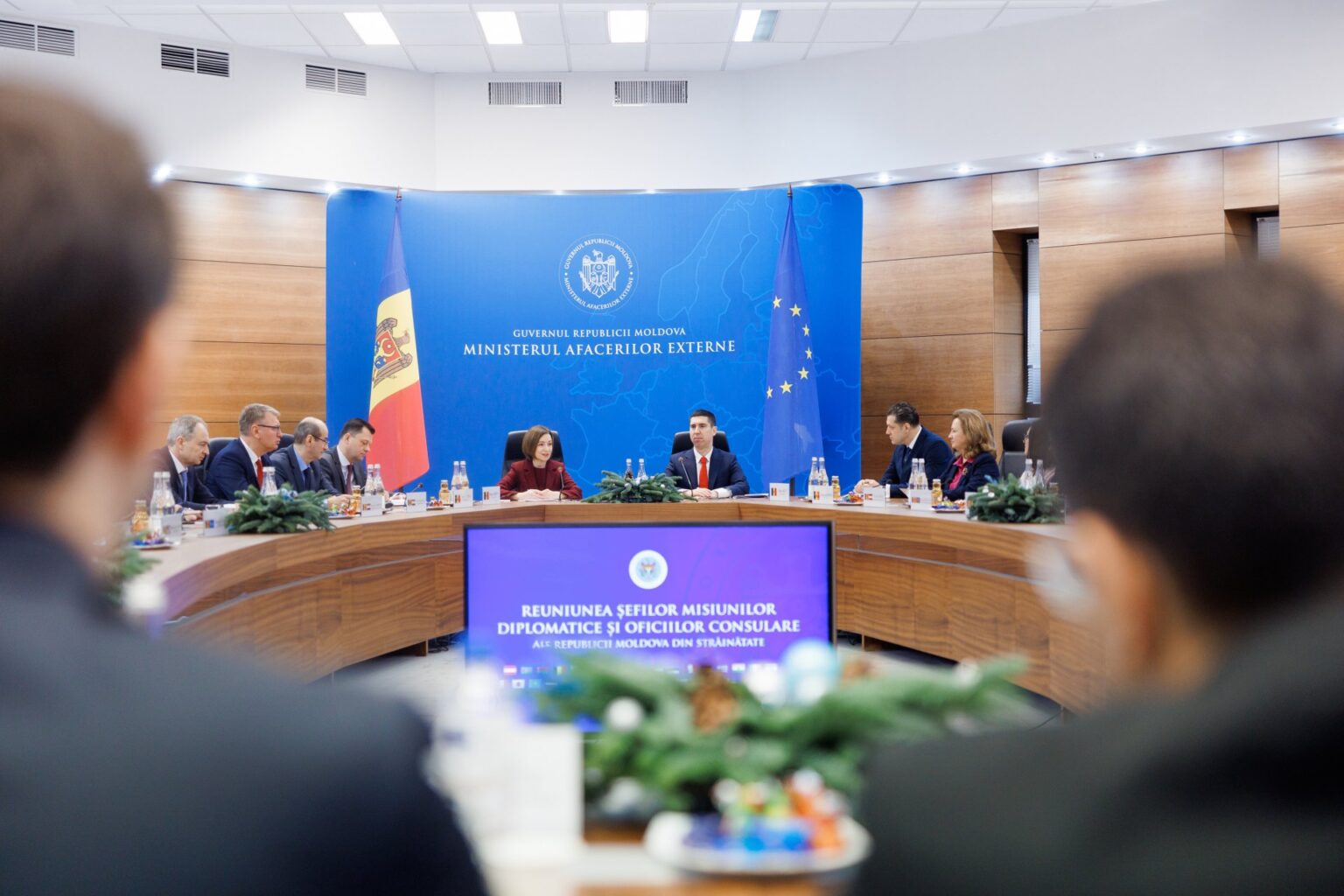
There is only one realistic strategy for survival as a democratic, free, and sovereign state for Moldova: joining the European Union. This objective is an absolute priority of the domestic and foreign policy, especially given the regional and international context marked by the intensification of hybrid threats, which stays complex. President Maia Sandu has made statements to this effect. She emphasized the main directions of foreign policy for the year 2026 at the annual meeting of ambassadors.
The head of state highlighted that Moldova was at a crossroads, where actions in the coming years will define the country’s future for decades. She urged Moldovan diplomacy to act with responsibility, determination and unity, in the national interest, in order to firmly advance the strategic objective of Moldova joining the European Union.
Thus, Maia Sandu stressed the need of intensifying political dialogue, strategic communication and actively promoting Moldova’s interests and image in European Union member states.
At the same time, special emphasis was put on relations with Moldova’s neighbors. According to a press release by the presidential institution, Maia Sandu reiterated that Romania remained the country’s number one strategic partner and the main supporter of the European path, energy security, economic development and connectivity with the European Union. Additionally, the head of state reaffirmed firm and constant support for Ukraine, stressing that Ukraine’s resilience is crucial for Moldova’s security.
The Moldovan president also referred to the necessity of deepening the bilateral relations with important partners, such as the United States, Canada, Japan, the United Kingdom, Norway, Switzerland and Turkey. Moreover, Moldova will continue to develop economic cooperation with countries in the Middle East, as well as with China.
Partnerships are to be strengthened in the extended neighborhood, including with the Western Balkan countries, which share with Moldova the aspiration to join the European Union. At the same time, economic cooperation is to be expanded in the Caucasus and Central Asia, especially in the context of opening the Moldovan embassy in Astana, Kazakhstan’s capital.
The head of state also addressed the role of the Diaspora as an important pillar of foreign policy. She highlighted the responsibility of diplomatic missions to actively support the Diaspora, including by improving the processes of issuing and renewing documents, modernizing consular services and expanding access to services for citizens.
For his part, Deputy Prime Minister, Foreign Affairs Minister Mihai Popsoi emphasized the role of diplomacy in promoting Moldova’s interests and strengthening cooperation with foreign partners.
“Even in a complicated international context, our country has proved that it can advance. We have political stability, reliable partners and real opportunities that we need to capitalize on together, through active, coherent and result-oriented diplomacy,” noted the deputy prime minister.
The annual meeting of the heads of Moldovan diplomatic missions and consular offices from abroad provides a framework for analyzing regional and global developments, strengthening interinstitutional coordination and setting action priorities for diplomatic missions and consular offices for the upcoming period, with an emphasis on advancing Moldova’s European path, the country’s security, and economic development.