
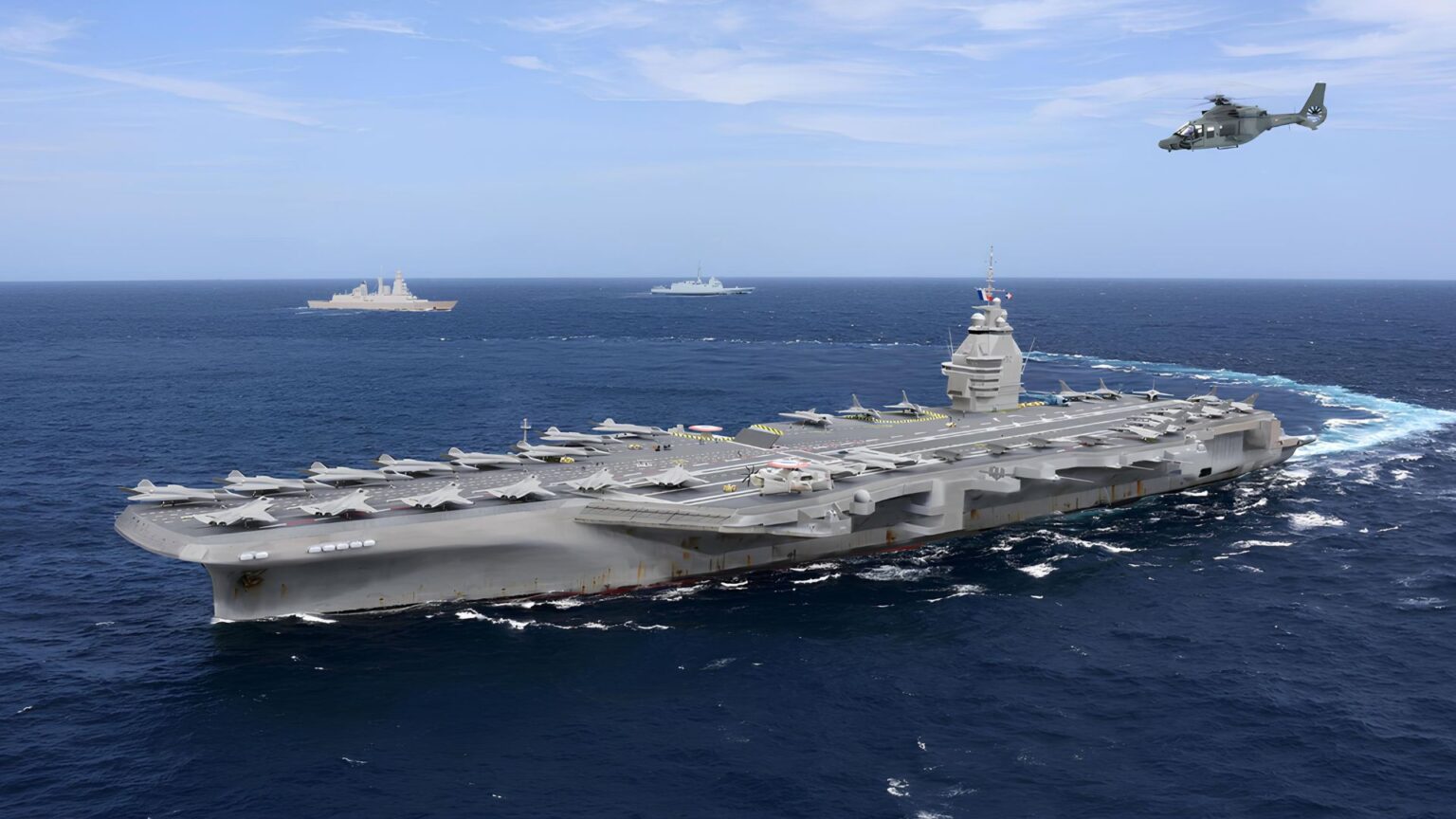
France has formally confirmed plans to build a new, larger nuclear-powered aircraft carrier to replace its ageing flagship Charles de Gaulle, marking one of the most significant naval investments in Europe in decades. President Emmanuel Macron announced the decision while addressing French troops stationed in Abu Dhabi, emphasizing the vessel’s role in France’s long-term maritime power projection and nuclear deterrence.
The new carrier, known as the Porte-Avions Nouvelle Génération (PANG), is expected to cost around €10.25 billion ($12 billion) and enter operational service by 2038, when the Charles de Gaulle is scheduled to retire. The French government has already begun work on nuclear propulsion components, with the final procurement decision to be approved under the 2025 defence budget.
If completed as planned, the PANG would become the largest warship ever built in Europe and secure France’s status as the European Union’s only nuclear-armed state operating a nuclear-powered aircraft carrier.
Macron’s announcement and strategic context
Macron announced during a visit to a French military base in Abu Dhabi, located near the Strait of Hormuz, one of the world’s most critical chokepoints for global oil flows. Speaking to deployed personnel, Macron said the decision to launch the programme had been taken “this week”. It highlighted its importance for strengthening France’s industrial base, particularly small and medium-sized enterprises.
According to Reuters, the new carrier is central to France’s broader defence posture at a time of heightened geopolitical uncertainty, including Russia’s ongoing war in Ukraine and growing debate in Europe over reliance on the United States for security.
Macron’s remarks came amid renewed discussions of European strategic autonomy, especially amid U.S. President Donald Trump’s reluctance to shoulder Europe’s long-term security commitments.
Despite these strategic arguments, the project has drawn criticism at home. Some lawmakers from the political centre and moderate left have questioned whether the programme should be delayed due to France’s strained public finances.
Design, capabilities, and industrial choices
Further technical details of the PANG programme have emerged from defence reporting cited by Global Times and Paris-based defence outlet Naval News. The carrier’s design was approved to enter a two-phase development process in December 2020, with four years of work resulting in a significantly larger vessel than its predecessor.
The new carrier is expected to displace approximately 78,000 tonnes, nearly double the 42,000-tonne displacement of the Charles de Gaulle. It would measure about 310 metres in length with a beam of roughly 90 metres and feature a fully electrified ship-wide power system.
Planned capabilities include a single integrated island superstructure, three electromagnetic aircraft launch tracks, a three-wire advanced arrestor gear system, two hangars, and two deck-edge aircraft elevators positioned on the starboard side.
France will also procure the electromagnetic catapult systems from the United States, stating that domestic production would not align with France’s schedule or cost constraints. China has recently developed its own electromagnetic catapult technology, but French officials have ruled out indigenous alternatives for this programme.
The air wing is expected to consist of around 30 combat aircraft or unmanned combat air vehicles, supported by E-2D Hawkeye early-warning aircraft and helicopters. The carrier is planned to operate Rafale M fighters upgraded to the F5 standard.
France and the global carrier scene
France is currently one of only six countries operating fixed-wing aircraft carriers capable of launching and recovering fighter jets at sea. The United States leads with 11 nuclear-powered carriers, while China operates three, including its newest electromagnetic-catapult-equipped Fujian.
India operates two STOBAR-configured carriers, the United Kingdom maintains two STOVL carriers, and Russia nominally operates the Admiral Kuznetsov, though its operational future remains uncertain.
A Chinese military affairs expert cited by Global Times noted that the PANG could address propulsion limitations on the Charles de Gaulle and significantly enhance France’s carrier capabilities. However, he also observed that while the Rafale M remains operationally viable, it would not represent a fifth- or sixth-generation fighter by the time the new carrier enters service.
Construction of the PANG is expected to begin in 2032 at Chantiers de l’Atlantique in Saint-Nazaire, with the ship transferring to Toulon in the mid-2030s for final outfitting, nuclear fueling, and sea trials ahead of its planned 2038 commissioning.
Kaif Shaikh is a journalist and writer passionate about turning complex information into clear, impactful stories. His writing covers technology, sustainability, geopolitics, and occasionally fiction. A graduate in Journalism and Mass Communication, his work has appeared in the Times of India and beyond. After a near-fatal experience, Kaif began seeing both stories and silences differently. Outside work, he juggles far too many projects and passions, but always makes time to read, reflect, and hold onto the thread of wonder.