
Despite a serious crisis of political governance, Montenegro is moving closer to the European Union (EU) with the help of Brussels. Montenegro’s rapid accession means that pressure on Serbia, which is lagging behind in the process, will consequently increase. This is why Aleksandar Vučić and Andrija Mandić are nervous, as it will be increasingly difficult for them to divert Montenegro from the EU path.
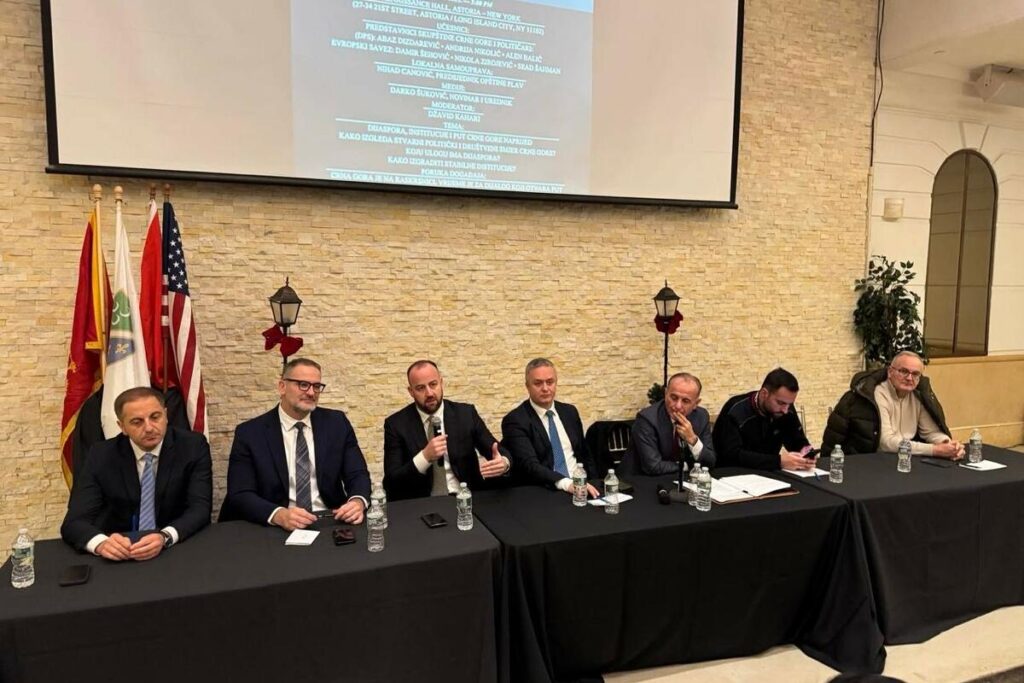
This was stated by the head of the parliamentary group of the Democratic Party of Socialists (DPS), Andrija Nikolić, who, together with the party’s vice president Abaz Dizdarević and member of the DPS Presidency, Alen Balić, participated in the roundtable “Quo vadis Montenegro?” in New York.
“Certainly, in the coming year, which will be crucial for Montenegro’s EU path, we should expect the heating up of new topics with the idea of undermining our EU membership,” Nikolić assessed.
The party announced that he, Dizdarević and Balić, along with other participants and people from the diaspora at the event, discussed the real social and political direction of Montenegro and the role and importance of the diaspora and emigrants in preserving the civic concept of Montenegrin society, as well as the economic development of the country, especially in the north.
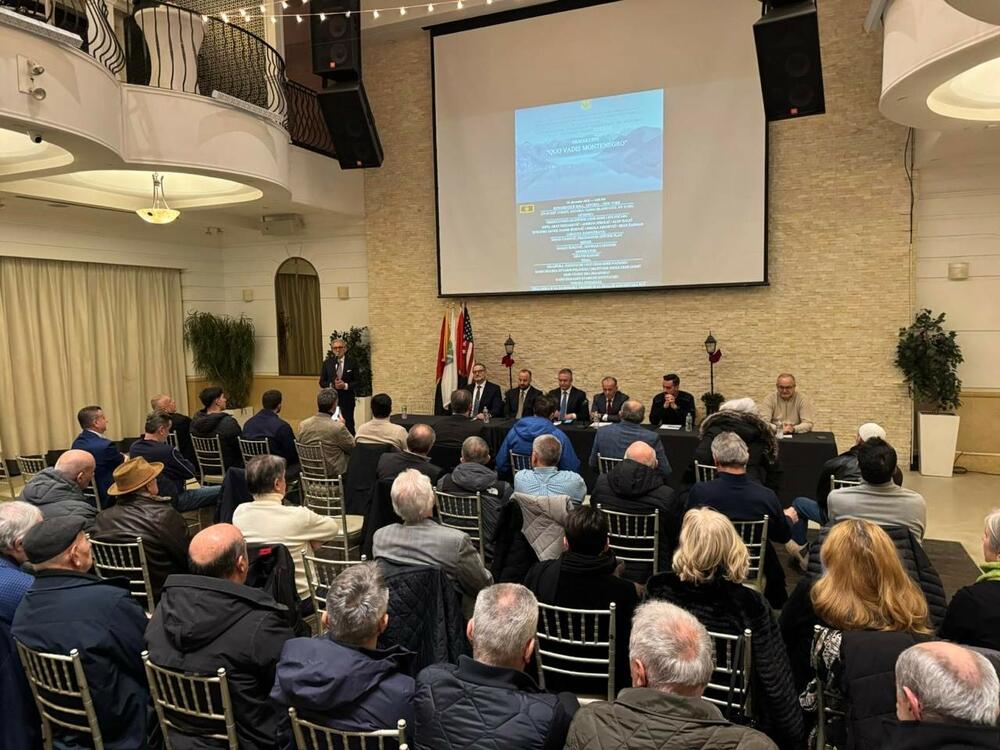
photo: DPS
Responding to the question of where Montenegro is heading, and whether we are closer to the EU or the “Serbian world”, Nikolić replied that Brussels is today accelerating the EU enlargement policy under the pressure of geopolitical crises and that Montenegro “with all its internal problems” is using that momentum.
According to Nikolić, Montenegro’s accession to the EU is a low-risk move with a high impact, which would show that the Union can strengthen confidence in its leadership in uncertain geopolitical times, but also prevent the region from being misused by other powers, which would use it as leverage against the EU.
The great ignorance, historical revisionism and the attack on the civic character that Montenegrin society faces remain the biggest challenges for Montenegro, Dizdarević told the audience. He also believes that few of those who voted for the changes on August 30, 2020 are satisfied with how Montenegro looks half a decade later.
“Today, many pretend not to see the institutional debacle of a state that cannot arrest the monument to war criminal and Hitler medal winner Pavle Đurišić, or the abuse of the repressive apparatus against people who protested at Vila Gorica over the humiliation of the Thirteenth of July Award. That is why we claim that the government is abusing the European integration process, and depriving it of its essence, because despite the formal rapprochement with Brussels, the country is in democratic regression,” Dizdarević pointed out.
Balić assessed that Montenegro has ceased to be a country in which there is “some minimum of respect for knowledge” and that most of the parliamentary majority’s attention is focused on the division of political spoils, nepotism, and partitocracy.
“Wages have increased. But prices have increased even more. We have lost five years, and there is no development. There are no investors, but also no ideas. Projects in the north have also stopped. There is no active approach towards the diaspora, which brings over 500 million euros into Montenegro every year. We need your knowledge, experience and investments. If you succeeded in New York, why couldn’t you do it in Montenegro,” concluded Balić, who is also the president of the Plav Municipal Assembly.
Dizdarević, Nikolić and Balić told the gathered representatives and supporters of the Gusinje Foundation in New York, as well as other guests, that all those who mean well to Montenegro must constantly insist on the values that are the foundation of its modern development – anti-fascism, the civic character of society and multiethnic democracy, with special emphasis on the fact that the future of cooperation between Montenegro and its diaspora should be dedicated to building knowledge, exchanging experiences, joint planning of elites and building institutions, i.e. what is coming tomorrow, the statement reads.

News