

Source and other data: Fertility intentions – Istat
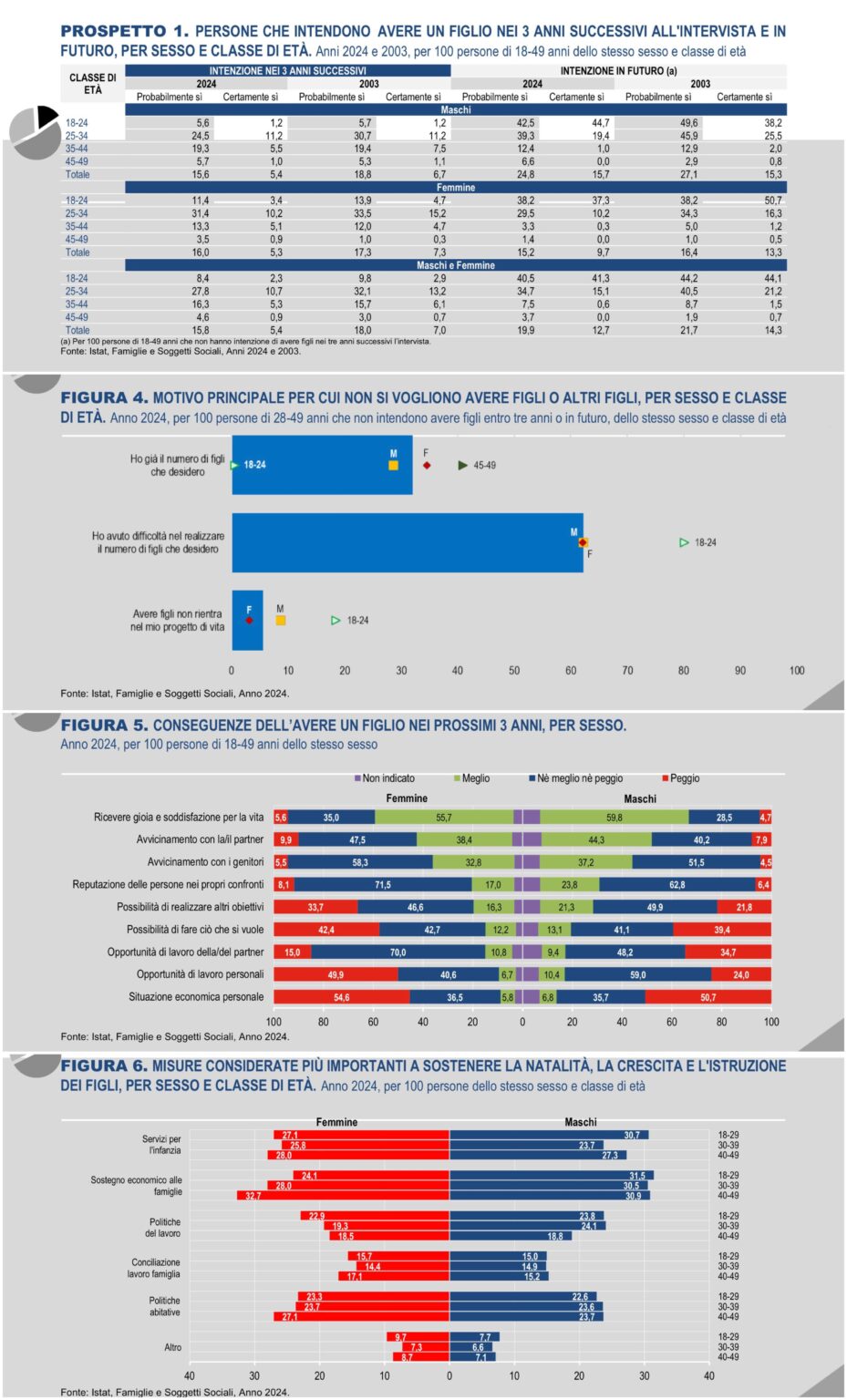
In 2024, only 21.2% of people between 18 and 49 intend to have a child (certainly or probably) in the next three years (it was 25.0% in 2003).
Over 10.5 million people do not want to have children or more children either in the three years following the interview or in the future. A third cite economic reasons as the origin of their choice, 9.4% cite inadequate working conditions and 8.6% lack of a partner.
Half of women think that the arrival of a child will worsen their job opportunities (among 18-24 year olds over 65%), while 59.0% of men do not expect it to affect them.
28.5% indicate economic support measures as a priority for the birth rate, followed by childcare services (26.1%) and housing benefits (23.1%).
Less than half of women who wanted a child in 2016 managed to have one in the following three years.
For several decades, Italy has been going through an important demographic transformation marked by a constant decline in births (1.18 children per woman in 2024, it was 1.29 in 2003). More and more often, in fact, young people choose to postpone or give up the project of building a family with children, amidst economic uncertainties, job insecurity and changes in life models.
In a context in which the majority of people of childbearing age use contraceptive methods to control births (65.1% among 15-49 year olds), reproductive intentions provide important indications about the potential for future fertility in the short and medium term and their analysis can help guide policies regarding birth support.
Over a fifth think about having a child within three years, a third postpone it, but want one in the future
In 2024, 21.2% of 18-49 year olds, around 4.5 million people, intend to have a child in the three years following the interview. Where it is not otherwise indicated, when we write “intends to have a child” we are referring both to people who declare that they “certainly” want it and to those who express the same intention but only “probably”. The same can be said, conversely, in the case of those who say they don’t want children. In both cases we are referring, overall, to people who may or may not have already had children.
This value is lower than that observed in 2003, when it was equal to 25.0%; Contributing to this decline, over the course of more than twenty years, is the increase in the share of 45-49 year olds (from 14.7% in 2003 to 19.9% in 2024), people who are now close to the end of the reproductive period or who, in most cases, have already achieved their fertility plans. On the other hand, 74.2% do not want a child in the following three years (71.2% in 2003). The remaining share (4.7%) refers to people who do not provide information on their fertility intentions.
A third of those who do not intend to have children within three years, equal to 5.2 million people, still say they want to have children after that time horizon (32.6%); this is a value more than 3 percentage points lower than that recorded in 2003 (36.0%) (Table 1).
In 2024, the overall share of men and women who show positive intentions within three years are completely similar; higher percentages are observed between 25 and 34 years (38.5%) and between 35 and 44 years (21.6%), phases of life in which it is more frequent for people to start planning the birth of children or trying to achieve the desired family size.
Among men with at least one child, the highest share of those who want another
Among those who already have a child, around a third of men and just over a quarter of women report wanting another in the three years following the interview (32.4% and 26.0% respectively), demonstrating their intention to continue or complete their reproductive plan.
If you don’t have children, however, the share of those who say they want them within three years drops significantly for men (23.6%), while it grows for women (29.7%); finally, if you have already had at least two children, these percentages are considerably reduced for both sexes (5.8% of men and 4.2% of women).
The vast majority of 18-24 year olds want to have children in the future
Almost 90% of 18-24 year olds do not intend to procreate within three years, most likely linking this choice to the desire to complete their study and training path; among these, however, the great majority (81.8%) express the desire to have a child in the future (almost 3 million people).
In particular, for boys the share is equal to 87.2% (44.7% say they are certain), while for girls the value stops at 75.5% (37.3% say they are certain). The 45-49 year olds who don’t want a child within three years take opposite positions; group in which there are more individuals who have already achieved their reproductive plan: 95.0% do not intend to have children in the future, and even more among women (96.9%), now close to the end of the fertile period.
Just under 5 million people, almost 60% of those who have not had children and do not intend to have children in three years, would like to have them in the future. In particular, it is men without children who see themselves as fathers in the long term (62.6% and a quarter express certain intentions), while among those who have already had one or at least two children the percentages of those who do not intend to have more are very high (92.4% and 97.0% respectively).
https://i.redd.it/db6lceq6is8g1.jpeg
Posted by sr_local
10 Comments
L’acqua bolle a 100 gradi.
Sinceramente, con la destra che vince un po’ ovunque nel mondo, la crisi climatica messa da parte in nome del profitto di pochi, guerre e genocidi io tifo l’estinzione. Non ci meritiamo niente
Io almeno un figlio lo vorrei anche, solo che è complicato trovare una donna disposta a fornire metà del patrimonio genetico e mettere a disposizione il suo utero per consentire l’ontogenesi di tale figlio.
Mi sembra un’analisi superficiale, sopratutto la questione “servizi all’infanzia”.
Il problema non è che mancano i nidi (opinabile, ma ok), ma che il nido funziona dalle 8:30-9 alle 17:00, mentre il lavoro full time funziona dalle 9-18 più il tempo di spostamento. E via cosi fino alle medie-superiori, che finiscono alle 13-14.
Ha senso fare figli da parcheggiare al nido e ritirare nelle tue 2-3 ore extra lavoro?
Il grosso punto non-detto è che nella società moderna è molto più attraente per entrambi i sessi fare carriera e realizzarsi rispetto che passare la giornata a casa con i bambini. In italia a questo si aggiunge il fatto che la scelta è anche obbligata dai bassi stipendi.
Si gode abbastanza.
Credo che lavoro e situazione economica siano delle bugie che raccontiamo a noi stessi per buttare fuori delle colpe che non ci sono.
Ci sono paesi che se la passano molto, molto meglio dell’Italia sia in termini di PIL che di stipendio medio dell’individuo ma che **non** stanno facendo meglio dal punto di vista demografico e di natalità. Quindi la questione economica può essere un fattore ma sicuramente non è l’unico in gioco.
I figli sono sempre un sacrificio. Sia che guadagni 1500€/mese sia che guadagni 5000€/mese l’investimento di tempo ed energie resta lo stesso e questo investimento è più sentito della questione economica. I soldi vanno e vengono, il tempo no. Poi c’è la perdita di libertà, ovviamente. Il mondo moderno è costruito come un parco giochi per persone single e la presenza di un figlio ti obbliga a riscrivere tutto, dalle attività del weekend alle vacanze alla cena che cucini a casa.
Molte persone, me compreso, non vogliono fare questo sacrificio.
Stasera mi sollazzerò pensando a questo dato, potrebbe essere il mio regalo di natale
Una cosa di cui non parlano tanto è che bisogna rendersi conto che un tasso di natalità di 1 figlio per donna non significa necessariamente che una donna fa un figlio. È assai più probabile che una donna decide di fare 4 figli, mentre 3 donne ne fanno 0.
Al di là del fattore economico, è più improbabile pensare alla famiglia se nessuno della nostra cerchia di amici/parenti fa amici, quindi è un fatto altrettanto preoccupante che ci siano molte persone che ne fanno 0. Avete presente tutta la campagna pubblicitaria fatta in Cina per far credere alle persone che avere un solo figlio era la cosa migliore. Ecco è più o meno la stessa cosa, solo che nel nostro caso succede spontaneamente senza che nessuno ci obblighi a pensarlo.
Interessante vedere che il motivo principale è “è difficile averne”
questa storia di definire l’egoismo come la causa di tutti i mali è odiosa e molto superficiale. La gente non fa figli perchè spesso il lavoro è asfissiante in tutti i sensi possibil (potremmo aprire un capitolo lungo quanto la divina commedia) e un singolo stipendio solo non è abbastanza per sostenere spese di affitto-mutuo e tutto il resto. Finiamola di parlare di egoismo, perchè è come i vecchi che dicono “EEEE i cciovani non vogliono lavowawe”