

The excavation, carried out over 14 months by the Cantonal Archaeology Department, revealed buildings with distinct Roman architectural features and evidence of intense commercial and administrative activity. Experts now believe the site was intended as a multifunctional center linked to the nearby Roman legion in Vindonissa, but the city it was meant to support was never built.
Located in Gebenstorf, the site was designed with clear strategic and political ambitions. According to a translated statement from Kanton Aargau, the structures uncovered—built directly along the riverbank—were more than just temporary or residential. The team found three major buildings, each with features associated with Roman civic and economic infrastructure, suggesting the area was on the verge of becoming a significant administrative center in the Roman province.
Roman-style Architecture And Military Construction
The layout and construction of the site demonstrate Roman precision and intent. One of the uncovered buildings featured a double-aisled portico with columned walkways—an element typical of Roman public spaces. Another building included a sunken hall, a design commonly found in Roman forums, used for markets and gatherings.
 Visualization of the Roman building complex – © Cantonal Archaeology / Canton of Aargau
The easternmost structure differed significantly from the others. It was larger and more complex, with courtyards, corridors, entrances, and multiple interior rooms. This architectural contrast indicates a diverse range of administrative functions intended for the site. According to Popular Mechanics, the entire complex is believed to have been constructed by the 11th Legion, a Roman military unit stationed nearby, underscoring the high level of planning behind the operation.
The Cantonal Archaeology Department confirmed that the configuration of these buildings aligns with what would be expected of a central Roman administrative facility. Despite the substantial investment in infrastructure, the full urban settlement meant to accompany it was never established.
Trade And Daily Life Through Unearthed Artifacts
The team recovered over 1,600 artifacts, offering insight into both the economic and everyday aspects of life at the early stage of the settlement. Among them were 137 coins, specialized weights, a stylus, and a folding ruler—all tools associated with record-keeping and commercial activity.
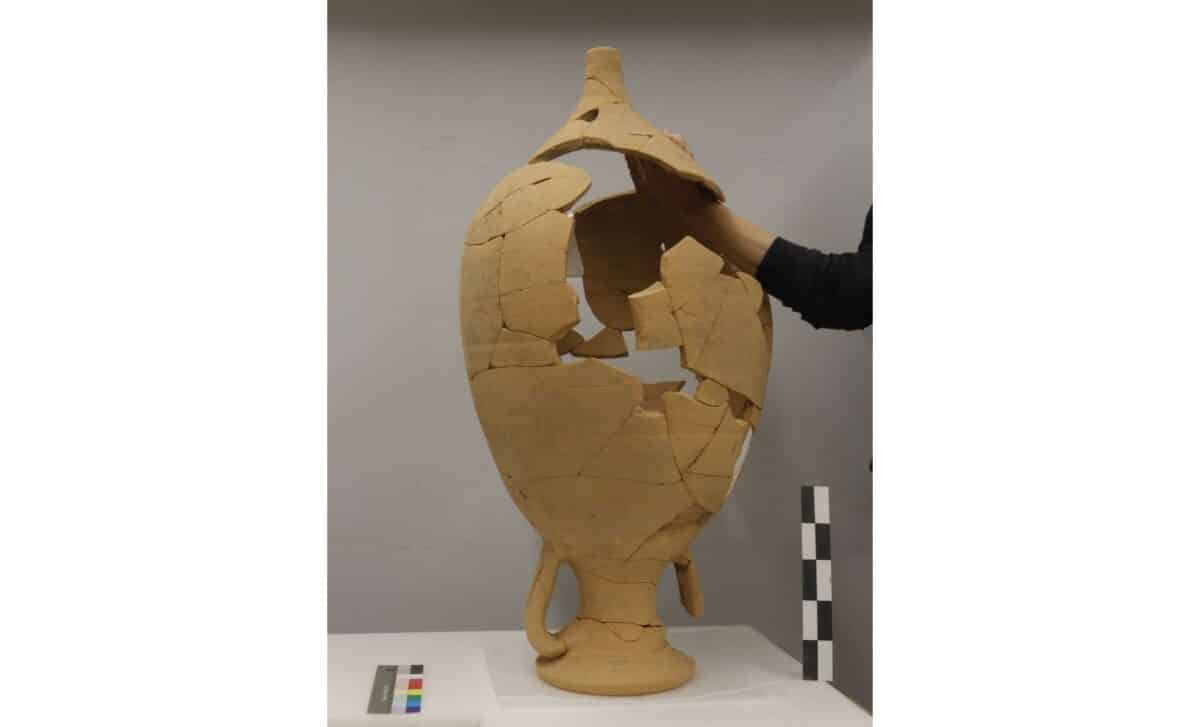
The fragmented amphora in the restoration laboratory – © Cantonal Archaeology Department / Canton of Aargau
In addition to administrative objects, the excavation also revealed evidence of domestic life. The most notable find was a fully intact amphora, which stood out among the many shards of broken pottery. The vessel was sent to the University of Basel for preservation, where researchers examined its contents: grey-white sediment filled with tiny fish bones and scales.
According to the Institute for Integrative Prehistoric and Natural Science Archaeology, these remains came from the Atlantic sardine, confirming that the amphora once contained liquid fish sauce, a staple in Roman cuisine. This is the first documented discovery of sardines in Roman-era Switzerland, highlighting the reach of Roman trade networks and culinary preferences.
Tracing The Origins Of Roman Fish Sauce In Switzerland
The analysis of the amphora has provided rare information on Roman food trade and long-distance transport. Researchers believe the vessel was produced on the coast of the Roman province of Baetica, in present-day Andalusia, Spain. Another possible origin is Lyon, in modern-day France. Based on the content and ceramic analysis, the amphora and its fish sauce were likely manufactured and transported between 25 and 50 C.E.
 Silicate fish bones from the sediments contained in the amphora – © University of Basel
Fish sauce, or garum, was widely used across the Roman Empire and stored in amphorae for trade. Romans were among the first civilizations to systematically process and preserve marine resources, building large saltworks and fermentation facilities. Small fish were allowed to ferment, and the resulting liquid sauce was bottled and exported throughout the empire. The presence of such an item in Gebenstorf signals the site’s integration into wider commercial networks, even at its early stage of development.
Any established Roman administrative center would have required storehouses for goods like fish sauce, and the discovery at the Limmat River site points to that readiness.
A City Planned, But Never Realized
Despite clear signs of structured development and a functional infrastructure, the city planned along the Limmat River never came into existence. Buildings were constructed, goods had begun to circulate, and specialized tools were already in use—but the broader urban expansion never took place.
No explanation has been confirmed for the project’s abandonment. The archaeological team has not linked the halt to conflict, natural disaster, or resource shortages. The site remains as it was found: a promising Roman initiative frozen in time.statem
The Cantonal Archaeology Department has also produced a documentary detailing the excavation and findings, bringing wider attention to this overlooked chapter of Roman history in Switzerland.