
In part one of this series on the top ten social issues in mainline Protestant sermons for 2024-25, we noted that preaching about racism, economics, and environment topped the list. This article examines these topics in more detail, noting the ways in which political divides, demographics, and local contexts factored into the complexities of addressing these issues. We offer suggestions for addressing these intersections in sermons.
By Leah D. Schade, with Amanda Wilson-Harper and Wayne Thompson
 Preaching about racism, economics, and environment is interconnected. Photo by Sean Lee on Usplash, https://unsplash.com/photos/people-gathering-on-street-during-daytime-ghBXLhdzhE8
How We Gathered Data on Preaching about Racism, Economics, and Environment
My colleagues, Amanda Wilson Harper (Tarleton State University) and Wayne Thompson (Concordia University) and I have surveyed thousands of preachers across four survey waves in the last eight years. We’ve collected more than 7,000 responses from clergy in all fifty states and across denominations such as ELCA Lutheran, United Methodist, Presbyterian-USA, Disciples of Christ, Episcopal, and United Church of Christ. We recruited respondents through surveys sent to denominational leaders, seminaries, and social media platforms. Respondents were anonymous.*
This repeated cross-sectional study allows us to examine clergy attitudes and experiences with preaching on social issues. In the 2025 study conducted during the first 100 days of the second Trump administration, respondents consisted of 1,017 mainline Protestant clergy serving U.S. congregations. Control variables incorporated into the analysis included gender, racial identity, political identity, and levels of congregational support, all assessed as factors in preaching about contested issues.
Respondents indicated which contemporary issues they addressed in a sermon in the previous twelve months, choosing from a list of 22 topics. Issues ranged from addictions to domestic violence, interfaith relations, and mental health. The data included both fixed-choice items and open-ended comments.
Preaching about Racism, Economics, and Environment – Top Three Issues in 2024, 25
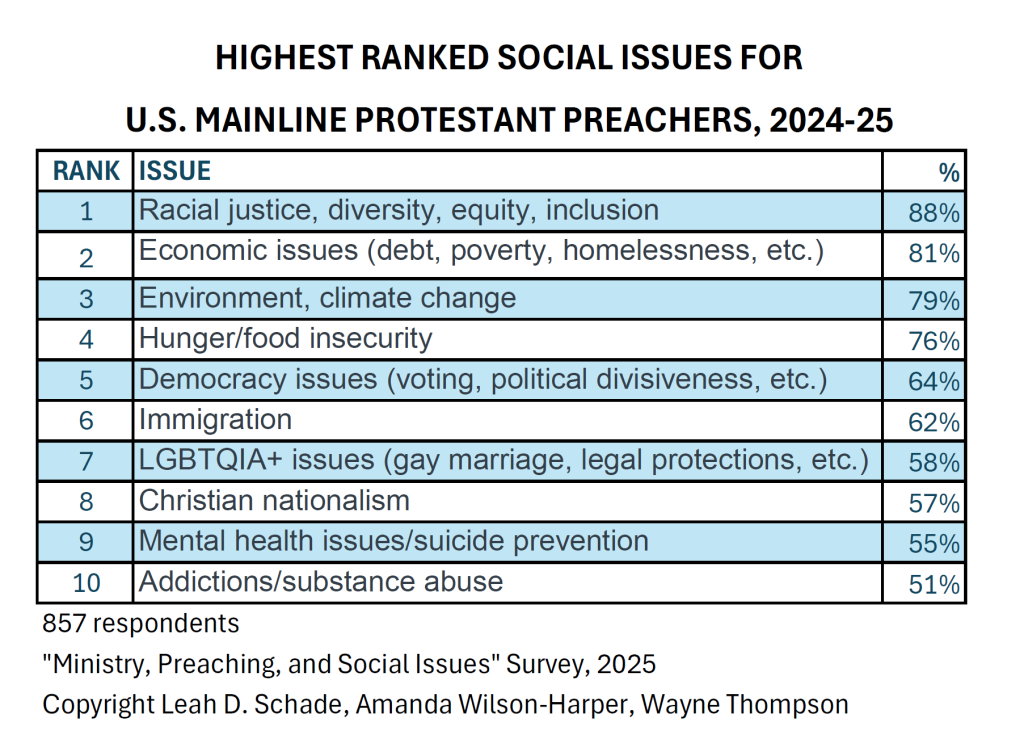 Top Ten Social Issues for Mainline Preachers, 2024-25
Here is what we learned when examining the responses on preaching about racism, economics, and environment.
Racism
In a previous study published in the edited volume Unmasking White Preaching, our team discovered that racial issues were the second-highest ranking topic among social issues addressed by preachers (69% in 2017 and 71% in 2021).[1]
However, certain factors correlated with greater hesitancy in addressing racism. White pastors, those serving congregations with fewer than 100 worship attendance, churches located in rural areas, and preachers new to their congregations were more hesitant to talk about racism. This group was twice as likely to refrain from addressing racism compared to their counterparts who had served four or more years, served in larger congregations (over 100 in weekly worship), and in were located in cities or suburbs.
In 2025, racism was the most frequent social issue addressed (88%), 16 percentage points higher than 2021. However, the same group of hesitancy factors persisted. In addition, lack of congregational leader support increased preachers’ silence on racism by ten percentage points.
Written comments revealed that preachers addressed racism primarily through theological and scriptural framing, practical expressions in worship, personal narratives, and local engagement. Consistent themes included advocacy for equality, inclusion, and compassion based on biblical teachings.
However, several responses showed hesitancy, indirect framing, or limitations due to context. For example, one respondent said they could only preach a general message about “supporting the equality of all people and acceptance of all,” while another said their message was about inclusion “but probably too generalized due to my current context.”
[See: The Church’s Racist Code of Silence: One Pastor’s Story.]
Economic issues and hunger/food insecurity
While the issue of hunger came in at #4 in the top ten, economic issues and hunger are strongly correlated, so we’ve paired them for this article. This is because nearly eight in ten preachers (78.5%) talked about both economic issues and hunger/food insecurity in their sermons in 2024-25.
Compared to the 2021 survey, economic issues edged up slightly from 76% to 81%. Hunger and food insecurity saw an increase from 62% to 76%.
Political and societal factors likely contributed to this heightened attention. Presidential policies enforcing tariffs, immigration crackdowns, and expansive tax-and-spending measures slowed economic growth, raised unemployment, spiked prices, and heightened stress for millions of Americans.
At the same time, billionaire wealth rose by about $2 trillion in 2025, reaching roughly $16.1 trillion across 3,028 individuals, according to Forbes and Gulf News. According to Common Dreams, the richest 0.001% now own three times more wealth than the poorest half of humanity combined.
This economic disparity hit many churches hard in 2025. Food bank lines increased while costs of doing ministry rose due to labor shortages and tariffs. Those serving immigrant populations saw decreased attendance and more demand for pastoral care. In short, the downstream effects of the upstream economic policies have been felt and voiced by parishioners and their pastors.
Those preachers who were less likely to address economic and hunger issues were Trump voters (59%) or politically conservative (58%). For all other respondents, factors such as gender, role in ministry, age, and geographic setting made little difference – the percentage remained at 70% or higher.
Given that passages about income inequality are woven throughout the Bible, preachers likely drew on teachings from the Hebrew prophets as well as Jesus and Paul in the New Testament. Wealth distribution, predatory landowners, taxes, and mutual aid are topics that have deep roots in scripture. Preachers find profound insights on the challenges of economic inequality and God’s mandate for caring for “the least of these” in the Bible’s historical narratives, wisdom literature, Gospels, and epistles.
[See: Their God is Their Gullet: Philippians 3:17-4:1.]
Environment
In 2025, nearly eight in ten respondents (79%) indicated that they had preached a sermon about caring for the environment or addressing climate change compared with five in ten in 2021.
We attribute the heightened attention to climate and environmental issues to three factors. One is the increase in catastrophic weather events. Another is the increasing number of congregations ministering to those affected by these disasters. Third is the growing number of people concerned about climate change.
Interestingly, few factors decreased preaching or teaching about environment below 70% in 2025. Those least likely were politically conservative (53%), associate/assistant/youth ministers (69%), and those in ministry less than four years (68%).
Common sermon themes centered on stewardship, caring for Creation, and special days such as Earth Day, Season of Creation, blessing of the animals, and Feast of St. Francis. However, many noted that they did not feel free to use the term “climate change” in the sermon itself and used more generalized language such as “caring for God’s Creation.” Others noted that environmental issues were mentioned more frequently in liturgical prayers than in sermons.
In a separate study of 97 faith leaders participating in the EcoPreacher Cohort that my team and I conducted this year, we found that preachers used several other themes and frameworks for ecological sermons as well. Spiritual practices in nature (65%), hope in the midst of the climate crisis (62%), ecological anxiety or grief (60%), and taking action on environmental issues (54%) polled highest.
[See: How to Preach a Sermon about Climate Change and Your Congregation.]
Preaching about Racism, Economics, and Environment – They’re All Connected
It’s not surprising that the issues of race, economic inequality, hunger, and environmental devastation topped the list of social issues for preachers in 2024-25. They are all connected. If you pull on the thread of racism, you tug on the economic policies that enforce white supremacy. At the same time, you also snag the reality of environmental redlining that locates polluting industries in Black communities.
Similarly, addressing the climate crisis connects to other social issues such as increased food insecurity due to drought and flooding, fossil fuel industries profiting from drilling and mining, and communities of color that bear the brunt of weather catastrophes.
[See: The Parable of the Talents Through the Lens of Race, Privilege & Wealth.]
Intersectionality in Preaching About Social Issues
In other words, preaching about racism, economics, and environment requires attention to intersectionality. Intersectionality is a term coined by Kimberlé Crenshaw in 1989. The term emphasizes the interconnectedness of various aspects of an individual’s social identity and how these intersect to shape experiences and opportunities.
For preachers, attention to the complexities of intersectionality can be a challenge within a 15-minute sermon. However, there are several approaches and tactics for incorporating intersectionality into sermons on social issues. These include:
- Drawing on biblical narratives such as Ruth or the Gospels to highlight how ethnicity, class, and power interact in the text. Then inviting hearers to notice similar intersections in their own communities.
- Naming multiple social locations in sermon illustrations.
- Avoiding single‑story characterizations of “the poor” or “Black people.”
- Including marginalized voices in the sermon as sources for biblical interpretation, contemporary issues, and illustrations.
- Pointing out how structures of racism, classism, and environmental exploitation intersect in the lives of hearers.
- Sharing long-form narratives that acknowledge concrete intersecting injustices.
[See: Race, Faith, and the Climate Movement: Interview with Rev. Lennox Yearwood, Jr.]
In sum, preachers can name specific intersecting injustices (for example, how racism and poverty combine in environmental harms) and connect these patterns to the biblical text’s vision of justice and community. This helps sermon listeners recognize that the testimonies and perspectives from people and communities at marginalized intersections are sources of theological insight and social critique. Such sermons can invite the congregation into creative visioning that inspires critical reflection and faithful action.
Coming next:
In the series’ next articles, we’ll explore preaching about the other top ten issues for preachers. Stay tuned for a piece on LGBTQIA, mental health, substance abuse followed by a post on democracy, Christian nationalism, and immigration.
We’ll conclude the series with an article on the “taboo topics” for preachers in 2026.
[1] Leah D. Schade, “Preaching about Race, Immigration, and White Privilege: 2017 v. 2021,” Unmasking White Preaching: Racial Hegemony, Resistance, and Possibilities in Homiletics (Postcolonial and Decolonial Studies in Religion and Theology), edited by Andrew Wymer and Liz Valle-Ruiz (Lexington Books, 2022).
*Note: The 2025 study was approved in a human ethics review by the Concordia University Wisconsin-Ann Arbor Institutional Review Board, #IRB-FY25-136. The 2017, 2021, and 2023 studies followed protocols for the study of human subjects.
Read also:
Top 10 Social Issues in Mainline Protestant Sermons, 2024-25
Survey Shows More Mainline Clergy Addressing Social Issues
Clergy Stress & Resilience in a Divided America: 2025 Survey
How to Handle Sermon Pushback on Social Justice Issues
 Leah D. Schade
The Rev. Dr. Leah D. Schade is a seminary professor and ordained minister. Her opinions are her own. Leah is the author of Preaching and Social Issues: Tools and Tactics for Empowering Your Prophetic Voice (Rowman & Littlefield, 2024), Preaching in the Purple Zone: Ministry in the Red-Blue Divide (Rowman & Littlefield, 2019) and Creation-Crisis Preaching: Ecology, Theology, and the Pulpit (Chalice Press, 2015). She is the co-editor of Rooted and Rising: Voices of Courage in a Time of Climate Crisis (Rowman & Littlefield, 2019). Her book, Introduction to Preaching: Scripture, Theology, and Sermon Preparation, was co-authored with Jerry L. Sumney and Emily Askew (Rowman & Littlefield, 2023).