
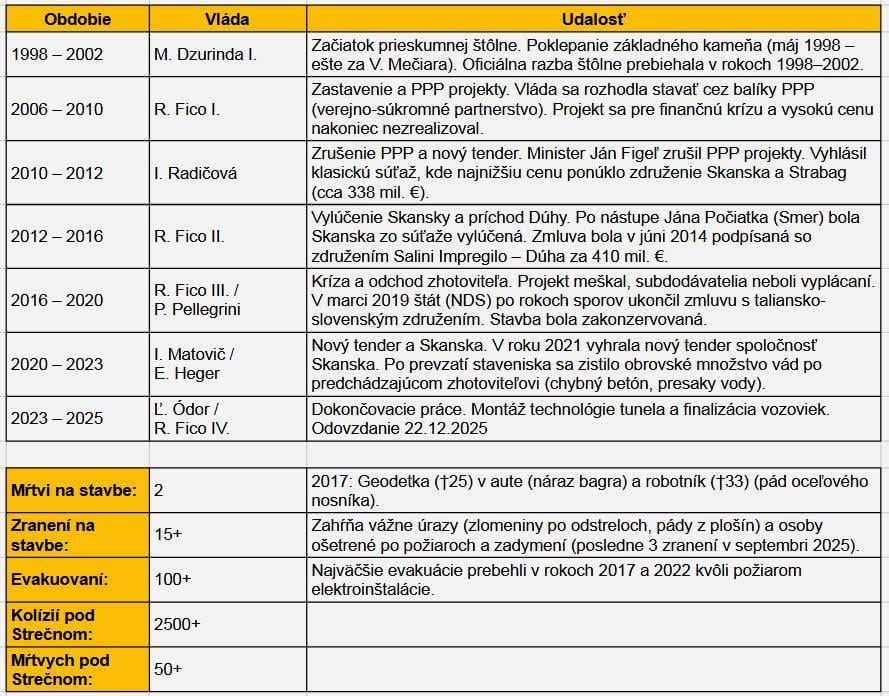
I would also like to add that in 2014, the Dúha company was third in the list in terms of price and had a worse reputation than Skanska.
The owner of the rainbow is Miroslav Remeta. He worked in the Istrokapital group, where Mario Hoffmann was his partner.
Below you can read a summary of Remet, Hoffmann, Istrokapitála and the companies Salini Impregilo (today Webuild) and Dúha as
Miroslav Remeta: Remeta’s company Dúha formed a consortium with the Italian Salini Impregilo, which did not complete the Višňové tunnel. The project was accompanied by delays, suspicions of poor quality work, and in 2019 the intervention of NAKA (“Tunnel” action) due to suspicions of economic criminal activity.
Non-payment of subcontractors: Dúha faced several bankruptcy filings by smaller companies who claimed the company owed them money for work on the Višňové project. Remeta repeatedly referred to these claims as “questionable” or “speculative”. According to Slovak laws, the court cannot declare bankruptcy if the claims are in dispute and their existence is not clearly proven. So children, document everything properly when you do something for the state.
Suspicion of tax fraud: The Criminal Office of the Financial Administration (KÚFS) previously investigated the Dúha company for suspicion of tax evasion and VAT fraud in the amount of more than 1.1 million euros. There have also been media reports that the investigation was suppressed for a certain period by influential people inside the financial administration.
Controversial property: He bought a villa under construction in Bratislava that originally belonged to the murdered underworld boss Petr Čongrády. The property was registered in the cadastre as MC REAL s.r.o. (formerly known as Čongrády’s firm, which Remeta controlled).
Contracts despite problems: Even after the fiasco with the Višňové tunnel, his companies continue to win state contracts. For example, in 2024 for the reconstruction of the building of the Ministry of Defense of the Slovak Republic, which raises questions about the effectiveness of the system for checking the reliability of state partners.
Mario Hoffmann: Caribbean corruption case (Turks and Caicos Islands): This is one of his biggest international cases. Hoffmann was suspected of corrupting local politicians in order to obtain land for a luxury resort. In 2012, an out-of-court settlement was reached in which Hoffmann agreed to pay millions of dollars and cease his activities on the islands, thus ending the criminal prosecution against him. In 2024, information appeared that the Slovak investigation into this case was definitively stopped as a result of an amendment to the Criminal Code
Slovakia Steel Mills: The company Hoffmann was associated with faced investigation for suspected credit fraud and falsification of financial results. The factory eventually ended up in bankruptcy
Istrokapital: Corruption in the Turks and Caicos Islands: This is the most serious case internationally, where Mário Hoffmann was suspected of bribing local government officials in order to obtain lucrative plots of land for development projects. In connection with this case, written evidence appeared in the British Parliament, which referred to Istrokapital as "gangster capital" from the era of post-Soviet privatization and also for a possible channel for money laundering from Russia. Hoffmann strongly denied these accusations, but the case ended with an out-of-court settlement and his departure from the islands
Organized crime links: British parliamentary documents have also claimed that Istrokapital has "the strongest ties to the underworld and is known for using the muscles of former Slovak secret service officers". These claims were also rejected by Hoffmann
Arbitration against Greece: Istrokapital, together with Poštová banka, led an international arbitration against Greece over the losses they incurred in the restructuring of the Greek sovereign debt in 2012. Although the tribunal ultimately decided that it did not have jurisdiction to hear the case, the effort to obtain compensation in the context of the Greek debt crisis was seen as controversial.
Non-transparent acquisition of assets: Istrokapital is suspected of having acquired great wealth thanks to political connections and non-transparent privatization deals, although direct evidence of judicial illegality is often insufficient
The company Salini Impregilo (today Webuild): In Slovakia and abroad, it faced several suspicions and legal disputes related to corruption, non-transparency and financial irregularities.
Višňové Tunnel: In December 2019, the National Criminal Agency (NAKA) carried out an enforcement action called “Tunnel”. The investigation concerned suspicions of economic criminal activity in connection with the construction of the section D1 Lietavská Lúčka – Višňové, which was not completed by the consortium led by Salini Impregilo
Financial imbalance: Suspicions appeared in the media mainly in connection with unpaid subcontractors, while it was discussed whether funds from the state were actually used for construction or withdrawn from the company
Allegations of tender-rigging (Italy): In March 2021, the CEO of Webuild (Pietro Salini) was accused of tender-rigging in connection with the construction of the “Terzo Valico” high-speed rail line in Italy
Strait of Messina Bridge Dispute (2025): Most recently, in October and December 2025, the Italian Court of Auditors blocked the construction of a gigantic bridge project in Sicily, which was to be carried out by a consortium led by Webuild. The court questioned the validity of the old tender from 2005, the discrepancy in the estimated costs (13.5 billion euros) and the possible violation of EU competition rules
Mafia infiltration: With major infrastructure projects in Italy, where Webuild operates, critics and environmental groups are repeatedly concerned about the possible infiltration of organized crime (mafia) into construction contracts.
International Arbitrations: The company is involved in long-running legal disputes with the governments of several countries, such as Argentina (where it won a $54 million arbitration award in April 2025 after years of concession disputes) and Panama (over the expansion of the Panama Canal).
But come on. It’s not that much text!
https://i.redd.it/jshcblsgju8g1.jpeg
Posted by trueSURO
5 Comments
Nj, pekne to deravý korčuliar prekrútil. Tu vidno, že Radičová len vybrala Skanska, ktorá to potom aj tak po čaptavých hranolovych firmách nakoniec musela dostavať.
[deleted]
Slovensku zial akutne chyba dlhodoba vizia, ktora ma vladny presah a absenciu rozkradania.
Mozno je to smiesne ale nam chyba desatrocia zakladna otazka: Kde chceme ako krajina byt?
Taketo vyznamne projekty by mali v idealnom Slovensku mat uplny konsenzus od lava do prava zhora dole.
Ale mozeme len snivat..
Načo Fico šáhne to poserie.
Chápem tomu správne, že sa reálne stavalo len tých pár prestávok medzi hranolovymi vladami? 😀