
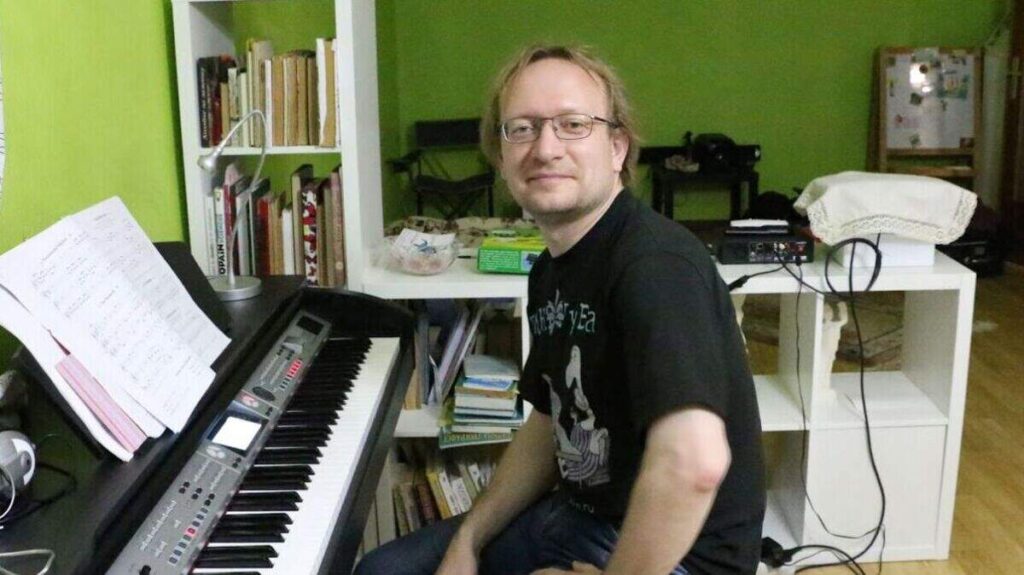
A Luxembourg cross-border worker held in a Russian jail since August has penned a moving letter to his family and friends from his prison cell.
Mikhail Lochtchinine, also known as “Mike”, is a dual Belgian-Russian national who was detained during a trip to see his father in the summer.
“I would so love to remember our encounters, but I mustn’t – because otherwise I’ll become homesick, and homesickness is the prisoner’s greatest enemy,” the 48-year-old has written in a letter received by his sister last week.
The nightmare began for Lochtchinine, who lives in Trier and works as a computer scientist in Luxembourg, when he decided to travelled to St. Petersburg to see his father, who had just had a heart attack.
He was detained and accused of “financing a hostile state”, in reference to a transfer of money made in 2022 to a former Ukrainian girlfriend. For Moscow, this is enough to invoke article 275 of the Criminal Code: treason.
His sister received a letter on Thursday that her brother wrote on Wednesday in the Russian remand prison SIZO1 in Pskov, just over the border with Estonia and Latvia.
It was delivered via the official electronic letter system of the Russian penal system.
Lochtchinine, who has been imprisoned in the country since the end of August, addresses his friends and supporters in the Grand Duchy in a moving letter which runs to about a page long, in crisp handwriting.
The letter contains a drawing at the bottom of the page: a red flower can be seen breaking through a tiled floor and blossoming, with the sun shining in the background – both symbols of hope.
The letter from Mike Loschtschinine to his family, friends and supporters © Photo credit: Provided by family
Keeping hope and humour
“I only receive echoes of what you say and do, but they leave me speechless. Whether comments, petitions or articles, I can’t finish reading them because they bring tears to my eyes,” writes Loschtschinine.
The next sentence shows that he has lost neither hope nor humour, even in his bleak place: “I have never misused so much toilet paper.”
Trust not, fear not, ask not
Mike Loschtschinine
Luxembourg cross-border worker currently detained in a Russian prison
But life in Pskov prison is harsh, as he also writes: “To avoid breaking down, I have to get used to the prison conditions, accept them as ‘the new normal.’”
Lochtchinine adds: “I let myself be guided by the three commandments of life in prison: Trust not, fear not, ask not.”
The letter also reveals a poetic streak: “I practise piano on a keyboard that I have drawn on paper. At night, the barbed wire outside my window sparkles brightly in the spotlight.”
Lochtchinine concludes his letter with the words: “I believe in it. I’m hanging in there.”
According to his family, however, he is in very poor health: he urgently needs medical help and is at risk of going blind due to a detached retina.
The Belgian embassy has been trying to get information about his condition since August. But the Russian Foreign Ministry has remained silent.
The 48-year-old is very short-sighted and suffers from a detached retina; he is at risk of permanent blindness © Photo credit: Provided by family
Mike’s case has made waves in Luxembourg; numerous friends and acquaintances are among his circle of supporters.
Over recent days, the Luxemburger Wort has spoken to relatives, supporters and friends of Lochtchinine as well as experts. Many want to remain anonymous because they fear reprisals against relatives remaining in Russia. Their full names are known to the authors of this article.
First held in a hotel, then abducted and tortured
Experts now advise Russian expats against travelling to their homeland.
Those living abroad should only travel to Russia in an absolute emergency, as it poses a significant risk, renowned Russian criminal defense lawyer Yevgeny Smirnov recently told the online publication Sever.Realii.
Lochtchinine was travelling to St. Petersburg on his BMW motorbike, which has been confiscated by the Russian authorities © Photo credit: Provided by family
Lochtchinine had told his neighbour in Trier, Ilja, that he wanted to be back in mid-July, around the 10th.
Ilja had just returned from holiday and rang his neighbour’s doorbell – but Mike wasn’t there.
“After a week, I thought something must have happened,” he said. “I wanted to go to the police about it. Mike is not only my neighbour, but also my friend. I thought maybe he’d had a motorbike accident.”
But then the police came to him: Lochtchinine’s employer in Luxembourg had called them because – uncharacteristically for him – he hadn’t turned up at work.
Lochtchinine’s landlord, who lives in the same building, describes him as uncomplicated, with a passion for travelling. The occasional, very friendly conversations centred around this, and not politics. Lochtchinine has already travelled all over Europe on his motorbike.
Travelling is Lochtchinine’s great passion. © Photo credit: Provided by family
It was only later that Ilja, and his and Lochtchinine’s landlord, learnt from the arrested man’s sister what had happened.
As he had done on many previous occasions to avoid visa formalities, Lochtchinine used his Russian passport to enter Russia. He crossed the Latvia-Russia border at the Ubylinka station on his German-registered motorbike.
“The fact that his motorbike had a German number plate was probably tempting for the border guards,” explained his sister. “They examined his phone. It contained lots of contacts in Ukraine because some of our family live there – and an ex-girlfriend of his.”
According to his sister, Lochtchinine was lured out of the border zone on a pretext, arrested and then held in a hotel in the town of Pytalovo, close to the Latvian border, for almost four weeks. The officers had found chat messages on his mobile phone from 2022 with his ex-partner about money.
During this time, the authorities called his mother and reassured her that it was a purely administrative matter, that he would soon be released, and that a lawyer wasn’t necessary.
However, his mother did not buy the assurances, and hired a lawyer who was able to speak with Lochtchinine for the first time in Pytalovo on 1 August.
The very next day, according to his sister, Lochtchinine was tied up and abducted by three armed men, and his motorcycle was confiscated. He ended up 1,000 kilometers south in a prison in Stary Oskol, together with Ukrainian prisoners of war.
“He was physically and psychologically tortured there,” said his sister. “The authorities deny this, claiming he was free to move around Russia, but that’s not true. We can prove he was in Stary Oskol.”
To back up her case, his sister refers to an official document: a confirmation for the lawyer that his client is in the SIZO2 facility in Stary Oskol, dated 7 August. The Luxemburger Wort was able to view the document, which was published by the online medium Sever.Realii.org.
It was only on 21 August, after three weeks without any sign of life, that Lochtchinine’s family found out where he was: in Pskov in SIZO1, and that he had been accused of treason.
The remand prison in Pskov, where Lochtchinine is understood to be being held © Photo credit: f-atlas.ru/catalog/object/si1pskov/
Fabricated accusations
“The problem is his dual citizenship. As a Belgian citizen without a Russian passport, they would have been more likely to let him go,” concluded a Russian legal expert who spoke to the Luxemburger Wort.
“The Russian passport also serves as a pretext to prevent Belgian diplomats from approaching him,” said the legal expert, who explained that the core issue is that Lochtchinine apparently transferred money to his Ukrainian ex-girlfriend in 2022.
From this seemingly innocuous incident, the Russian judiciary has fabricated an accusation of providing financial support for activities deemed detrimental to the security of the Russian Federation.
Russian sociologist Anna Kuleshova, who has lived in Luxembourg since 2022, knows Lochtchinine, of whom she is a big admirer.
“He has always been very committed to art and creative work and has never refused to offer his help,” she said.
“What happened to him follows a tried and tested pattern used by repressive states. To maximise the intimidating effect, such regimes deliberately select random individuals as victims and imprison them. This creates a climate of fear and simultaneously provides a pool of hostages for future political negotiations,” added Kuleshova.
In his letter, Lochtchinine expresses his final wish to his supporters, “to be able to embrace you all in the new year”.
Whether this scenario will come to pass, however, remains entirely uncertain.
Speaking to Sever.Realii, Smirnov, considered an expert on treason trials in Russia, offered his assessment of the case.
He stated that it would be easy for the Russian authorities to fabricate further accusations, such as alleging that his ex-girlfriend belonged to the Ukrainian secret service.
Regarding the Lochtchinine case and similar ones, he said: “There is no easy way out of such a situation. They can receive up to 13 years in prison, and the only chance of release is linked to an exchange, which requires a political decision.”
For Lochtchinine’s family and friends, they are pinning their hopes on the outcome of the upcoming trial, which could take place in mid-January.
(This article was originally published by the Luxemburger Wort. Machine translated using AI, with editing and adaptation by John Monaghan.)