
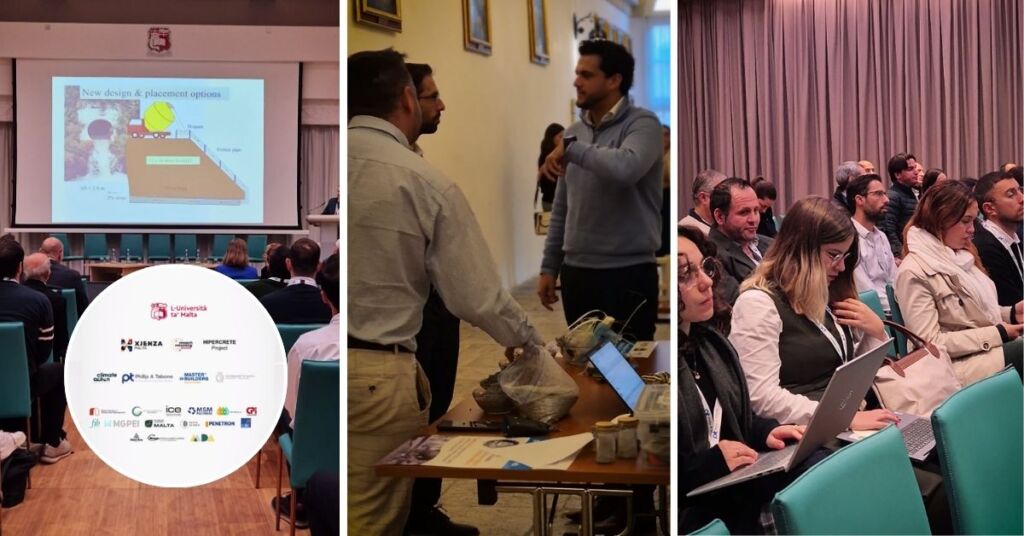
International experts in construction, engineering, and materials science gathered in Malta this week for CSMS 2025, a global conference focused on the future of sustainable concrete.
The fourth edition of Concrete Sustainability: Materials and Structures (CSMS 2025) is being held at the University of Malta’s Valletta Campus, bringing together researchers, engineers, academics, and industry professionals from across the world to explore how concrete — one of the most widely used building materials globally — can be produced and used more sustainably.
Organised by the University of Malta’s Faculty for the Built Environment through its Construction Materials and Structural Monitoring Research Group, in collaboration with the International Federation for Structural Concrete (fib), the conference focuses on low-carbon concrete technologies, sustainable structural design, and innovative construction materials. The programme offers a platform for both academic research and real-world industry applications.
A key highlight of CSMS 2025 is a series of keynote lectures delivered by Professor Kamal Khayat, a globally recognised concrete scientist and Vice-Chancellor at the Missouri University of Science and Technology. Professor Khayat shared insights from decades of pioneering work on self-consolidating concrete and high-performance concrete, research that has significantly improved construction efficiency, safety, and sustainability worldwide.
The conference programme also includes sessions on recycling and reuse strategies, digital inspection and monitoring of concrete bridges, 3D concrete printing, and the development of innovative low-carbon mortars and binders. Contributions are being delivered by both local and international experts, including Professors Ruben Paul Borg, Carl Debono, Edward Gatt, Dr Himanshu Sharma, Ing. Loai Al Mawed, and industry partners.
Conference organiser Professor Ruben Paul Borg said the event forms part of a broader effort to promote quality concrete while addressing climate resilience and sustainability in the built environment. He noted that CSMS is designed to initiate practical discussions on how construction practices can evolve in response to environmental challenges.
Special attention was given to collaborative research projects supported by Xjenza Malta, Horizon 2020, and Horizon Europe. CSMS 2025 is also supported through Xjenza Malta’s RNS Programme via the HIPERCRETE project at the Faculty for the Built Environment, highlighting the role of research-industry partnerships in advancing sustainable construction solutions.
Another major feature of the conference is the CSMS 2025 Concrete Industry Forum, a panel discussion chaired by Perit David Xuereb. Industry representatives, regulators, and policymakers — including the CEO of the Building and Construction Authority, the President of Kamra tal-Periti, and leaders from Malta’s construction sector — discussed the future of quality concrete in Malta and the challenges facing the industry.
CSMS 2025 continues over the coming days, including a dedicated workshop in Victoria, Gozo, aimed at exploring applied research and practical solutions. The conference positions Malta as an active contributor to global conversations on sustainable construction and low-carbon building practices.