
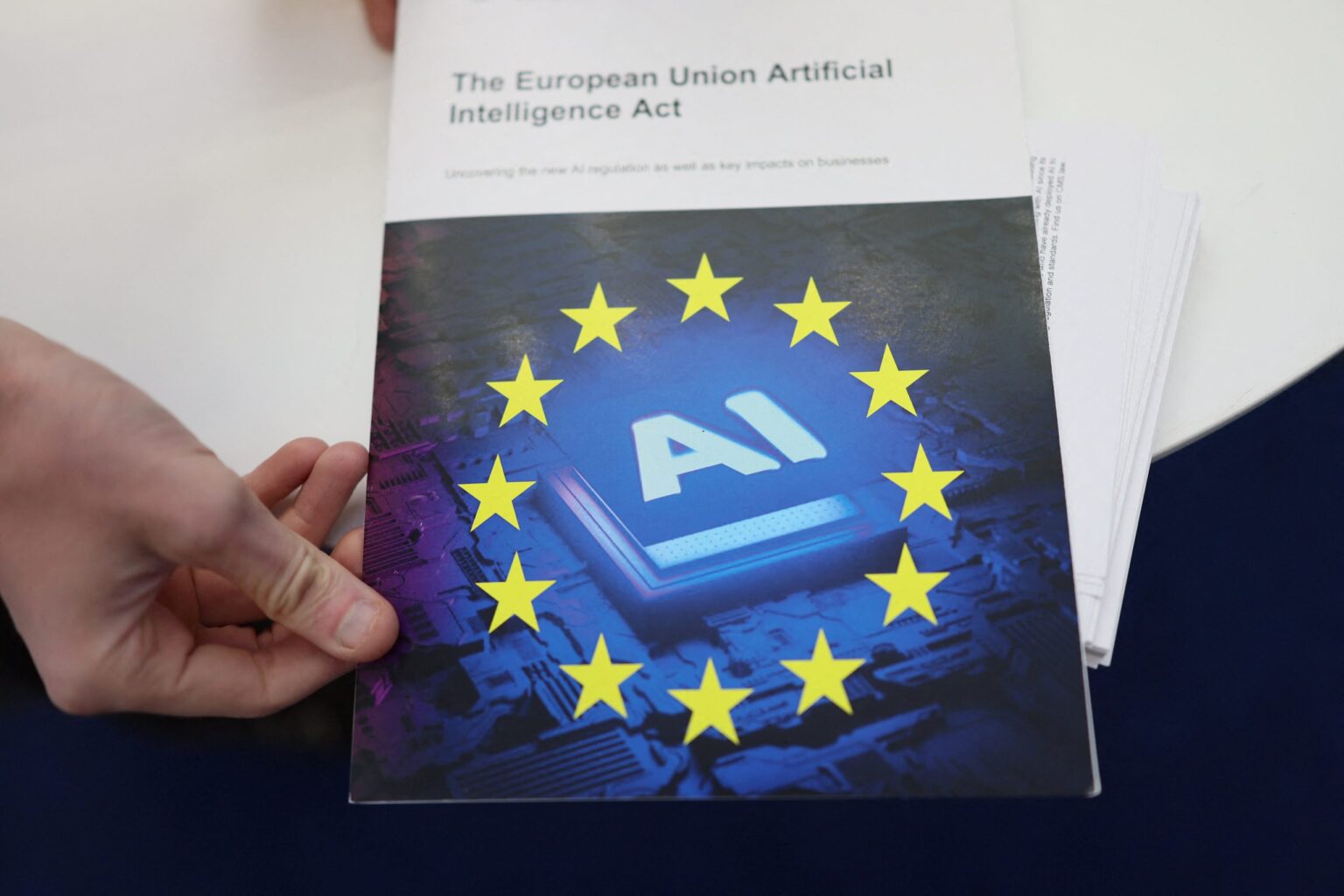
When we asked our fellows to spread around the globe to name the single most important technology development in the past year, the overwhelming answer was the rise of AI. Quantum computing, fusion, and batteries also made the grade.
On the policy front, Europe woke up to the danger of overregulation, while the US amplified its attacks on European rules. Despite few areas of convergence, common concerns emerged about protecting children and the best way to meet China’s tech challenge.
The following contributions have been edited for length and clarity:
Ronan Murphy, Director
This year brought us an unexpected story in European tech policy: “Sovereignty Strikes Back.” It began with the arrival to power of a right-of-center, pro-American European Commission. French Commissioner Thierry Breton was gone, and his “digital sovereignty” agenda looked set to vanish with his departure. Instead, it has returned with a vengeance. Europeans of all political stripes promote Digital Sovereignty. But there is no agreed-upon definition. Many see digital sovereignty as building up European tech capabilities. For others, it is a rallying cry for replacing everything that is not made in Europe. The cost of change would be enormous. Expect the coming year to be full of new Digital Sovereignty debates.
Enrique Dans, Senior Fellow
If 2025 is going to be remembered in the history of technology, it won’t be because of some shiny new gadget, but because this was the year when AI finally asserted itself as the structural engine of the economy and society. The big platforms released models capable of tackling complex tasks. Within three to five years, today’s AI models will inevitably be replaced by systems that learn like children do: by observing, interacting, predicting, and continuously updating an internal model of reality — systems that don’t just stitch together patterns, but actually build meaning from experience.
Anda Bologa, Senior Researcher
In 2025, the most important tech development was the industrialization of AI. While advances in model capability were steady rather than dramatic, investment in data centers, energy systems, and supply chains surged. AI began to look more like heavy industry. The defining question of the year was no longer how powerful AI could become, but who controls the infrastructure it depends on, who pays for it, and on whose terms this expansion continues.
Heather West, Senior Fellow
In 2025, AI shifted from novelty to infrastructure. The result is a structural change in cybersecurity risk. Deep integration across enterprise software and cloud environments expands the attack surface. A compromise no longer hits a single application — it can cascade across the chain. Decades ago, cybersecurity was framed as a software problem, and more recently as a human one. Now, the defining challenge will be the security of the connections.
Elly Rostoum, Resident Senior Fellow
2025 will be remembered as the year that quantum computing and AI moved from theory into practice. Companies demonstrated practical quantum advantage in real-world applications, with Google’s Quantum Echoes algorithm operating roughly 13,000 times faster than traditional supercomputers. At the same time, enterprises began deploying autonomous AI agents capable of executing complex, multi-step tasks with minimal supervision.
On the policy front, the US reversal of advanced chip export controls toward China arrived too late to reshape the competitive landscape, landing at a moment when Beijing had already accelerated its own semiconductor capabilities and shifted decisively toward domestic suppliers. Chinese regulators rejected the newly permitted American hardware in favor of reinforcing growing self-reliance and domestic alternatives.
Get the Latest
Sign up to receive regular Bandwidth emails and stay informed about CEPA’s work.
Christopher Cytera, Senior Fellow
Sodium‑ion batteries deserve recognition as 2025’s most significant green technology. They give European and US households a realistic path to energy sovereignty, breaking dependence on Russian and Iranian hydrocarbons and Chinese lithium supply chains. In my hometown of Cambridge in the UK, for example, a typical home can now install a 4.5 kWh scalable sodium‑ion battery from local startup Eleven Energy. The battery charges when wholesale prices are driven towards zero overnight by high wind output and displaces gas‑fired generation when demand peaks. It’s a textbook case of how targeted technology deployment can reduce authoritarian influence over democratic energy and digital infrastructure.
Kevin Allison, Senior Fellow
China’s restrictions on exports of rare earths in 2025 sent shockwaves through boardrooms and capitals. The restrictions led to supply shortages of permanent magnets and critical components, forcing some factories to close. The episode showed that Beijing has developed powerful policy levers in its technology and trade confrontation with Washington, and that it is willing to use them. China is home to most of the technology and know-how needed to separate, purify, and shape elements like terbium and dysprosium into products used in everything from cars to datacenters to military drones. The repercussions will reverberate into the next year, as the US and its partners invest billions of dollars and pursue new private-sector partnerships to diversify supply, while companies scramble to gain visibility into supply chains and policy risks.
Reinhard Bütikofer, Senior Fellow
My favorite tech development of 2025 comes from France, where the start-up Altrove could provide a pivotal protection against China’s attempt to blackmail Europe and the US through their quasi-monopoly of rare earths processing. The company produces AI-designed alternatives for critical inorganic materials and promises to scale up production to a relevant level within two years. More efficient use of rare earth or serious recycling efforts of such raw materials will also have to play a role, but if Altrove is successful, it would be a leap forward in reducing the reliance on China.
Seth Hays, Senior Fellow
In 2025, Australia implemented one of the first social media age-restriction rules, which is now being closely watched by other liberal democratic nations. At the same time, age-verification rules proliferated in the US, and an important Supreme Court ruling in Free Speech Coalition v. Paxton restricted access to online pornography. More than 20 states now require age verification. Expect additional age restrictions to be imposed around the globe in the coming years, especially around AI and children. These developments signal a tightening of rules around technology that have been held loosely for a generation.
William Echikson, Senior Fellow
For me, an American living and working in Europe, it has been painful to watch transatlantic relations plunge into the abyss, and one of the major causes of conflict has become technology policy. The US and Europe long stood shoulder to shoulder to push back against Chinese, Russian, and other authoritarian attempts to “censor” the Internet. No longer. The US now seems to see Europe as a bigger threat to Internet freedom than the authoritarians.
Fiona Alexander, Senior Fellow
The much-overlooked debate at the United Nations over Internet governance achieved a surprising positive outcome. Authoritarian attempts to clamp down on Internet freedom were rebuffed. Instead, bottom-up multistakeholder governance, giving civil society and companies a voice alongside governments, emerged victorious. This shared decision-making has been critical to the Internet’s success. The UN’s Internet Governance Forum (IGF) was made permanent.
Hillary Brill, Senior Fellow
In a major realignment, the US pivoted to a pro-innovation agenda that positioned AI as central to economic competitiveness and strategic rivalry with China. Washington prioritized AI infrastructure, boosting federal support for data center development, streamlining permitting for high-capacity energy infrastructure, and imposing new export financing tools for AI-related technologies. Private investment aligned with this agenda, announcing a $500 billion Stargate initiative to build data centers. The largest cloud providers and frontier model developers signed multibillion-dollar deals. Internationally, this policy turn did not produce convergence, as US officials increasingly criticized heavy-handed AI regulation abroad, while European governments accelerated investment in domestic AI capacity to reduce reliance on American firms.
Eriks Selga, Fellow
The Baltic countries, so long seen by Moscow as vulnerabilities to exploit, are now NATO’s frontline defense‑tech sandbox. Latvia has stopped thinking of itself as just a consumer of foreign kit and started acting as an innovation hub: hosting NATO’s largest ‘Digital Backbone’ experiment to harden command‑and‑control against mass drones, co‑building a Baltic ‘drone wall’ with AI‑enabled systems born on the Ukrainian battlefield, and locking in a path toward 5% of GDP defense over the next decade. Latvian companies are no longer only buying deterrence from abroad – they are exporting it.
Jack Galloway, Program Assistant
President Trump gave the AI sector rocket fuel; he appointed tech investor David Saks as AI and Crypto Czar, loosened chip export controls to China, and issued an executive order to preempt any state-level AI regulation. NVIDIA stock jumped 32% year-to-date due to the expectation of expanded market access, and Google Cloud revenue grew by 34%, driven by AI search demand. The Trump administration’s top priority is American economic dominance, and tech policy was the focal point for the President’s economic agenda in 2025.
Bandwidth is CEPA’s online journal dedicated to advancing transatlantic cooperation on tech policy. All opinions expressed on Bandwidth are those of the author alone and may not represent those of the institutions they represent or the Center for European Policy Analysis. CEPA maintains a strict intellectual independence policy across all its projects and publications.
Read More From Bandwidth
CEPA’s online journal dedicated to advancing transatlantic cooperation on tech policy.