
Higher education in Georgia has long been viewed as an integral part of the country’s European integration. Despite this, new reforms proposed by Georgian Dream threaten not only these connections but the very independence of the system itself.
December 23, 2025 –
Giorgi Odoshashvili
Nino Dolidze
Tamar Gamkrelidze
– 
Articles and Commentary
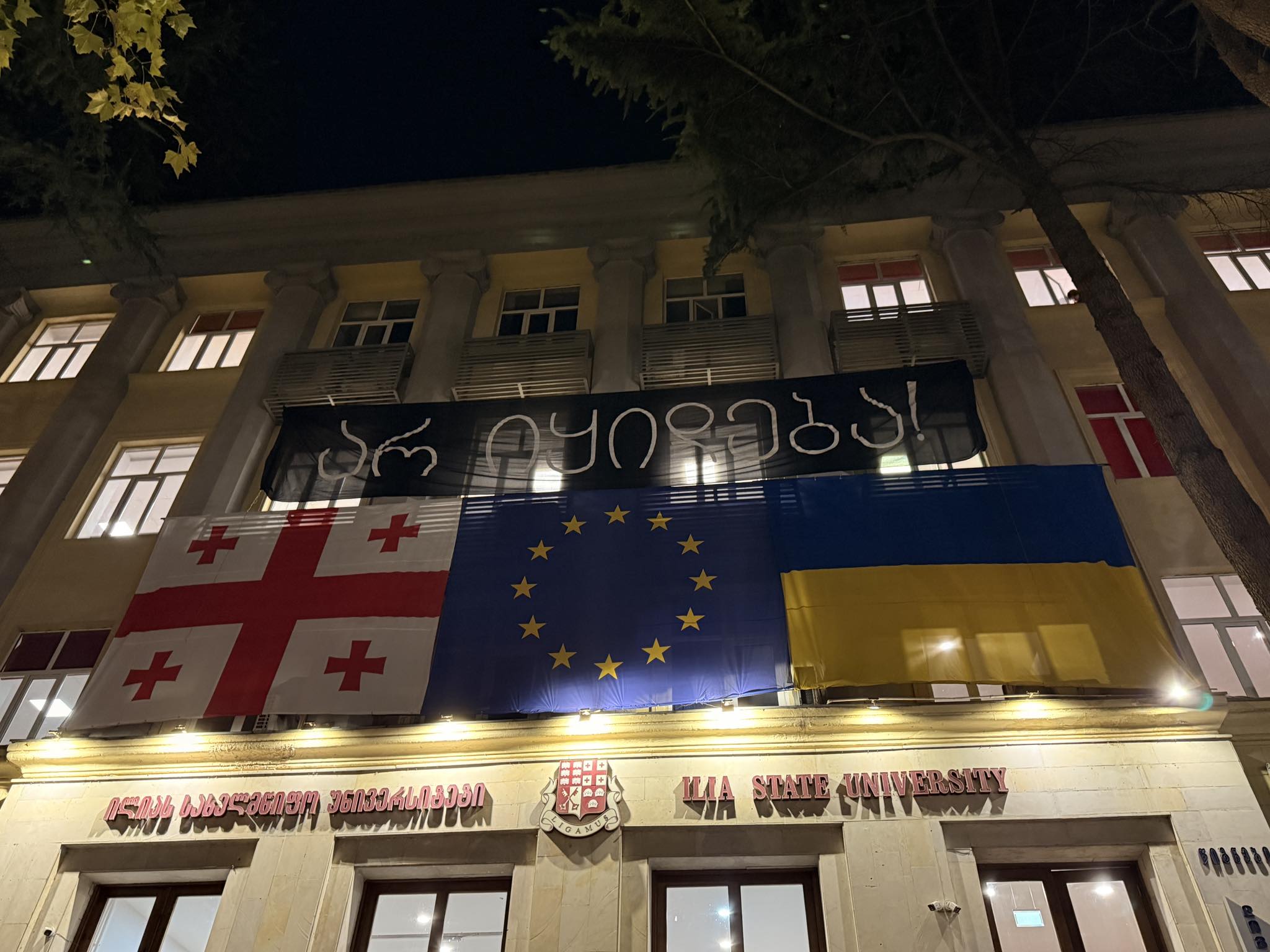
“Not for Sale” states a banner placed on the façade of the main building of the Ilia State University. Photo: Iliauni Student Movement.
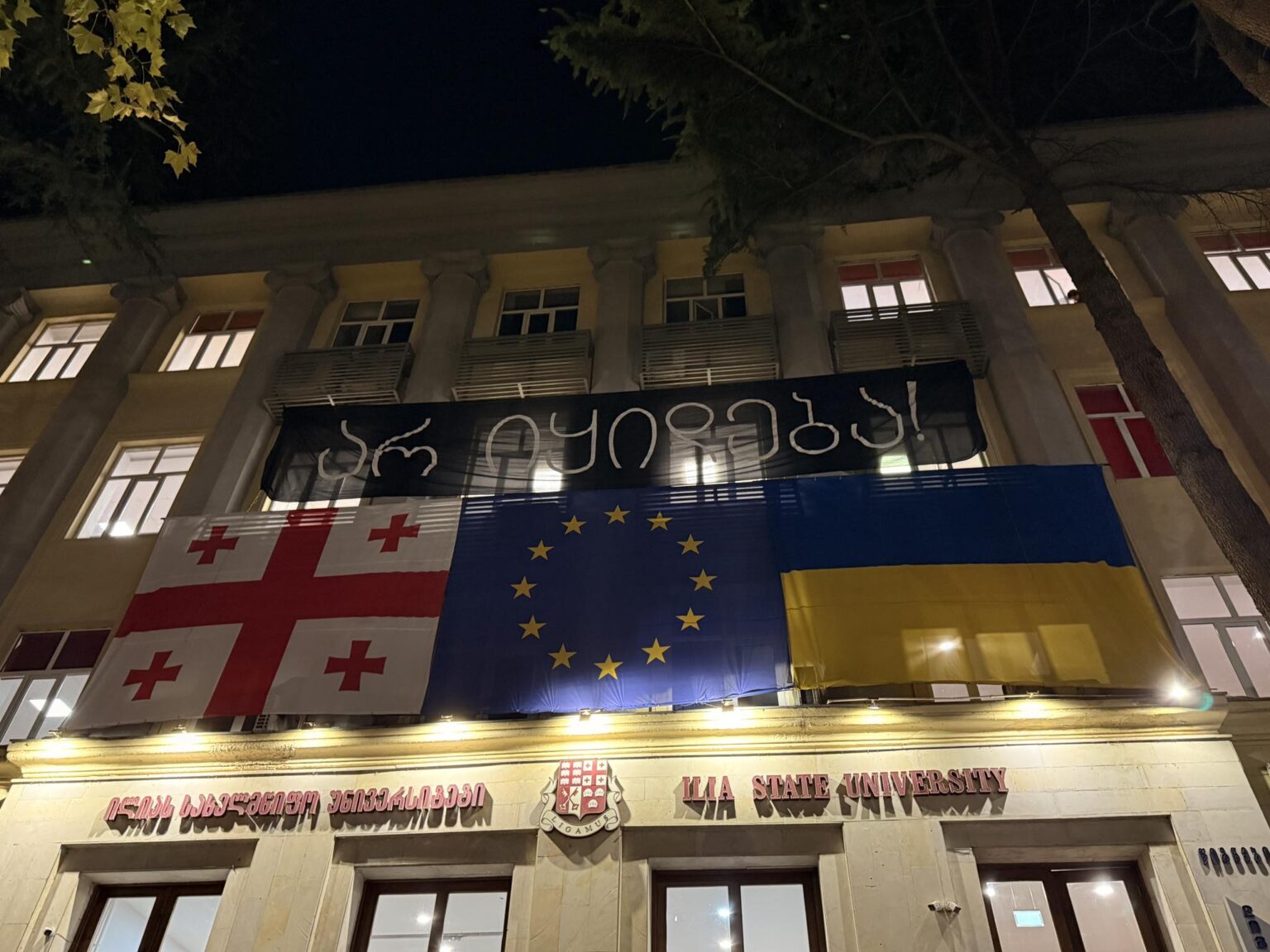
As you walk past one of the central buildings of Ilia State University, Georgia’s leading research university, you cannot miss the large banner draped across its façade: “Not for Sale.” It stands as a reminder about just how far Georgia’s democratic collapse has stretched, now fiercely knocking on the door of academia. In recent weeks, the ruling Georgian Dream party unveiled an all-encompassing higher education “reform” package, described by many experts not as reform but as “deform”.
This push to reshape universities is certainly strategic in more ways than one. It cuts to the core of a system built on Georgia’s earliest aspirations for Europe and intellectual self-determination. The first university in the Caucasus, Tbilisi State University, was founded in 1918 under Ivane Javakhishvili with a deliberate mission to place Georgia firmly within a western intellectual tradition. For the young Georgian republic, a university was not just an institution but an anchor of nationhood. Education itself was an act of resilience.
However, Soviet rule from 1921 onward quickly submerged the education system under its influence. The Bolsheviks transformed universities into instruments of state control: curricula were tightly controlled by Moscow, mandatory courses in Marxism-Leninism suppressed critical thought, and academic appointments depended on party loyalty. Stalin’s purges of the 1930s swept up Georgian scholars and students alike. In short, higher education under the USSR became highly centralized, bureaucratic, and limited in scope, the opposite of the classic Humboldtian model of a free university.
After the re-establishment of independence in 1991, Georgia endured years of profound instability, during which the higher education system was practically obsolete, neither Soviet nor reformed, but suspended in a period of chaos. It was only after the revolution in the early 2000s that the country began to break decisively from this legacy. Georgia launched an ambitious wave of higher education reforms, joined the Bologna Process in 2005, and began modernizing curricula and governance structures in line with European standards. New institutions emerged or were reconfigured as flagships of this transformation: Ilia State University was established as a research-oriented public university, and a number of strong private institutions, such as the Free University of Tbilisi, entered the scene. Against the odds, Georgia managed to position itself as a promising, and in some areas, leading player in the regional academic landscape.
Does this mean that further reform of higher education was not needed? Of course not, but the results were truly tangible.
David Tarkhnishvili, former dean of Ilia State University’s School of Natural Sciences, states: “The reform concept assumes that academic research in Georgia is “inadequate”, but the data show the opposite. In the 2026 Times Higher Education rankings, seven Georgian universities appeared — up from none in 2011 — and Georgia outperforms Armenia, Azerbaijan, Belarus and even Russia across several fields (population weighting was applied). In physics and related sciences, Georgian universities hold the highest position in the region; in biology we rank second only to Lithuania; and in social sciences we surpass all neighbours. SCImago data also place Georgia second after Lithuania in citations per capita. These indicators clearly demonstrate that Georgian university science has been steadily rising over the past two decades, not declining.”
But progress without consolidated autonomy is fragile. Had Georgia truly achieved academic autonomy, free from political intervention, its universities might now be standing on firmer footing. In any democratic system, the state’s role is to guarantee the autonomy of universities and to refrain from interference in their academic affairs. Even well-intentioned governmental involvement is problematic since it violates the principle of institutional independence. This, however, is a moot point today. Although this principle is stated in Georgia’s constitution (Article 27 guarantees academic freedom and the autonomy of higher education institutions), the process behind this so-called reform disregards these guarantees entirely.
🎙️ Listen to the latest Talk Eastern Europe podcast episode:
A politicized reform process
This disregard is evident through how the reform concept was conceived. The proposal was not prepared by educators, researchers, university administrators, or independent experts, but by a political commission. Prime Minister Kobakhidze personally chairs a 15-member state body, which was established in January 2025. Academic voices were effectively excluded. In his public presentation, Kobakhidze made no mention of consultations with university representatives, faculty councils, researchers or students. No white paper was circulated for peer review, no open hearings were held, and no stakeholder analysis was conducted. The entire concept was pushed through a party-controlled structure.
In announcing the new “National Concept for Reforming the Higher Education System”, Kobakhidze set far-reaching measures and presented them as solutions to “seven key challenges”: overconcentration in Tbilisi; inefficient use of resources; uneven teaching quality; disorganized personnel policy; weak research links; misaligned labour market needs; and inadequate funding. The trajectory is disturbingly reminiscent of Soviet-era centralization, not a reform, but an orchestrated effort to seize control of the entire system.
Among all state universities, Ilia State University emerged as the only institution that openly opposed the government’s plan. While the majority of rectors publicly endorsed Georgian Dream’s proposed restructuring, with some describing the meeting with Kobakhidze as “very interesting” and others calling the reform “necessary”, ISU sharply warned that the model constituted an attack on institutional autonomy. Rector Nino Doborjginidze described the unfolding process as the “hollowing out of universities”, stressing that under the new system the state would determine which programmes universities may offer, how many students they may admit, and the nature of their institutional profile. These were decisions that, she argued, violated constitutionally protected academic freedom.
What the reform would implement
- Territorial and structural changes: The plan identifies the overcrowding of universities in Tbilisi as a “core problem”, proposing the creation of two new hubs in Rustavi and Kutaisi and the relocation of programmes out of central Tbilisi. In practice, this means selling or repurposing prime university real estate. These steps also occur in parallel with a broader crackdown on corruption involving members of Georgian Dream, as well as other measures that appear aimed at mobilizing funds. This has led to growing suspicion that the ruling party is facing a financial crisis and that the territorial restructuring of universities is, in part, a way of generating money. It is also important to note that Kutaisi International University, one of the main beneficiaries of these shifts, belongs to Ivanishvili, adding another layer of political interest to the decision to prioritize Kutaisi as a new “hub”.
- One city – one programme: A flagship element of the reform is the “one city – one programme” rule, under which each academic discipline — law, medicine, business, etc. — would be offered by only one state university per city. Tbilisi is the only exception, yet even there the plan effectively positions the dominant, politically connected Tbilisi State University to absorb smaller programmes, while regional institutions in Kutaisi or Batumi are reduced to single profile universities assigned by central decisions. No criteria for these allocations have been provided beyond vague references to each institution’s “historical profile”.
This is, in essence, a Soviet model. Soviet higher education was built on narrow functional profiling —technical, medical, agrarian and pedagogical — which served the needs of the planned economy but restricted interdisciplinarity and the broad intellectual education expected of a university. Kobakhidze himself acknowledged the Soviet origins of the idea, noting on state television that the principle of non-multifunctional universities had been “preserved since the Soviet period”.
This change would dismantle established academic and research groups, shatter comprehensive universities like Ilia State by stripping them of their multidisciplinary character, and eliminate competition between institutions, long viewed as a core driver of academic quality.
- Shortening degree cycles: The four-year Bachelor plus two-year Master model will become three plus one (with only one-year MAs, except in a few fields like medicine). At the same time, schooling would shrink from 12 to 11 years. Kobakhidze claims three-year BAs are “fully sufficient for most specialties”, but this breaks Georgia’s alignment with the European Higher Education Area (EHEA). Other countries generally assume a minimum of 300 ECTS credits (often via three plus two or four plus one), plus 12 years of school. Shorter Georgian degrees will fall below that benchmark and would risk isolating Georgian students; blocking Erasmus and other mobilities; and making joint degrees and foreign admissions much harder (and effectively favouring only well-off families who can tack on an extra year abroad).
This move can also be read as a way for the government to save money: fewer years of schooling and reduced higher-education cycles mean lower public spending on teachers, infrastructure, academic staff, and university operations. In a context where the ruling party appears to be searching for revenue and cost-cutting opportunities, the reform’s compression of the length of a degree fits a broader pattern of financially motivated restructuring.
- New funding and staffing regime: The current grant-based financing system — where students apply their state-funded scholarships to universities of their choice — would be replaced by a new “state-order” model. Under this plan, each university’s budget and the number of funded student placements will be set directly by the government, based on vaguely defined “national priorities”. This change effectively gives the ruling party control over which disciplines and institutions receive financial support, opening the door to politically motivated interference.
Students will no longer receive individual grants. Studying at a state university will be free, but receiving public funding for private universities will no longer be possible. As the education expert and opposition Freedom Square party leader Simon Janashia explained, “This will lead to fewer students being able to enroll. If a student was able to get funding from the available 63 universities, now there will be only 19 universities to choose from, and only two universities will have two of the same faculties.” The result will be both a decrease in student enrollment and a sharp restriction of academic choice.
In addition, Kobakhidze proposes a strict new staffing model: each department will be led by a single full professor (with a promised minimum salary of 10,000 Georgian lari), supported by a limited number of associate and assistant professors. All other instructors will be employed on a part-time or hourly basis. While this is officially framed as an effort to improve pay for top academics, it risks becoming a tool for dismissing politically “unreliable” faculty and rewarding loyalty.
- Restricting foreign students: State universities will only accept non-Georgians in “exceptional cases” defined by law. Until now, international tuition has been a vital revenue source (especially in medicine and engineering). Foreign students typically pay double the fees of locals, funding infrastructure and giving institutions financial independence. Limiting them is thus a “financial attack on university autonomy”, forcing schools to rely on state money and political dictates. However, private universities will still be able to host foreign students. With the ties of existing private universities with members of the GD party publicly known, it is most likely these universities will try to attract these foreign students.
From Bologna to Kutaisi: what the “process” actually means for students and EU perspectives
In Georgian political debates, the Bologna Process is often described as a diplomatic label: something that belongs to ministerial communiqués and EU-style reform talk. But for students it has been something far more concrete — an invisible infrastructure that quietly shapes life decisions.
Georgia’s entry into the Bologna Process in 2005 came with a set of practical reforms: a three-cycle degree system (BA/MA/PhD) and the logic of the European Credit Transfer and Accumulation System (ECTS). These changes did not merely “Europeanize” administrative paperwork – they made Georgian degrees legible in Europe in a way that Soviet-style diplomas never were. They gave students a recognizable structure, a comparable workload, and a clearer pathway for both short-term mobilities (one semester or one year) and full degrees achieved through study abroad.
Put simply, Bologna has meant three things in everyday terms: Georgian BA and MA credentials that can be understood within European frameworks; the ability to participate in Erasmus+ and other exchange programmes with credit recognition back home; and easier full-degree migration as foreign universities can put Georgian diplomas into their own admissions and qualification systems without guesswork.
This is not an abstract benefit – it ultimately shows up in patterns of student mobility. UNESCO’s UIS-based estimates suggest that around 9,765 Georgian students are enrolled abroad in tertiary education (all levels combined). This is compared with roughly 161,300 students enrolled in Georgian higher education in 2022-23. This implies that around five to six per cent of Georgian tertiary students are studying outside the country at any given time.
These numbers can be read in more than one way. They can signal ambition and an outward-looking society and they can also point to structural push factors — limited academic opportunities, uneven quality, and a labour market that rewards foreign credentials. Either way, they underline a central point: Bologna is not a symbolic ornament. Instead, it is a set of rules that translates directly into opportunities. It is also one of the few policy areas where Georgia’s “European orientation” has been operational rather than rhetorical.
Ultimately, institutions that once helped place Georgia within Europe’s intellectual space are now being restructured in ways that undermine that very orientation.
What the future holds
While undoubtedly a heartbreaking period for Georgia, history suggests this strategy is unlikely to work. In Georgia, universities have never been just administrative units. They have always been places where political pressure runs into intellectual resistance. Efforts to control thought through centralization or strict profiling are not new, and they have failed before. Pressure does not erase awareness – it sharpens it. When academic freedom is threatened, it becomes visible and it is defended not only by academics, but by students and society more broadly. Georgian universities have endured imperial rule, Soviet control, and the collapse of the state in the 1990s. They will endure this as well.
The real question is not whether resilience will prevail, but how much damage will be done before that resistance forces a change. Because once European compatibility is lost — once degrees become harder to recognize, mobility becomes harder to sustain, and international partnerships become riskier — restoring it is not a matter of a single law or election cycle. Bologna’s “invisible infrastructure” was built slowly. Georgia can dismantle it quickly. And that would be the real deform.
Nino Dolidze is a public administration and policy expert with over 15 years of experience collaborating with governmental institutions, international organizations, and academic institutions. She has worked extensively on public administration reform, civil service development, and modern HR practices in public organizations, both in Georgia and across Central and Eastern Europe. Currently an Associate Professor at Ilia State University and an invited lecturer at Caucasus University, she has contributed significantly to academic discourse, supervising master’s and doctoral research and delivering courses on public administration, policy analysis, and comparative governance.
Giorgi Odoshashvili is a study process manager at the Faculty of Arts & Sciences, Ilia State University (Tbilisi, Georgia), where he coordinates academic processes and contributes to internal quality assurance and student-centred initiatives. He also teaches political science and international relations, with a strong focus on European studies and contemporary regional security debates. His academic interests include EU institutions and policymaking, EU–Georgia relations, and geopolitical dynamics in the Black Sea and South Caucasus region, including connectivity and external actors’ engagement. Beyond teaching and administration, he is involved in international academic cooperation and peer-learning activities related to institutional development and state governance. He supports student research and academic skills development through mentoring, curriculum work, and event-based learning formats (e.g., conferences and simulations).
Tamar Gamkrelidze is a research fellow at the College of Europe in Natolin and a Ph.D. student at the Georgian Institute of Public Affairs (GIPA). Her research focuses on education governance and the impact of European integration on Georgia’s education system. She has worked in research coordination and management at Ilia State University and the Horizon Europe National Office of Georgia.
New Eastern Europe is a reader supported publication. Please support us and help us reach our goal of $10,000! We are nearly there. Donate by clicking on the button below.

civil society, Georgia, Georgian politics, Higher education, protest, Society