
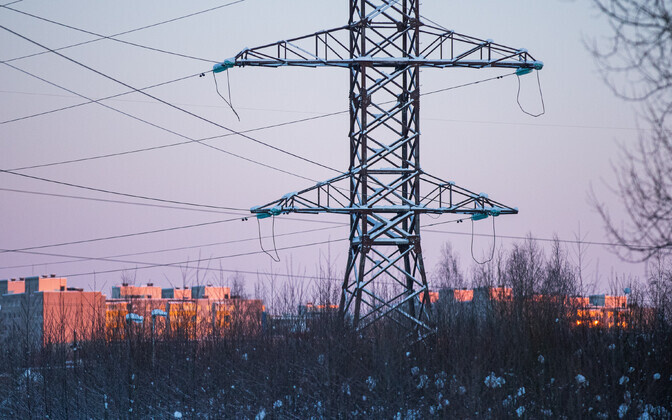
To ensure grid stability, Baltic system operators will cap the Estonia-Latvia transmission capacity below 1,000 megawatts next year, limiting power producers.
The electricity system operators of the three Baltic states have conducted new stability calculations, resulting in a decision to adjust transmission capacities. For the Estonia-Latvia connection, this means that starting January 1, the transmission capacity from Estonia to Latvia will be reduced from 1,447 megawatts to 922 megawatts. In the opposite direction, from Latvia to Estonia, the capacity will increase slightly from 1,259 megawatts to 1,272 megawatts.
Estonia’s system operator Elering told ERR that these figures represent the maximum possible transmission capacities. Actual capacities will be determined by ongoing calculations that are regularly updated. For instance, reconstruction work on the Kiisa-Paide transmission line is currently underway and will also affect cross-border capacity. Some portion of the transmission capacity must be reserved to ensure system stability.
Because transmission capacity fluctuates regularly, Elering believes its impact on the electricity market price is relatively limited. Instead, the primary factors influencing price fluctuations are tied to renewable energy production levels in the region.
Smaller transmission capacity takes local producers by surprise
Elering made the decision to reduce Estonia-Latvia transmission capacity based on electricity system stability considerations and did not consult market participants — namely, electricity producers and sellers — beforehand. As a result, the announcement that the Latvia-bound capacity would be limited to 922 megawatts starting January 1 came as a surprise to market players, said Tiit Hõbejõgi, acting head of energy trading at Enefit.
“Until now, market participants have assumed that once the grid reconstruction and development work related to synchronization was completed, the transmission capacity available for market use from Estonia to Latvia would increase in full, up to 1,400 megawatts. That’s why the news about limiting capacity through 2026 was unexpected,” Hõbejõgi said.
In practice, he noted, the restricted transmission capacity means that in situations where electricity prices in Latvia and Lithuania are higher than in Estonia, Estonian producers are unable to increase output and boost exports. The same applies to Latvia and Lithuania, which may miss out on cheaper electricity from the north.
However, the impact on electricity prices in Estonia is the opposite: due to capacity limits, prices in Estonia often remain lower than in Latvia and Lithuania. For example, this year the average price of electricity in Estonia has been about five euros per megawatt-hour cheaper than in Latvia, Hõbejõgi said.
“At the same time, lower prices force renewable energy producers to scale back output during certain periods, because prices fall close to zero and no longer cover the cost of producing and selling electricity into the grid,” he added.
While the installed transmission capacity from Estonia to Latvia is 1,400 megawatts, the actual usable capacity — both this year and as projected for next year — is in the range of 800 to 900 megawatts. According to Hõbejõgi, 200 to 300 megawatts of this is typically reserved for balancing and reserve markets.
“As a result, the maximum amount of electricity that can actually be transmitted from Estonia to Latvia on the regional wholesale market is usually limited to just 600 to 700 megawatts,” he said.
Currently, there are three electricity interconnections between Estonia and Latvia, with a fourth in the planning stage. Estonia is linked to the Latvian power system by three 330-kilovolt lines: the Tartu-Valmiera overhead line, the Tsirguliina-Valmiera overhead line and a third interconnection completed in 2021, which consists of the Harku-Lihula-Sindi 330/110-kilovolt line on Estonian territory and the Kilingi-Nõmme–Riga 330-kilovolt line segment up to the Estonian-Latvian border.
As of January 1, transmission capacity from Latvia to Lithuania will increase from 1,201 to 1,272 megawatts, while capacity from Lithuania to Latvia will decrease from 1,334 to 1,272 megawatts.
—