
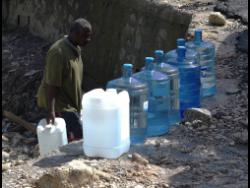
Jamaica’s chronic water shortage in rural communities and the impact of neglect on food security is a ticking time bomb. Are we ready to address the crisis, or will history continue to repeat itself?
In Lottery, St James, residents have lived for over 50 years without running water in their homes. Tragically, this is not unique. Across rural Jamaica, countless families still struggle to access basic water, fetching it from ponds, roadside standpipes, and catchment tanks.
This is not just a crisis of basic need. It is a contradiction to what Jamaica stands for. The Taino name for the island, Xaymaca, means “land of wood and water.” Yet vast parts of the population in the poorest areas live without reliable access to clean drinking water.
What happened to the land of water?
LONG-STANDING TRAGEDY
Eta Brown, a resident of Lottery, recently shared her struggle, explaining how she often must pay for trucked-water deliveries. She has not had piped water for over 50 years and sometimes is forced to walk over a mile to a nearby standpipe.
Her story is just one of many in a nation that seems to have abandoned its rural poor. The tragic irony is that even as Jamaica talks about modernisation, the water crisis persists. This shockingly reveals how little has changed for black poor people.
Dr D. K. Duncan, a champion for social justice, spent his life fighting rural development. In the sunset of his life – in one of his greatest moments of triumph, securing water for Jericho – he died on September 17, 2020, after achieving his objective.
This isn’t just the loss of one man. It is the loss of a fundamental fight affecting thousands of Jamaicans, many still waiting for their right to clean water.
Water poverty is not just inconvenience. It is a matter of life and death. Families without access to running water often suffer from poor hygiene, health risks, and malnutrition.
When children lack clean water, their health is compromised. Mothers face impossible choices between their children’s well-being and their own survival. This cycle perpetuates poverty. The connection between water and food security is undeniable.
The recent devastation of rural Jamaica by Hurricane Melissa highlights this. The storm swept away homes, crops, and lives but underscored a deeper, more systemic crisis: Jamaica’s reliance on an unreliable, fragmented water infrastructure and an agricultural system barely hanging on.
CLIMATE CHANGE AND FOOD SUPPLY
Climate change is exacerbating the problem. Extreme weather events – floods and droughts – are becoming more common, creating even more hardship for the rural poor.
While the Government makes half-hearted attempts at climate resilience, these efforts often come too late, after damage has already been done. If climate change is rewriting the rules, Jamaica must respond with practical solutions.
We need drought-resistant crops like cassava, dasheen, sweet potato, and breadfruit – crops that sustained generations before refrigerated ships and global supply chains. But these crops won’t thrive without water.
Without a reliable water supply, even resilient crops won’t grow. Farmers, especially in rural areas, are the unsung heroes who feed the nation. Yet they are burdened with the impossible task of growing food in conditions that barely allow them to sustain their own families.
There are, however, glimmers of hope. A recent project was implemented to provide water to 1,000 residents in the Lapland District of Catadupa, St James.
My friends, it is a step forward, but it is just that – a step. What about other rural communities that have waited for decades for urgent water solutions? The human cost of Government’s inaction can no longer be ignored.
FORGOTTEN LESSONS FROM HISTORY
Jamaica has been here before. In the 1960s, Edward Seaga’s Five-Year Independence Plan focused on economic independence and sustainable agriculture, emphasizing water and food security.
Michael Manley’s Operation Grow initiative in the 1970s sought to reduce Jamaica’s reliance on imported food. These ideas were powerful but lacked continuity. Successive governments failed to build on them, shifting instead to an export-oriented, import-dependent model. In 2025, we are paying the price for succumbing to the International Monetary Fund’s model and debt trap.
Jamaica’s dependence on imported food is a national security issue. Hurricanes come and go, but hunger lingers. Our exposure to extreme weather – both storm and drought – has revealed the folly of relying on imported food. As the population grows, the pressure on agriculture intensifies. Yet small farmers struggle without the needed support to thrive.
So, what needs to happen?
SOLUTIONS OR EMPTY PROMISES?
Small farmers need government support in seeds, hand tools, access to tractors, irrigation, and cash-for-work recovery programmes.
National food reserves and modern storage facilities must be built not just talked about. Feeder roads must be repaired to get food from farms to markets. Most importantly, water infrastructure must be prioritised in every corner of the island.
The long-term solutions to Jamaica’s water and food security problems are clear: tap into aquifers, drill wells, and build micro-dams.
My dear friends, we have the natural resources – over 100 rivers, numerous aquifers, and pristine springs – to solve this crisis. Jamaica has had the ideas for decades but not the leadership to implement them. The willpower to act is just not there!
ACT NOW
Hurricane Melissa has reminded us that food security is not a secondary issue. It’s a matter of national survival.
As climate change intensifies and the population grows, our vulnerability to food shortages, water crises, and extreme weather will only worsen. The next storm may be even worse than the last. Are we ready to face it?
We have been warned by history. The question is whether we will heed that warning or wait for another disaster to force urgent actions to solve the perpetual problems. If we don’t act now, we risk repeating the same mistakes with more devastating consequences. The choice is ours – urgent action is needed mow!
That’s the bitta truth.
Norris R. McDonald is an author, economic journalist, political analyst, and respiratory therapist. Send feedback to columns@gleanerjm.com and miaminorris@yahoo.com.