
Belgrade’s neighbors were spreading anti-Serbian propaganda.
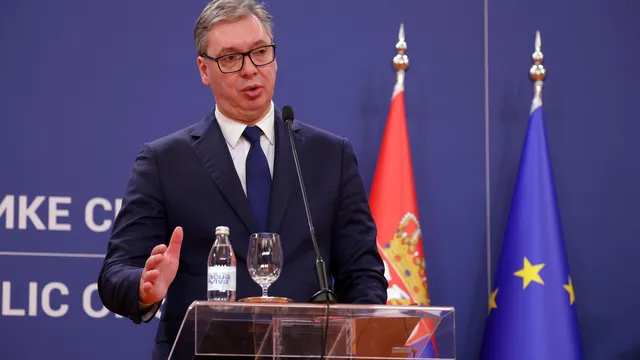
With accurate quotes from Serbian President Aleksandar Vučić, the publication Blitz, which is completely controlled by the regime in Belgrade, declared Bulgaria, Croatia, and Albania to be historical servants of the great powers. According to the “experts,” Montenegro joined them during Milo Djukanovic’s rule, BGNES reported.
“There are no big countries in the Western Balkans, but in the words of Aleksandar Vučić, ‘all these small countries around us were used mainly to contain Serbia,’ almost all neighbors can be recognized, from Croatia and Bulgaria to Montenegro and Albania. As they say, Albania and Montenegro, primarily because of their promotion of Kosovo’s independence, and Croatia and Bulgaria because of their obstruction of Serbia’s European path, analysts told Blitz.
Vucic “spoke about relations in the region in connection with the fact that Serbia had been waiting for the opening of Cluster 3 for four years, but the big powers had used these small countries in the region to spread anti-Serbian propaganda and scare their own populations with Serbia.”
“Throughout history, Croatia, Bulgaria, and Albania have mainly served the big powers to suppress Serbia’s interests in this region. Recently, Montenegro has also joined them, especially during Milo Djukanovic’s rule,” says diplomat Zoran Milivojevic, adding: Albania promotes the West’s strategic interest in an independent Kosovo. Montenegro has been on this line since it separated from Serbia, recognised Kosovo and joined NATO. All recognitions of Kosovo by neighboring countries are aimed at pressuring Serbia to recognize reality and accept the independence of so-called Kosovo. According to him, this was done to harmonize the interests of large and small countries in the Western Balkans.
“The military alliance between Croatia, Albania, and Pristina (Kosovo, ed.) should also be viewed in this light. Croatia also serves to suppress Serbia’s interests as a competitor in the region. We must not forget Slovenia, which is in alliance with Croatia,” Milivojevic said, adding that “the coincidence of the interests of the big and small countries against Serbia has been evident throughout history.”
“After the Congress of Berlin, we had the annexation of Bosnia and Herzegovina, after the London Conference, an Albanian state was created, and Serbia was cut off from access to the sea. All this was done in coordination with the great powers. Then, in the Second Balkan War, Bulgaria attacked Serbia, Milivojevic emphasized, directly pointing to “Bulgaria and Croatia as the culprits for hindering Serbia on its path to Europe.” “Since 2014 and the beginning of Serbia’s European integration process, Croatia and Bulgaria have constantly had reservations about Serbia’s progress. They are obviously doing this under the influence of Germany,” Milivojevic added.
According to political scientist Ognjen Gogic, “Vucic was referring primarily to Croatia and Bulgaria as countries that are accustomed to blocking Serbia.” “However, Croatia and Bulgaria are not the only EU countries voting against the opening of Cluster 3 for Serbia. It is possible that he (Vucic, ed.) also had Albania and Montenegro in mind, as they have made the most progress on the European path and are not waiting for other Western Balkan countries to join the EU together, as Vucic has proposed,” Gogic told Blitz.
The publication recalls Vucic’s statement that the government will “continue to work and do everything possible” on the European path. The publication ends with a long quote from Vucic, which says: “Do I expect big changes in the EU on this issue? I don’t. Don’t forget that in the meantime, all these small countries around us have been used mainly to, as they say, contain Serbia. Because when Serbia is strong and growing, regardless of the fact that we are a small country, we are much bigger than the others in our environment, then these big countries use these small countries to spread anti-Serbian propaganda and scare their own population with Serbia and, of course, with all this talk about how everyone else in Europe is good and nice, except us. This has been the case since the Congress of Berlin, the Balkan Wars, World War I, World War II, and up to the present day. We will not change this situation easily, but we must respect our friends, be infinitely grateful to them, and believe in ourselves. Let us continue to work to raise the standard of living, prepare for the Expo, and make this our most important goal. Will someone open a chapter for us, clusters or not? Don’t forget that, in addition to the clusters, we have opened three, and there are only three more chapters left.” I BGNES