
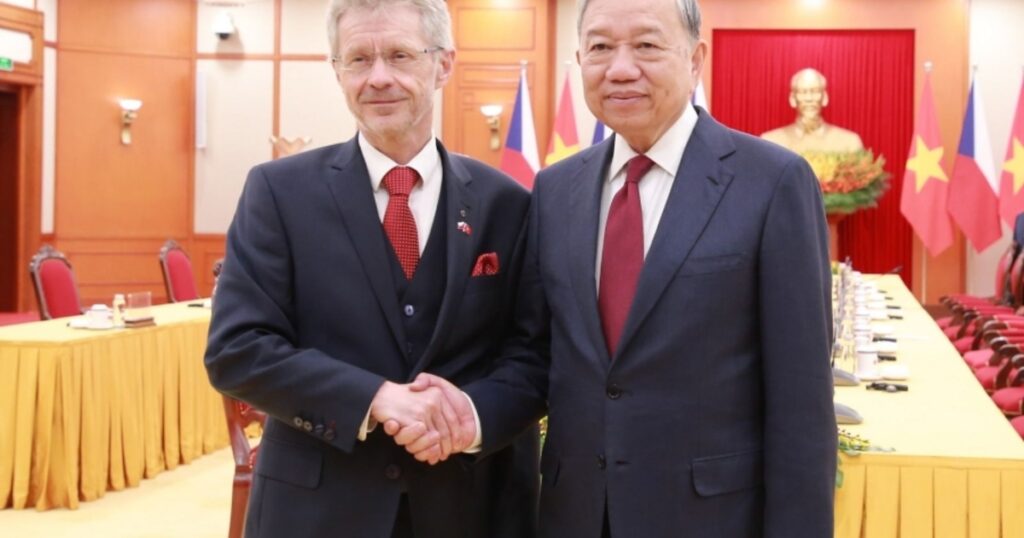
Cooperation between Vietnam and the Czech Republic has been steadily
strengthened and expanded across a wide range of fields in the 75 years since diplomatic
relations were established in 1950. This year, notably, marks a significant milestone
with the two countries officially upgrading their relationship to a Strategic Partnership,
opening a new era of deeper, more effective, and more substantive collaboration.
The elevated partnership is set to enhance cooperation not only in politics
and economics but also in security and defense, education, science and technology,
and cultural and people-to-people exchanges, creating a solid foundation for long-term
mutual benefit.
Key strategic partner
The Vietnam-Czech Republic relationship has recorded numerous positive outcomes
in cooperation. The Czech Republic is one of Vietnam’s leading trade partners in
central and eastern Europe, while Vietnam stands as the Czech Republic’s most important
partner in ASEAN. Notably, the Czech Republic was the first member of the EU to
ratify both the EU-Vietnam Free Trade Agreement (EUVFTA) and the EU-Vietnam Investment
Protection Agreement (EUVIPA), underscoring its commitment to deepening economic
and strategic ties with Vietnam and paving the way for even greater collaboration
in the future.
Czech businesses have also been actively investing in Vietnam in recent
years. According to data from the Foreign Investment Agency (FIA) at the
Ministry of Finance, the Czech Republic has invested in 46 active projects in Vietnam
with total registered capital of $91.5 million, ranking it 52nd among countries
and territories investing in Vietnam. Czech investors are primarily focused on sectors
such as manufacturing and processing, real estate, and clean energy.
Importantly, the elevation of relations between Vietnam and the Czech Republic
to a Strategic Partnership this year is expected to open the door to more intensive
cooperation across economic, technological, and educational fields. Mr. Miloš Vystrčil, President of the Senate of the Parliament
of the Czech Republic, told Vietnam Economic Times / VnEconomy that the longstanding
and positive historical ties between the two countries will further strengthen the
development of their already strong cooperation.
While the Czech Republic brings a well-developed technological and industrial
base, Vietnam offers a dynamic and rapidly-expanding market. This combination creates
fertile ground for collaboration. “This creates space for trade growth, joint investment
projects, and the sharing of know-how, for example in the fields of energy, innovation,
science and research, and a number of other sectors,” he noted.
Vietnam and the Czech Republic are also poised to strengthen collaboration
in the fields of education, culture, and security. By leveraging these opportunities,
the strategic partnership can promote long-term and stable development in bilateral
relations, bringing benefits not only economically but also socially and politically.
Such comprehensive cooperation will lay a solid foundation for future generations,
fostering shared prosperity and a resilient, enduring partnership between the two
countries.
Gateway to growth
Vietnam has increasingly emerged as a market of special interest to the Czech
business community over recent years. Its stable macro-economic environment, combined
with the rapid development of key industries, makes the country highly attractive
to investors seeking new opportunities in Asia. Against this backdrop, Vietnam is
widely regarded as a promising partner for Czech businesses, offering significant
potential for both medium and long-term cooperation.
The interest of Czech businesses in Vietnam also stems from the continual strengthening
of economic and trade relations between the two countries over recent years. Bilateral
trade has maintained a positive growth trajectory, reaching more than $2.04
billion in 2024 and $1.87 billion in the first ten months of 2025, thereby
providing an important foundation for expanding investment cooperation. Many Czech
companies view Vietnam not only as a promising consumer market but also as an effective
gateway to access the broader ASEAN region.
Beyond the sectors where the Czech Republic has long invested in Vietnam, Czech
businesses are also actively exploring and expanding into new and emerging areas
with the potential for high growth. Mr. Radek Jakubský, Vice President of the Czech Chamber
of Commerce, said many Czech companies have been seeking investment and cooperation
opportunities in fields such as information technology, smart city solutions, environmentally-friendly
technologies, healthcare, and a wide range of other sectors.
The growing interest reflects both the dynamic development of the Vietnamese
market and the willingness of Czech enterprises to bring their expertise and innovative
solutions to support Vietnam’s modernization and sustainable growth.
Vietnam’s emphasis on attracting high-quality investment, promoting digital
transformation, and developing green infrastructure has also created numerous new
opportunities for international investors, including those from the Czech Republic.
Support mechanisms for foreign enterprises in Vietnam, such as administrative reforms
and tax incentives for high-tech sectors, are increasingly recognized as transparent
and competitive. “Vietnam’s rapid economic growth is creating countless opportunities
not only for large-scale investments but also for expanding cooperation across multiple
fields,” Mr. Jakubský
noted.
For future cooperation
There remains considerable space for further cooperation and development between
Vietnam and the Czech Republic, both at the State level and between businesses on
both sides. For example, as Vietnam moves towards green growth, digital transformation,
and advanced technologies, the Czech Republic brings extensive experience in areas
such as defense, automation, robotics, environmental management, and clean energy.
The potential for the two to jointly develop projects or cooperate in technology
transfer in these fields is vast and largely untapped.
Mr. Vystrčil highlighted that the Czech Republic
possesses a strong technological foundation, particularly in automation, robotics,
and eco-innovation, which are precisely the areas that Vietnam, as a rapidly-growing
economy, requires for sustainable modernization. Technology transfer and joint projects
in these sectors could generate mutual benefits. “Vietnam could use Czech know-how
to ensure energy efficiency, develop green infrastructure, and support digital transformation,
while Czech companies would have access to Vietnam’s growing market with all the
new favorable opportunities it brings,” he said.
Looking ahead, if both countries focus their efforts on cooperation in these
strategic areas, the benefits could extend beyond economics to create a positive
impact on global sustainability. Furthermore, fostering collaboration through initiatives
such as joint research centers, startup support, and expert exchanges will play
a key role in strengthening bilateral ties.
The Czech Republic sees Vietnam as a reliable and dynamically-developing partner in the key region of Southeast Asia, which is of growing economic and political importance. For us, Vietnam is a bridge to ASEAN, a stable partner with a clear vision for modernization, and a country with which we share an interest in open trade, technological progress, and strengthening international security.
Mr. Miloš Vystrčil, President of the Senate of the Parliament of the Czech Republic.
However, Czech businesses still face several challenges when investing in Vietnam,
which could partly affect the overall picture of cooperation. Mr. Vystrčil noted that the main obstacles include cultural
differences in the business environment and the complexity of administrative procedures.
Though Vietnam holds enormous growth potential, it continues to present challenges
related to legal certainty and transparent bureaucracy.
To overcome such barriers, it is crucial to strengthen and support diplomatic
and trade channels through political leadership, increase the presence of Czech
companies in the region, and facilitate mutual business missions, while promoting
closer collaboration between business associations and industry partners in both
countries. “It is also important to facilitate access to information about the Vietnamese
market and investment conditions for Czech businesses, not only at the government
level,” Mr. Vystrčil suggested.