
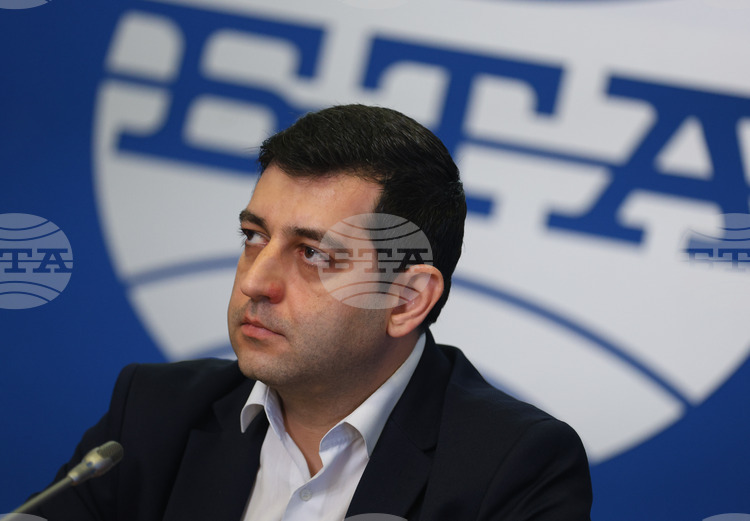
Retailers and consumers are together in the process of transitioning to the euro as of January 1, 2026, Nikolay Valkanov, Executive Director of the Association for Modern Trade (AMT), said in a BTA interview. He believes that retailers—regardless of whether they are large chains or smaller outlets—have made every effort to ensure a smooth transition to the new currency.
AMT brings together the large supermarket chains in Bulgaria.
“I would like to advise both consumers and checkout staff – those who are on the front line and who will bear the full brunt of the tension—to stay calm and have patience, because we are in this process together,” Valkanov said. He reiterated his confidence that retailers, regardless of size, have made all possible efforts, within their available resources, to go through the transition smoothly together with their customers. “We all need to be a bit calmer and more patient during the first two to three weeks of the year,” he added.
Nikolay Valkanov said that AMT members are fully prepared for the adoption of the euro, noting that they have approached the process with great responsibility and in partnership with institutions – a collaboration that began about two years ago with the establishment of the first working groups on the topic.
“As of today, we are at the final stage of a very important process: the proper logistics of the new cash that will be used for payments,” Valkanov noted. Retailers have declared the quantities they need of the starter packs of euro coins and banknotes, and their transportation is already underway. This is a complex and responsible task both for retailers – who must ensure they have sufficient funds to operate normally and in compliance with the law – and for banks and the Bulgarian National Bank (BNB). This process is currently being carried out and will soon be completed, he said.
Significant investments have been made in software to facilitate as much as possible the checkout process during the period of use of the two currencies, so that there is no doubt—neither for the cashier nor for the consumer—about the exact amount of change to be returned. These are serious investments, amounting to over EUR 18 million for the sector by AMT estimates, along with tens of thousands of hours of staff training—both on how to operate with the new currency during the first month, on legal requirements, on recognizing counterfeit banknotes should they appear, and generally on ensuring a smooth transition to the new currency, Valkanov said.
Regarding large retail chains, Valkanov expressed confidence that companies have secured the necessary quantities of coins, noting that this has recently been a major topic in the sector—whether there will be enough coins for giving change. He recalled that the law allows change to be given in lev coins if euro coins are not available at the till. This could theoretically raise some questions among citizens, he said, but people should know that this is fully permissible and nothing to worry about. Every retailer, large or small, has made the necessary efforts to obtain sufficient quantities of the new currency.
“A potential risk could arise if some citizens decide to use retail outlets as exchange bureaus, but I hope that both consumers and retailers will approach this process responsibly and will not create unnecessary tension at the checkouts, since we are all in this together and must go through it without unnecessary stress,” Valkanov said.
Regarding staff training for communication with customers, Valkanov explained that cashiers must know that, upon request by the customer, they are obliged to verbally provide information about the amount of change to be returned in both leva and euros. They must also be able to carefully explain to consumers that they have the right to refuse single payments made with more than 50 coins. Valkanov added that this is a legal provision intended to prevent situations where large quantities of uncounted, unsorted coins are dumped in a supermarket, where they do not belong.
Another important aspect of training concerns recognizing counterfeit banknotes—an element that is normal and objectively linked to the introduction of a new currency and cannot be ignored, he noted.
Valkanov highlighted the role of the Association of Banks in Bulgaria and the BNB, as well as their partnership with AMT in this training process.
Among the recommendations he addressed to consumers, Valkanov said it is good for everybody to ensure they have money in cash and on their bank cards, to pay by card whenever possible, and not to use an excessive number of coins for each individual payment.
Asked about concerns among part of the public regarding a price surge after January 1, Valkanov said he sees no grounds for concern, particularly regarding food prices. He argues that food prices have settled in recent months and this is reflected in national statistics and in the weekly bulletins of the State Commission on Commodity Exchanges and Wholesale Markets.
He added that consumers can easily check prices themselves – especially using brochures from major retail chains, which are available with dates, weeks, and years going back – to compare current prices with those from the same period last year and see that there has been no significant movement in food prices. Monitoring price movements of key commodities and foods on global exchanges also shows no cause for concern, as prices are always determined by supply and demand, and in this case supply is abundant, even excessive, in major commodity groups such as grains.
European Commission data on cow’s milk production in the EU also show very optimistic figures for the final months of the year. Similar trends can be observed for other goods and raw materials. Therefore, there is absolutely no reason for people to worry that something extrordinary might happen to basic food prices, Valkanov said.
He also noted that the state introduced strict control mechanisms and severe sanctions in August this year regarding potential food price hikes.
“We see that these control mechanisms are working and creating the necessary respect for institutional oversight,” he said.
“There are no objective market factors that would indicate anything dramatic happening to food prices, and there are sufficiently strong state control mechanisms in place. Therefore, I find all claims that some kind of ‘cataclysm’ will occur on January 1 or 2 to be unfounded,” Nikolay Valkanov said.
In his view, the coming months will be calm in terms of prices, and some food groups are even likely to get cheaper, except for out-of-season fruits and vegetables, which always become more expensive during the winter months, as well as certain niche products such as cocoa and coffee, which are influenced by global market dynamics.
Commenting an interim sectoral analysis by the Commission for Protection of Competition (CPC) on competition in the modern retail sector for agricultural and fast-moving consumer goods, which found “structural problems”, Valkanov noted that this is an interim report and that much work remains to be done. “We have a recommendation for the watchdog: to look at the whole picture and not just a segment of the market,” he said.
Regarding commercial policy, he believes the analysis would be far more objective and useful if it examined the weighted average markup of individual retailers. According to him, this would show that momentary distortions do not represent an accurate picture of the market. In reality, gross margins in Bulgaria for large retailers are significantly lower than those often cited, something evident from companies’ financial statements.
Valkanov also noted a European Commission analysis published in December assessing the impact of the directive on unfair trading practices across the EU, which provides interesting facts and comparative data between member states. It reveals something very interesting and contrary to most public claims in the sector—namely, that the role of agricultural producers in the supply chain in Bulgaria is significantly stronger than in any other EU member state, perhaps comparable only to Romania, he said.
Everyone in the supply chain has their fair share of what they provide as goods and services, and we should not focus on just one segment of the market. We must look at the whole picture in order to make the right decisions as a state and as a society, especially since the CPC and its analyses aim to form the basis for legislative recommendations, Valkanov said. The overall picture must be considered, and focusing solely on retail markups is quite misleading, because markups ultimately cover employee wage costs. “I don’t think anyone in the country would say that employees in this sector receive excessive salaries that should be reduced. That is essentially what a markup represents—the costs retailers incur in bringing products to the market,” Nikolay Valkanov concluded.