
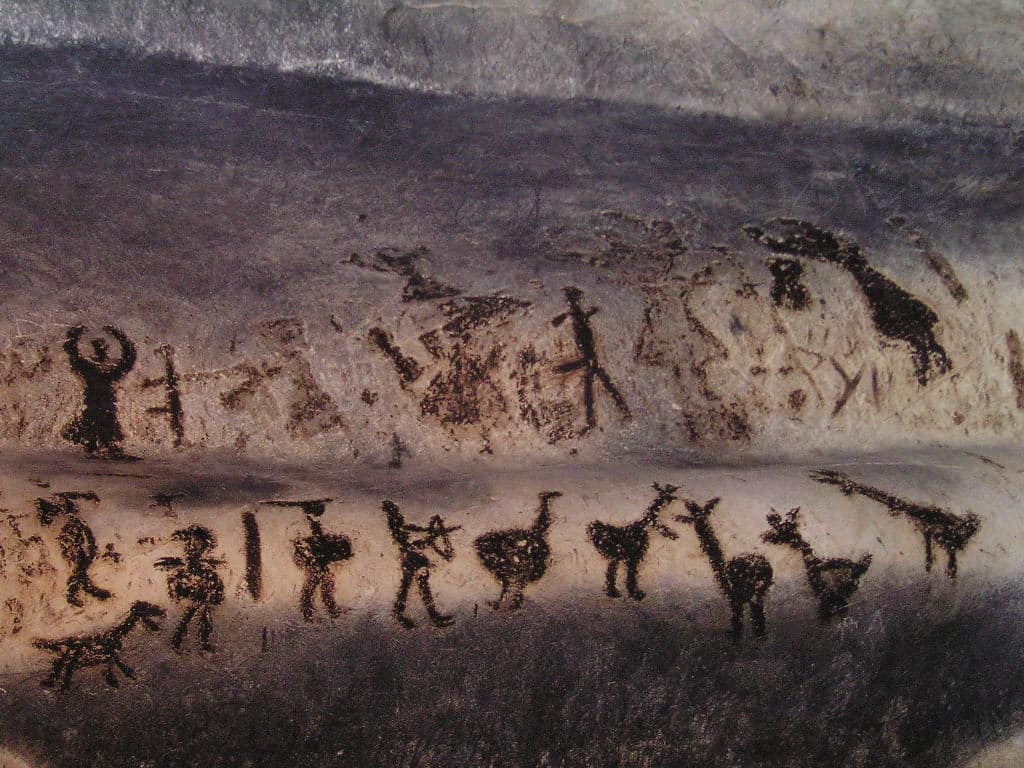
Prehistoric drawings in the Magura cave, Bulgaria. Credit: Nk / Wikimedia Commons / Public domain
Archaeologists in Bulgaria have uncovered rare textile fragments believed to be about 5,000-year-old inside Magura Cave, one of the country’s most important prehistoric sites.
Research director Dr. Vanya Stavreva announced the discovery during a press briefing at the BTA National Press Club in Vidin, noting that the find comes from ongoing excavations supported by the Municipality of Belogradchik for a third consecutive year.
Cave conditions help preserve fragile fabric
Researchers say the discovery is highly significant because ancient textiles almost never survive. Fabrics decay quickly in most environments. In this case, Magura Cave’s stable microclimate, with constant temperatures and high humidity, likely helped protect the material for millennia.
The fragments are expected to shed light on how prehistoric communities produced textiles, what fibers they used, and how clothing and craft traditions developed during the Early Bronze Age.
Scientific testing confirms Early Bronze Age dating
Dr. Stavreva explained that the textile fragments were found in an archaeological structure where charcoal samples had been previously collected for radiocarbon dating. Those samples dated the context to between 3300 and 3000 BC, placing the find at the beginning of the Early Bronze Age.
5,000-year-old textiles discovered in Bulgaria’s Magura Cave. A rare Early Bronze Age find revealing how prehistoric communities made and used fabric. #Archaeology #Science pic.twitter.com/UepBmRpwix
— Tom Marvolo Riddle (@tom_riddle2025) December 23, 2025
Laboratory studies carried out at the National Academy of Art confirmed that the fabric was made from hemp, a key raw material of the period, along with wool and flax.
A rare glimpse into prehistoric textile production
The archaeologist stressed that the discovery is not being described as unique, but it is regarded as extremely rare. In Bulgaria, finds of this kind from the same period are known only from Devetashka Cave, and they are limited in number.
Most knowledge about prehistoric textile production usually comes from indirect evidence such as spindle whorls and ceramic loom weights. Actual preserved fabric fragments are almost never found, making the Magura Cave textiles especially valuable for research.
Excavations expand the cave’s prehistoric timeline
Recent archaeological work has also expanded the known chronology of habitation in Magura Cave. Researchers have identified evidence for a transitional phase between the Chalcolithic (Copper Age) and the Early Bronze Age, helping fill an important gap in regional prehistory.
The cave’s natural environment has become a crucial factor in preserving organic materials that rarely survive at open-air sites.
Artifacts set to go on display
Alongside the textile fragments, archaeologists uncovered a restored ceramic vessel, bone artifacts, and other finds. These will go on public display in February at the National Archaeological Institute with Museum, marking the first time Magura Cave will participate with its own artifacts.
For now, all discoveries are housed at the Belogradchik Historical Museum, with future plans to exhibit some of them either inside the cave or in museum collections.
Belogradchik Mayor Boyan Minkov described Magura Cave as a treasure of global value. He said the site is important not only for Bulgaria and Europe but for the entire world, praising the partnership between the municipality and the scientific team in uncovering and protecting the region’s cultural heritage.