
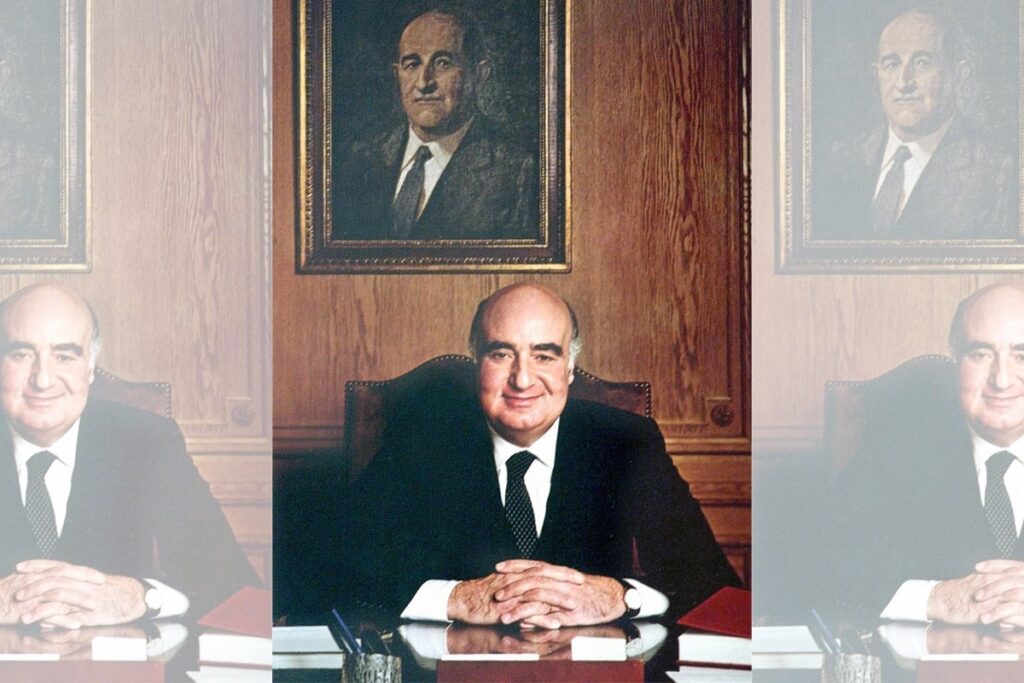
Netflix’s new hit documentary “Murder in Monaco” doesn’t offer new answers about the 1999 death of Edmond Safra, the Jewish billionaire and banking scion, who was killed, along with one of the nurses in his employ, Vivian Torrente, in an apartment fire deemed to be arson. Safra, who was battling Parkinson’s, was 67 when he died in the bathroom of his Monaco penthouse.
Like many crime documentaries, it spends little time on the actual victim and a lot of time on those who may or may not have led to Edmond’s death. It asks: Was his wife, Lily Safra, the Brazilian-born Jew and so-called “social climber” who inherited his fortune, involved? Was it the Russian mafia, whose corruption Safra had exposed to the FBI? Was it the negligence of the police and firefighters in Monaco, who couldn’t reach him, barricaded in the bathroom, paranoid about potential armed invaders? Or was it Safra’s other nurse and supposed former Green Beret Ted Maher, the only man to see said invaders, and who admits to lighting the fire in Safra’s penthouse in an attempt to play the hero? Maher is, after all, the man who was convicted of the crime and who served a prison sentence for it.
Viewers will have to answer that for themselves. But for those wondering who Safra was, here’s what you need to know.
Who was Edmond Safra?
At the time of his passing, Edmond Safra was one of the richest men in the world and known as one of history’s greatest bankers. He was just 15 when he was sent to Milan to establish the family’s business there, and he was the one who urged the family to move to Brazil, where they opened Banco Safra. He was the founder of Republic New York Corporation and Republic National Bank of New York, which catered to wealthy private clients. He also founded the private Trade Development Bank in Geneva, which he later sold to American Express.
Edmond Safra was born in Beirut, into a family whose banking roots, according to the website of the Edmond Safra Synagogue in New York, date back to the Ottoman Empire. His father, Jacob Safra, was a Jew from Aleppo, Syria, who opened a bank in Beirut. His mother, who died when he was young, inspired him to focus on philanthropy.
“Fluent in six languages, and with an eye for value, managing risk, and personal potential, Safra was in perpetual motion until his tragic death in 1999,” Dan Gross, who penned the 2022 “A Banker’s Journey” about Safra, wrote.”The modern, global financial empire he built was based on timeless principles: a banker must protect his depositors and avoid excessive leverage and risk. In an age of busts and bailouts, Safra posted remarkable returns while rarely suffering a credit loss.”
How involved was he in the Jewish community?
Safra was incredibly committed to his Jewish faith and history. He was known for championing Jewish causes in Israel and the diaspora, and especially for his dedication to his Sephardic community and Jews from Aleppo.
“The Sephardic world has lost its crown,” Clement Sofer, a leader in the Egyptian and Syrian community, shared after Safra’s death, according to JTA, “He was like a wonderful king. He just helped the people without asking anything back. I don’t think on this planet we have somebody else to take over his shoes.”
“[His death] will have a tremendous effect,” Rabbi Moshe Shamah of Brooklyn’s Sephardic Synagogue told JTA. “Practically every institution opened in the Middle Eastern Jewish community would think first about how they can count on Safra.”
Alice Sardell Harary, the president of the Council for the Rescue of Syrian Jews, added: “I would venture to say that there is not a Jewish community in this world that has not been touched by Edmond Safra’s kindness.”
There are so many Jewish spaces named after Safra, including multiple synagogues, museums and educational institutions.
The Shema prayer is inscribed on his grave in Geneva, and the Hebrew words “tzadik be’emunato yichye,” — “a just man lives in his faith,” from the book of Habakkuk. Safra was expected to be buried in Israel, where the family helped establish many a synagogue, but security concerns at the time of his death made that too hard.
His funeral was attended by hundreds, including Elie Wiesel. “You have brought together people from different backgrounds, cultures, religions and social horizons, just as you always have,” Wiesel said at the funeral.
What did Lily Safra actually have to say about her husband’s death?
We don’t know what Lily Safra said at her husband’s funeral, but she did speak, via live audio broadcast, at a New York memorial service where she read a letter written by one of their granddaughters. (Edmond and Lily did not have any children, but he welcomed her children from a previous marriage and her grandchildren into his family.)
Lily spent much of the rest of her life working to keep his memory and the legacy of his philanthropy alive through the Edmond J. Safra Foundation. She lived in London, where she rubbed elbows with Prince Charles and Jacob Rothschild and organized charity events featuring Elton John.
“Their foundation endowed the Edmond J. Safra Center for Ethics at Harvard, the Edmond J. Safra campus at the Hebrew University of Jerusalem, the Edmond and Lily Safra International Institute of Neuroscience in Brazil and the Edmond and Lily Safra Children’s Hospital in Israel,” according to the New York Times.
Safra also dedicated herself to the cause of helping treat and prevent Parkinson’s, the disease her husband battled with at the end of his life. She was on the board of directors of the Michael J. Fox Foundation for Parkinson’s Research.
“Lily’s friendship was instrumental in establishing our path and expanding our work further than we could have dreamed,” Michael J. Fox and Tracy Pollan shared after her death. “She sharpened our vision and lent us her strength so that we might make a greater difference in the lives of all people and families touched by Parkinson’s disease.”
What happened to Safra’s family?
Edmond’s wife, Lily, died in 2022, as the documentary says, and she is buried next to her late husband in Geneva’s Jewish Cemetery of Veyrier.
Edmund’s brother Moise died in 2014, and when his brother Joseph died in 2020, he was the richest person in Brazil. The documentary suggests that the Safra brothers did not approve of the match with Lily, who was Ashkenazi and secular. Edmond was an avowed bachelor who feared that a woman would marry him for money, but Lily came to the marriage with wealth of her own. Lily reportedly did not invite Joseph and Moise to Edmund’s Geneva funeral, and the two were reportedly upset that their brother was not buried in Jerusalem.
Safra’s three sisters, Arlette Friedler, Gaby Safra and Huguette Michaan, not mentioned in the documentary, have also died.
Having no children of his own, Edmund Safra sold his business shortly before his death, after Parkinson’s made him unable to run it. Half of Safra’s fortune was donated to charity.
Can we ask?
It’s important to us to keep the warm, joyfully Jewish community on Kveller accessible for all. Reader donations help us do just that. Can you spare a few to keep Kveller free? (We’ll love you forever.)