
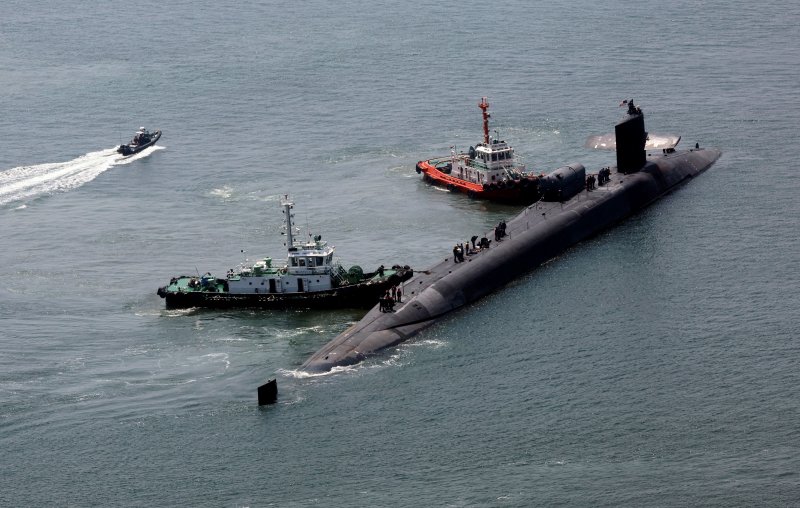
South Korea and the United States have agreed to pursue a stand-alone agreement on cooperation for nuclear-powered submarines, with working-level talks expected to begin early next year, National Security Adviser Wi Sung-lac said Friday.
Wi made the remarks after returning from a weeklong trip to the U.S., Canada, and Japan, where he met with U.S. Secretary of State Marco Rubio, who also serves as national security adviser, and U.S. Energy Secretary Chris Wright in Washington, News.Az reports, citing Yonhap.
He noted that the two sides conducted “practical and in-depth consultations” on security agreements outlined in a joint fact sheet released last month, following President Lee Jae Myung’s summit with U.S. President Donald Trump on the sidelines of the Asia-Pacific Economic Cooperation summit in Gyeongju in late October.
“We shared the view that a stand-alone agreement on cooperation over nuclear-powered submarines is necessary, and agreed to move forward with discussions,” Wi told journalists.
While Section 91 of the U.S. Atomic Energy Act bans the transfer of nuclear materials for military use, Wi said Seoul is seeking a U.S. exception or exemption by signing a separate agreement on nuclear-powered submarines, which would allows the U.S. president to authorize such transfers.
Australia took a similar approach, signing a separate pact with Washington for its nuclear-powered submarine program under the AUKUS security partnership.
During discussions on uranium enrichment and reprocessing of spent nuclear fuel, Wi said he reaffirmed Seoul’s commitment to nuclear non-proliferation.
South Korea plans to secure low-enriched uranium at levels below 20 percent to fuel the nuclear-powered submarines, Wi said, stressing that highly enriched uranium is not under consideration.
A working-level U.S. delegation is expected to visit South Korea early next year to hold consultations on implementing the agreements outlined in the joint fact sheet, he added.
Under a bilateral nuclear accord with the U.S., South Korea is largely prohibited from enriching its own uranium and must import all of its low-enriched uranium.
Calling uranium supply an issue that requires “strategic cooperation,” Wi added that Seoul and Washington have agreed to move discussions forward quickly and to review progress through high-level meetings sometime next year.
During his trip to U.S., Wi also exchanged views on the security situation on the Korean Peninsula and explored ways to resume stalled talks with North Korea.
Wi said he met U.N. Secretary General Antonio Guterres in New York to discuss ways to promote peace and stability on the Korean Peninsula.
Asked about the prospects of resuming dialogue with Pyongyang, he said Seoul would continue diplomatic efforts whenever opportunities arise.
His visit to Canada focused on strengthening security and defense industry cooperation, including promoting South Korea’s advanced shipbuilding capabilities for Canada’s patrol submarine program, which aims to procure up to 12 diesel-powered submarines.
During his stop in Japan, Wi met with Foreign Minister Toshimitsu Motegi to discuss maintaining stable bilateral relations and coordinating efforts for peace on the Korean Peninsula.
He also likely coordinated the agenda for Lee’s anticipated summit with Japanese Prime Minister Sanae Takaichi, with consultations under way for Lee’s visit to Japan next month.
Asked whether the two sides discussed Takaichi’s renewed claims over South Korea’s easternmost islets of Dokdo, Wi remained cautious, saying only that they broadly agreed on the need to further develop their partnership.