
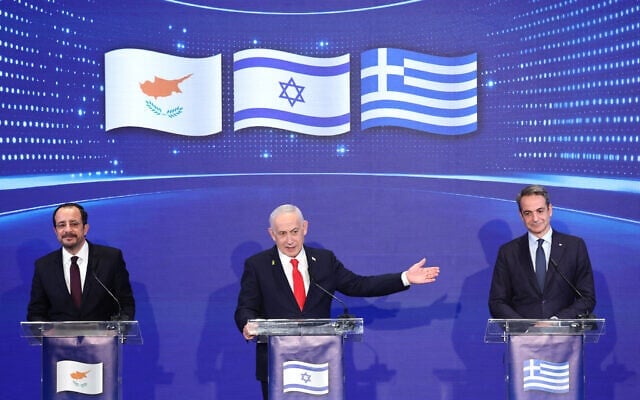
In the Eastern Mediterranean, infrastructure has become power—and power has become measurable.
What binds Israel, Greece, and Cyprus today is not diplomatic theater but quantifiable assets: trillions of cubic feet of gas, billions of euros in infrastructure, thousands of kilometers of contested seabed, and a growing lattice of military capabilities designed to survive pressure from Ankara. This is not a soft alignment; it is a hard, material strategy built for endurance.
In this equation, energy is the foundation. Israel’s offshore gas discoveries—Tamar (≈10 trillion cubic feet) and Leviathan (≈22 trillion cubic feet)—redefined the country’s strategic horizon after 2009. In the same way, Cyprus followed with Aphrodite (≈4.5 tcf), creating an Eastern Mediterranean gas basin large enough to matter geopolitically, even if not to replace Russian supplies wholesale.
Together, these fields anchor export contracts worth tens of billions of dollars over multi-decade horizons, primarily to Egypt and regional markets, but always with Europe in view.
Meanwhile, Greece’s role is not geological but logistical and political: it is the EU-facing hinge that turns offshore molecules into European relevance.
These numbers matter because energy contracts lock states into shared risk. Disputes over reservoirs like Aphrodite–Ishai dragged on for over a decade precisely because unresolved unitization could jeopardize investment, delay development, and invite external interference. The recent move toward settlement reflects a strategic truth: fragmentation is a vulnerability Turkey can exploit; integration is a shield. Gas here is not merely fuel—it is time, leverage, and predictability converted into alignment.
Simultaneously, electricity escalates the logic. The undersea power interconnector linking Israel, Cyprus, and Greece—projected at roughly €2–3 billion, spanning over 1,200 kilometers of subsea cable—is designed to end Cyprus’s status as the EU’s last energy-isolated member state.
Once connected, Cyprus plugs directly into the European grid. Israel, for the first time, gains a physical electrical umbilical to Europe. This transforms political risk. Sabotaging or coercing such infrastructure is no longer a bilateral dispute; it implicates EU energy security, regulators, insurers, and capital markets. That is precisely why Turkish naval pressure has repeatedly targeted survey vessels. The cable’s vulnerability is not a weakness—it is the reason it changes the game. It internationalizes deterrence.
History sharpens the picture. Turkey’s Eastern Mediterranean doctrine did not emerge overnight.
From the 1974 invasion of Cyprus to the articulation of Mavi Vatan (“Blue Homeland”) in the 2010s, Ankara has consistently fused maritime claims with military signaling.
Hence, its navy is now the largest in the Eastern Mediterranean, operating over 150 vessels, backed by a defense industry that produces indigenous drones, corvettes, and submarines.
The message has been clear: presence creates facts. The Israel–Greece–Cyprus response has been equally clear, but quieter—facts can also be laid in concrete, steel, and fiber-optic lines.
Yet, defense cooperation supplies the muscle behind the math. Israel’s security relationship with Greece deepened rapidly after the 2010 Israel–Turkey rupture, culminating in joint air exercises, intelligence sharing, and long-term training arrangements.
By the same token, Greece’s decision to procure Israeli systems—air defense, intelligence platforms, and precision capabilities—reflects not ideology but arithmetic. In a region where reaction time is measured in minutes, interoperability saves hours and hours save territory.
However, the most consequential shift is underwater. Israel’s development and export of autonomous underwater vehicles—often described as “submarine drones”—marks a doctrinal evolution in maritime deterrence. Systems such as the BlueWhale are designed for weeks-long endurance, passive intelligence collection, and seabed monitoring at depths where traditional patrols are inefficient or politically escalatory.
In a sea increasingly crowded with pipelines, cables, and survey routes, seabed awareness is strategic dominance. Thud, undersea autonomy denies plausible deniability while turning covert interference into detectable behavior. This way, it protects infrastructure whose repair timelines can stretch into months and whose disruption can trigger market shock within hours.
Turkey understands this shift. Its leverage has always rested on proximity and tempo—the ability to appear first, stay longer, and signal harder.
Nevertheless, autonomous underwater systems invert that advantage. They privilege persistence over presence, data over drama. They are cheaper than submarines, harder to detect, and perfectly suited to a gray-zone environment where escalation is calibrated rather than explosive.
Strip away the diplomacy, and the picture is stark. Israel, Greece, and Cyprus are constructing a regional order in which coercion becomes inefficient. Gas binds markets for decades. Power cables bind grids and institutions. Defense cooperation binds militaries beyond election cycles. Undersea systems bind awareness to deterrence. Each layer reinforces the next. None requires a formal alliance. All raise the cost of disruption.
This is why Ankara pushes back—not because the projects are provocative, but because they work. They erode veto power without firing a shot. They replace ambiguity with embedded interests. They turn the Eastern Mediterranean from a theater of unilateral pressure into a networked space where interference multiplies consequences.
In this sea, power no longer announces itself only with flags and frigates. It flows through contracts signed for 20 years, cables laid for 40, and systems designed to watch silently for weeks. Israel, Greece, and Cyprus have understood something fundamental: deterrence in the 21st century is not always loud. Sometimes it hums—through gas lines, through power grids, and through machines moving unseen beneath the waves.
Jose Lev Alvarez is an American–Israeli scholar specializing in Israel Studies and Middle Eastern Geopolitics.
Lev holds a B.S. in Neuroscience with a Minor in Israel Studies from The American University (Washington, D.C.), completed a bioethics course at Harvard University, and earned a Medical Degree.
On the other hand, he also holds three master’s degrees: 1) International Geostrategy and Jihadist Terrorism (INISEG, Madrid), 2) Applied Economics (UNED, Madrid), and 3) Security and Intelligence Studies (Bellevue University, Nebraska).
Currently pursuing a Ph.D. in Intelligence Studies and Global Security at Capitol Technology University, his research focuses on Israel’s ‘Doctrine of the Periphery’ and the Abraham Accords’ impact on regional stability.
A former sergeant in the IDF Special Forces “Ghost” Unit and a U.S. veteran, Jose integrates academic rigor, field experience, and intelligence-driven analysis in his work.
Fluent in several languages, he has authored over 250 publications, is a member of the Association for Israel Studies, and collaborates as a geopolitical analyst for Latin American radio and television, bridging scholarship and real-world strategic insight.