
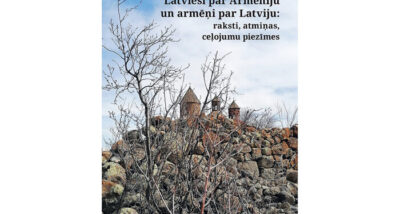
The Academic Publishers of Latvia has released the volume Latvians about Armenia and Armenians about Latvia: Articles, Memoirs, Travel Notes (258 pages). It was compiled and edited by the Latvian-Armenian scholar of religion, Associate Professor at the University of Latvia Elizabete Taivāne (see my interview with her in the Mirror-Spectator of October 12, 2023).
The book consists of two parts. The first section (“Armenians in Latvia and in Latvian Literature”) opens with economist Ruzanna Grigoryan’s article “Armenians in Latvia and the Latvian Environment.” It summarizes information about Armenians living in Riga from the mid-19th century: students of the Polytechnic School, local Armenian merchants, the Armenian church, and notable compatriots who lived and worked there.
In his article “Jānis Rainis and Armenia,” Leons Gabriels Taivāns, Professor of Asian Studies at the Faculty of Humanities of the University of Latvia, examines publications about Armenia during Latvia’s independence period, including materials in the Latvian Encyclopedia, some of which were authored by great Latvian poet Rainis himself.
In her article “The Portrayal of Armenians in Latvian Literature,” Armenologist Valda Salmiņa presents literary works featuring Armenian characters, Armenian reality, and customs. The introduction speaks about the making of Rainis’ article “The Most Unfortunate Country and People: Notes about Armenia.” It mentions the poet’s personal contacts with Social Democrat Ashot Khumaryan, who, at Rainis’ request, prepared materials on Armenian history, press, and literature. The article also discusses Minna Freimane’s travelogue depicting Western Armenia and Gyumri, her encounters with Armenian women; Ernest Birznieks-Upītis’ story “The Little Riders” (about the Armenians of Artsakh), and Pāvil Grūzna’s novella “New Current,” one of whose heroes is the Armenian tavern-keeper Yenovk Kazarov.
The book also includes contemporary authors Lauris Gundars and Luīze Pastore. Drawing on his Armenian heritage, Gundars analyzes the relationship between names and identity in his novella “Becoming a Stranger,” while in Pastore’s children’s story “The Circus on Rainis Street,” the Armenian character Vip Vipatossyan symbolizes cultural distinctiveness and difference.
In her article “The Armenian Artist from Riga: Babken Stepanyan,” Nadezhda Pazukhina presents Stepanyan’s artistic path and his collage technique, which reflects the transformations of the era. Pianist, musicologist, educator, and public figure Rafi Haradžanjans (Raffi Kharajanyan) provides detailed memoirs of his meetings with Latvian composers of middle and senior generations.