
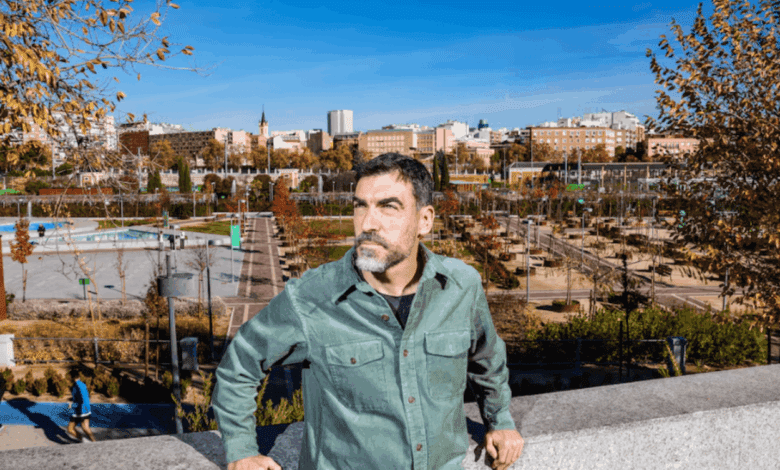
Javier Pérez, head of the independent organization Political Watch and winner of the Ashoka Fellow 2025 award, welcomes the journalist at Vallehermoso Stadium in Madrid. For him, this venue is more than just a sports arena—it stands as a symbol of residents’ victory over an attempt to turn the stadium into an exclusive golf course. Pérez emphasizes that it was only thanks to the neighbors’ persistence and their legal battle that the stadium remained open to everyone. He runs here in the mornings, and today he shares his views on democracy and civic participation.
Pérez describes his work as an effort to strengthen democracy. To him, democracy is not just about laws and official buildings, but above all, about people living together, their ability to reach agreements, and their power to influence decisions that affect everyone. He believes Spain becomes stronger when citizens don’t just watch from the sidelines but bring ideas forward and help make decisions. Yet, he notes, such initiatives now often go against the system rather than being supported by it. Political Watch works to make state information clear and accessible, turning it into a tool for collective action.
Democracy and Disillusionment
Peres acknowledges that many Spaniards today are disillusioned with democracy and question its effectiveness. He believes that democracy must once again become attractive and deliver tangible results. People should see public institutions not as faceless entities, but as partners willing to listen and help. Peres offers an example: although Spain’s constitution guarantees the right to petition, victims of natural disasters had to turn to the European Parliament because they found no support in either the national parliament or regional authorities. He insists that the state should be an ally, not an obstacle.
Within his organization, Peres and his team translate complex data on the work of the Congress of Deputies into clear information so civil society groups can use it in their campaigns and hold politicians accountable. They also monitor all government spending in real time — from central authorities down to municipalities. Any organization suspecting misuse of funds can review the data and, if necessary, demand an investigation. Peres notes that in Brazil, about one and a half million people participate in public consultations, while in Spain the average is only 40. But in his view, the worst outcome is when people take part yet nothing changes — this only deepens frustration.
Collective experience
According to Pérez, more and more people in Spain are living individually, lacking experience in collective action. He notes that many avoid participating in neighborhood associations or parent committees, preferring to look after only themselves. Pérez believes that the habit of collective participation is gradually disappearing, and without it, democracy loses its strength. He compares democracy to a virus that society must be ‘inoculated’ with to prevent it from fading away.
There are two places that have shaped Pérez’s life — Boston and Vallecas. He grew up in a modest neighborhood of Madrid, and at age seven, moved with his family for a year to Boston, where his father taught at MIT. Returning to Spain was a true culture shock, but the experience helped him appreciate the opportunities and privileges provided by family and environment. Pérez says it taught him to see extraordinary people as ordinary and ministers as people with the same flaws as everyone else.
First steps toward change
Pablo Osés and Javier Ripollés—family friends who supported allocating 0.7% of the budget to fight poverty—had a significant influence on Peres. As a child, he saw them mobilize thousands for demonstrations, hunger strikes, and public actions. Peres recalls how his parents allowed him to join: he camped out on Paseo de la Castellana and took part in events at La Almudena Cathedral. This experience taught him the power of collective action and inspired his commitment to public service. He later pursued studies in law and economics, aiming to work in international cooperation and social justice.
When asked whether he has ever been invited into politics, Peres sidesteps the question. He considers it more important to remain independent and to focus on engaging citizens in decision-making. His main goal is to help everyone have a say in what happens around them and make government more accessible and transparent to all.