
Unlock the Editor’s Digest for free
Roula Khalaf, Editor of the FT, selects her favourite stories in this weekly newsletter.
The Bayeux Tapestry is set to be covered by a UK Treasury indemnity of about £800mn during its loan to the British Museum in 2026, in a sign of the extraordinary value attached to the 70-metre fabric depiction of the Norman Conquest.
The indemnity, backed by the British taxpayer, will cover the tapestry against damage or loss during its transfer from Normandy to London and while it is on display for what is expected to be the biggest blockbuster exhibition for a generation.
The Treasury told the Financial Times that it had “received an estimated valuation of the Bayeux Tapestry which has been provisionally approved”.
Officials briefed on the project said they expected the final valuation to be “around £800mn”, a sum not disputed by the finance ministry, although it declined to comment on the price expected to be attached to the priceless artefact.
That is more than twice the value of the most expensive artwork ever sold at auction: “Salvator Mundi”, the Leonardo da Vinci painting of Jesus commissioned by King Louis XII of France, which sold at Christie’s in New York in 2017 for $450mn.
The Treasury indemnity, which will have to be signed off by chancellor Rachel Reeves, is part of a complex agreement between Britain and France to cover the loan of the tapestry, announced by President Emmanuel Macron during his state visit to London in July.
The transfer of the almost 1,000-year-old woollen embroidery on a linen backing from its home in Bayeux to the British Museum in central London has been criticised by some in the French art establishment, who fear it will be damaged during its loan to Britain.
A six-page “administrative agreement” between the British and French culture ministries, recently released, sets out in detail how the work will be transported to London and how it must be protected when the British Museum exhibition opens in September.
The deal refers to “the temporary relocation of a fragile and degraded thousand-year-old textile” and how it must be moved to London in a special crate, with provisions for it to be displayed behind a protective screen.
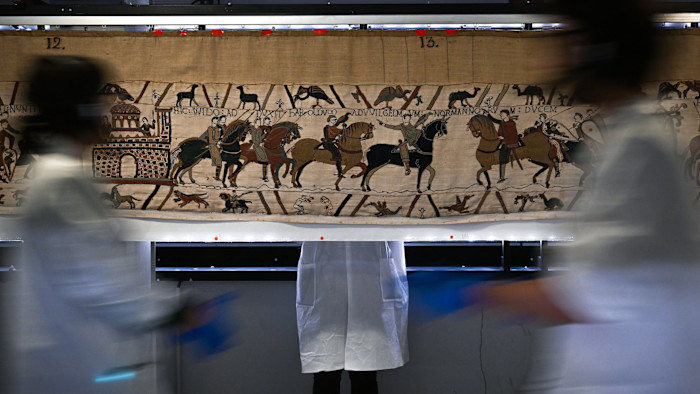
 Workers and volunteers prepare the Bayeux Tapestry for packing before its move to London © Lou Benoist/AFP via Getty Images
It says that the “French state” will oversee a “dry run” of the transfer to London, “using the crate containing a facsimile of the tapestry, equipped with a vibration analysis device”.
The crate must be “compliant with isothermal preservation standards”, the agreement states. People briefed on the project said they expected the tapestry to come to London in a truck, travelling via the Channel Tunnel.
The deal says the British Museum is responsible for the display and safekeeping of the tapestry during its stay in London until July 2027 and “at its own expense, carry out the condition report upon the return of tapestry to Bayeux”.
George Osborne, former Conservative chancellor and chair of the British Museum, has said he expects the Bayeux Tapestry to be “the blockbuster show of our generation”, comparable in scale to the famous Tutankhamun exhibition of 1972.
The tapestry, which tells the story of the Norman invasion of England in 1066, is thought to have been made by nuns in England in the 11th century. Its iconic comic strip-style telling of the story is expected to spawn a merchandising bonanza for the British Museum.
The Government Indemnity Scheme is a long-standing provision that allows museums and galleries to borrow high-value works for major exhibitions.
Recommended

“Without this cover, public museums and galleries would face a substantial commercial insurance premium, which would be significantly less cost effective,” the Treasury said.
It has been used for numerous high-value loans, including Vincent van Gogh’s “The Bedroom”.
The GIS is estimated by the Treasury to have saved UK museums and galleries approximately £81mn compared with commercial insurance.
The government said in a statement: “The Treasury has received an estimated valuation of the Bayeux Tapestry which has been provisionally approved. The loan will not be formally confirmed until we receive the final valuation.”
The tapestry’s loan to the British Museum takes place while the work’s home in Bayeux undergoes restoration work.
British artefacts, including the Sutton Hoo treasures, will be sent to Normandy museums as part of a cultural swap.