
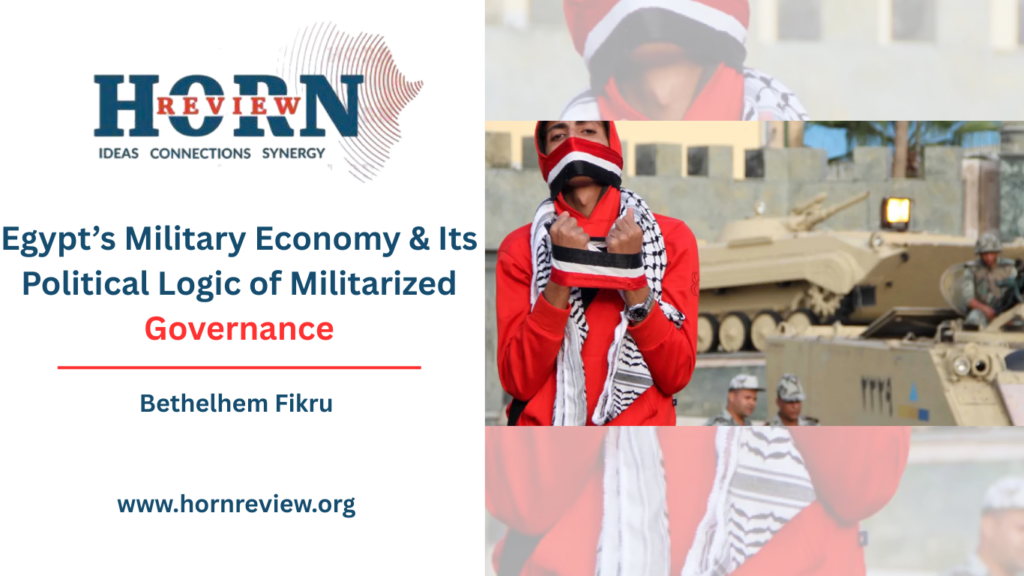
Since seizing power in 2013, President Abdel Fattah al-Sisi has overseen a dramatic transformation of the Egyptian state: not merely in the realm of security and politics but in the very structure of the economy itself. What began as a bounded military economic enclave has, over the past decade, evolved into a dominant model of state capitalism where the military functions not simply as a defense institution but as the central economic agent of the regime. This shift reflects both Sisi’s political priorities and an emerging system of economic governance that privileges militarized control over sustainable, inclusive growth.
At the heart of this transformation lies a strategic calculation: the military is not just an instrument of coercion but an instrument of economic command. In the early years of the 21st century, military business activities in Egypt were largely confined to internal patronage , perks and fringe benefits for cadres and officers that did not fundamentally reshape national economic balances. These projects were largely an “enclave” insulated from broader economic dynamics and pursued primarily to secure elite loyalty. Under Sisi, however, this model has been both broadened and deepened, positioning the military at the center of national economic planning, execution, and ownership.
Sisi’s justification for this expansion has always been framed in the language of efficiency and national capacity. Civilian bureaucracies are routinely portrayed as corrupt, lethargic, and incapable of delivering results. By contrast, the military is cast as a disciplined, technocratic force capable of execution at scale and pace. This discourse resonates with a wider political narrative: the state must demonstrate visible achievements, and only the military has the bandwidth to deliver them. It is a logic that privileges order and visibility over participatory governance or economic innovation.
The most vivid example of this is Egypt’s New Administrative Capital (NAC), a large-scale, multi-billion dollar project located east of Cairo, touted by Sisi himself as a demonstration of the state’s capabilities. Developed under the management of military-related institutions and financed by borrowing, the NAC can be viewed as a quintessential representation of the capacity and fallibility of the militarized paradigm. From its dramatic symbolism, shining towers, wide streets, and large-scale investments in infrastructure, the economic rationale tends to be opaque. As is often argued, many large-scale projects “sink capitals” in the name of symbolism but fail to deliver long-term employment-generating capabilities or provide a foreign exchange revenue stream. International pressure, even from within Egypt’s private sector, has also cautioned against the state’s heavy reliance on foreign exchange reserves due to the state’s mega-investment policies.
In defense of Sisi, it is suggested that change in infrastructure must be done with an iron fist; Egypt’s bureaucracy is not capable of making infrastructure investments quickly enough. However, there is an element of truth that corruption and an overly bureaucratic government have long hindered growth. But with military intervention not just within infrastructure but within industries such as steel, cement, agriculture, and retailing as well as others ,there seems to be an underlying issue that state power is stifling enterprise instead of facilitating it. The military’s influence within society has reached an extent that it directly competes with the private sector. It gets all the best deals: tax exemptions and special financial treatment that other enterprises do not receive.
This rivalry is not a mere aftereffect; rather, it is a natural characteristic of the system in place. The resultant economic growth established by the military has been characterized as a type of state capitalism whereby leverage is realized through entities such as Tahya Misr Fund, sovereign wealth funds, and military factories at the expense of the private sector. According to experts , this has led to the drainage of capital, a low value of the exchange rate, and distortions in the strategic sectors, which has created tension between global bodies proposing privatization to countries such as Egypt to achieve economic progress, with little to be achieved in the military privatization process.
The political rationale for this expansive role is two fold. First, the military serves as a regime stabilizer in a political context where elite cohesion cannot be taken for granted. By embedding officers in economic networks and granting them control over lucrative sectors, the regime creates vested interests that are aligned with its survival. Second, the military’s economic presence functions as a legitimacy device at home and abroad: projects become proof of competence, and Sisi’s Egypt is marketed as open for investment and capable of transformative feats. What this obscures, however, is that visible infrastructure does not automatically translate into broad-based growth or productivity improvements.
The impact of such a militarized political economy is already apparent. So too have been the complaints of private investors, from old Egyptian families to regional capitals, about the uneven playing field. There are investors who have already diversified holdings to other neighboring countries where such investors feel the policy predictability is more reliable. On the other hand, the local economic data, from inflation to unemployment, suggests problems that large projects are not capable of addressing.
In order to grasp the military economy in Egypt, it is necessary to recognize the military economy not only as a series of isolated investments but also as a component of a governance agenda. The military in Egypt is a major organizational force in the state. It dwarfs the size of the rest of the state’s institutions. By doing so, it maximizes economic outcomes in a manner which actually indicates political as opposed to economic motivations.
Egypt’s military economy should be understood less as an anomaly than as a governance choice shaped by political uncertainty and institutional weakness. It has delivered order and visibility at a critical juncture, but at the cost of flexibility and inclusiveness. Whether this model can evolve to support long-term competitiveness remains an open question, one that will shape Egypt’s economic and political trajectory well beyond the present decade.
By Bethelhem Fikru, Researcher, Horn Review