
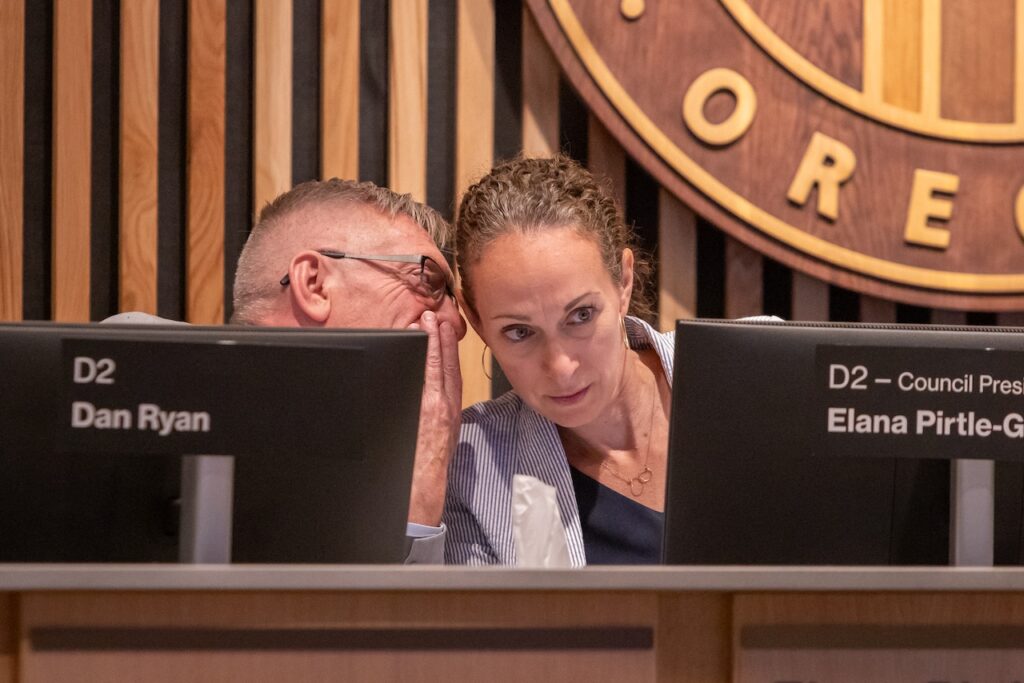
It’s been no political picnic for Elana Pirtle-Guiney in the 12 months since she narrowly became Portland’s first council president under the city’s new form of government.
She has presided over an often-divided legislative body, whose members have at times bristled at her leadership and struggled to find a functional framework for doing business or to even agree on what that might look like.
She has been unable to forge a governing majority or cement a coherent council policy agenda, despite a willingness to give her colleagues equal voice and her frequent efforts to build consensus on shared priorities.
Still, she hopes to continue in the role come January.
“Good policy takes a lot of work,” said Pirtle-Guiney, 40, who represents North and Northeast Portland. “I am always going to try to find places where we can bring more people into the tent. Unapologetically.”
It’s unclear whether Pirtle-Guiney — or a potential challenger — can muster the seven votes needed to win the presidency when she and her 11 council colleagues return from winter recess early next month, adding yet another potential layer of instability to the burgeoning body.
And it remains unknown how a different councilor could utilize or recast the president role, which comes with some agenda-setting authority but holds far less power than leaders in other legislative bodies.
With no declared opponent, the job, as she’s come to define it, is currently hers to lose.
Observers say Pirtle-Guiney has been an understated and steady presence during a topsy-turvy period in which councilors have attempted to stand up a brand new branch of government while facing fiscal headwinds, federal threats and a garden variety of municipal problems.
Perceived by many as a bridge builder between progressive and more traditionally liberal blocs on council, she has cast herself as a cautious facilitator focused on good governance rather than a flashy or iron-fisted leader out to claim an easy win.
But Pirtle-Gyuiney has also faced her fair share of criticism by those inside and outside City Hall. Some have faulted her for not fully wielding the authority she possesses, sufficiently empowering or controlling her council colleagues, or positioning the council to be a forceful enough counterweight to Mayor Keith Wilson and the city administration.
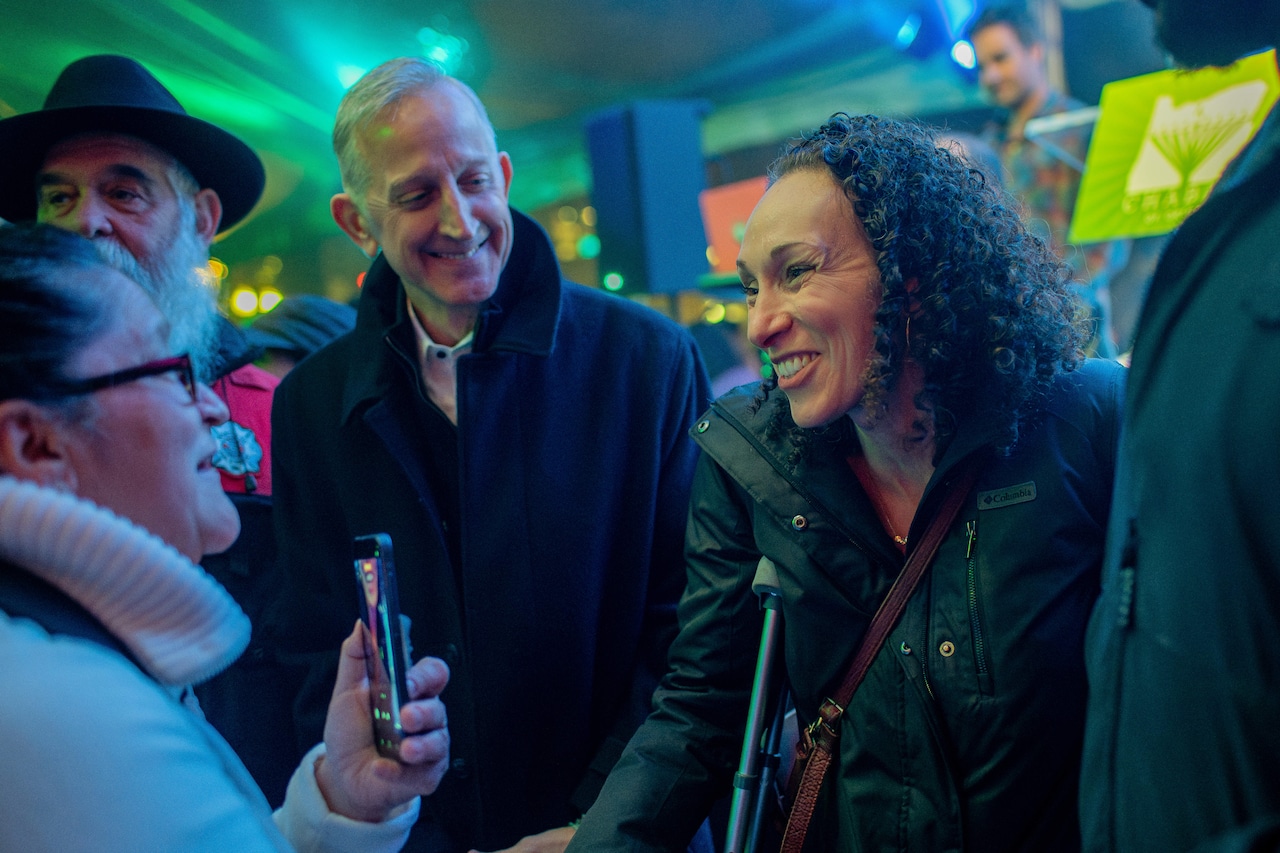 Portland Mayor Keith Wilson and Portland City Council President Elana Pirtle-Guiney attend the first night of Hanukkah during the lighting of Portland’s public menorah at Pioneer Courthouse Square on Sunday, Dec. 14, 2025.
Mark Graves/The Oregonian
“When you are in a position of leadership, people are always going to take issue with how you do things, raise questions,” said Pirtle-Guiney, who previously spent years as a labor union leader and governor’s adviser. “That is just the truth of being the first in a position like this.”
Many agree that this particular role comes with some remarkable hardships.
“I used to tell (former Portland Mayor) Ted (Wheeler) that he had the worst job in Oregon politics. Now, Elana has the worst job,” said retiring City Administrator Michael Jordan, echoing a view shared by a string of longtime local government workers and watchers.
“Imagine being there. No rules, no handbook, no cultural history,” Jordan continued. “Twelve people, all with a ‘newly elected psychosis,’ and you’re supposed to herd them up. And by the way, you’re supposed to be the person that liaisons with the 7,000 other (city workers) who don’t know what the hell they’re doing either. And with the mayor. And with the public. Holy s***.”
Councilor Jamie Dunphy offered his own blunt assessment of being council president.
“There’s no upside, and almost all downside. The majority of the time you’re just reacting to other people’s priorities,” said Dunphy, who would like to see the president’s gavel change hands next month. “Under no circumstances would I ever consider that job.”
Building a new system
Difficulties aside, Pirtle-Guiney said the role has offered a unique opportunity to help build a city government that Portlanders would like to see and ultimately come to trust: One that is more transparent and accessible to residents and laser-focused on supporting the needs of working people.
“I really do believe that my work this year was mainly about setting the precedents and creating the norms in this new system,” said Pirtle-Guiney, who lives in the Concordia neighborhood with her wife and two children.
She and others said she’s taken a largely collaborative approach with her council colleagues as well as with Portland’s reconfigured bureaucracy and its mayor, a former businessman with no prior government experience.
With the council’s approval, Pirtle-Guiney established eight five-member policy committees that each had a chair, vice chair or two co-chairs chosen by her, effectively doling out leadership assignments to every member — including those who did not back her council president bid. She’s also given her colleagues a great deal of leeway on how they use their time during council meetings she runs.
“We had 12 people come in essentially as equals with no seniority, no more experience in this system than anybody else,” Pirtle-Guiney said. “I think it was really important to make sure that everybody had space to prove themselves, to show what they would do with a job.”
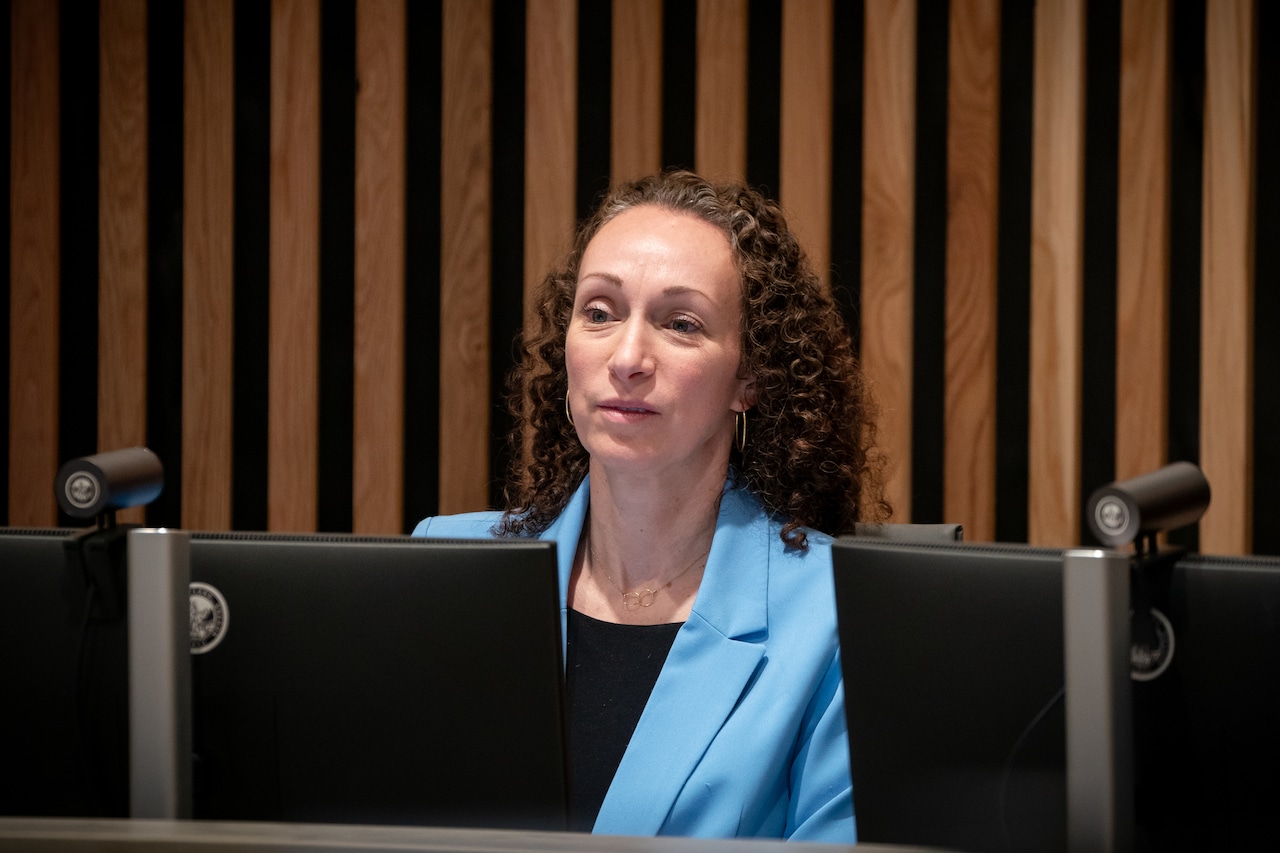 “I get the impression the council president wants to be a convener or coordinator and not make people mad,” said Terry Harris, a City Hall watchdog who served on Portland’s government transition advisory committee last year. “She hasn’t leaned into the powers that she has.”Mark Graves/The Oregonian
Councilors this year managed to ban the use of algorithms to set residential rents, suspend development fees in an effort to spur more housing production and stave off significant cuts to the Parks Bureau. They also approved an historic settlement for Black Portlanders displaced by urban renewal policies.
Pirtle-Guiney’s approach, however, has not been without some serious setbacks.
The sheer volume and variety of committee and regular meetings has often proven to be overwhelming for councilors, their offices and city staff and has been perceived by many members to be a persistent obstacle to their work. Yet time-consuming attempts to streamline or change the committee structure failed because councilors couldn’t agree on a fix.
Meanwhile, protracted discussions and heated disputes over rules, routine city business and interpersonal conflicts have become a defining feature of the body. That’s led to meetings that run hours longer than scheduled and caused councilors’ tempers to flare.
On many occasions, Pirtle-Guiney has refrained from demanding more professional conduct on the dais or enforcing procedural violations, allowing colleagues to veer wildly off topic or trade barbs.
“I get the impression the council president wants to be a convener or coordinator and not make people mad,” said Terry Harris, a City Hall watchdog who served on Portland’s government transition advisory committee last year. “She hasn’t leaned into the powers that she has.”
Still, Harris praised Pirtle-Guiney on her overall performance.
“She’s smart and thoughtful and probably works harder than anybody,” he said. “She’s done a great job under difficult political circumstances.”
A divided body
Pirtle-Guiney and her fellow councilors were all elected last year to an expanded 12-member City Council as part of Portland’s voter-approved government overhaul.
The new legislative body was given the mandate to set policy and control spending, with the mayor forbidden from vetoing legislation and allowed to cast a vote only in the case of a tie.
Yet the council has thus far been evenly split on a range of issues, often between a closely aligned six-member progressive caucus — known as “peacock” — and the other councilors, including the council president, who are less in lockstep.
While disagreements between various factions have flared on policing, livability and other contentious topics, there have also been sharp differences on governance and council operations.
In such instances, Pirtle-Guiney, a seasoned political operator who spent more than a decade working for the Oregon AFL-CIO and later for Gov. Kate Brown, said she tends to proceed with caution.
“For better or worse, I actually care about what my colleagues think and want,” she said. “I try to be cognizant of the places where I think there are things that divide us relatively evenly. And I’m careful about how I approach those places.”
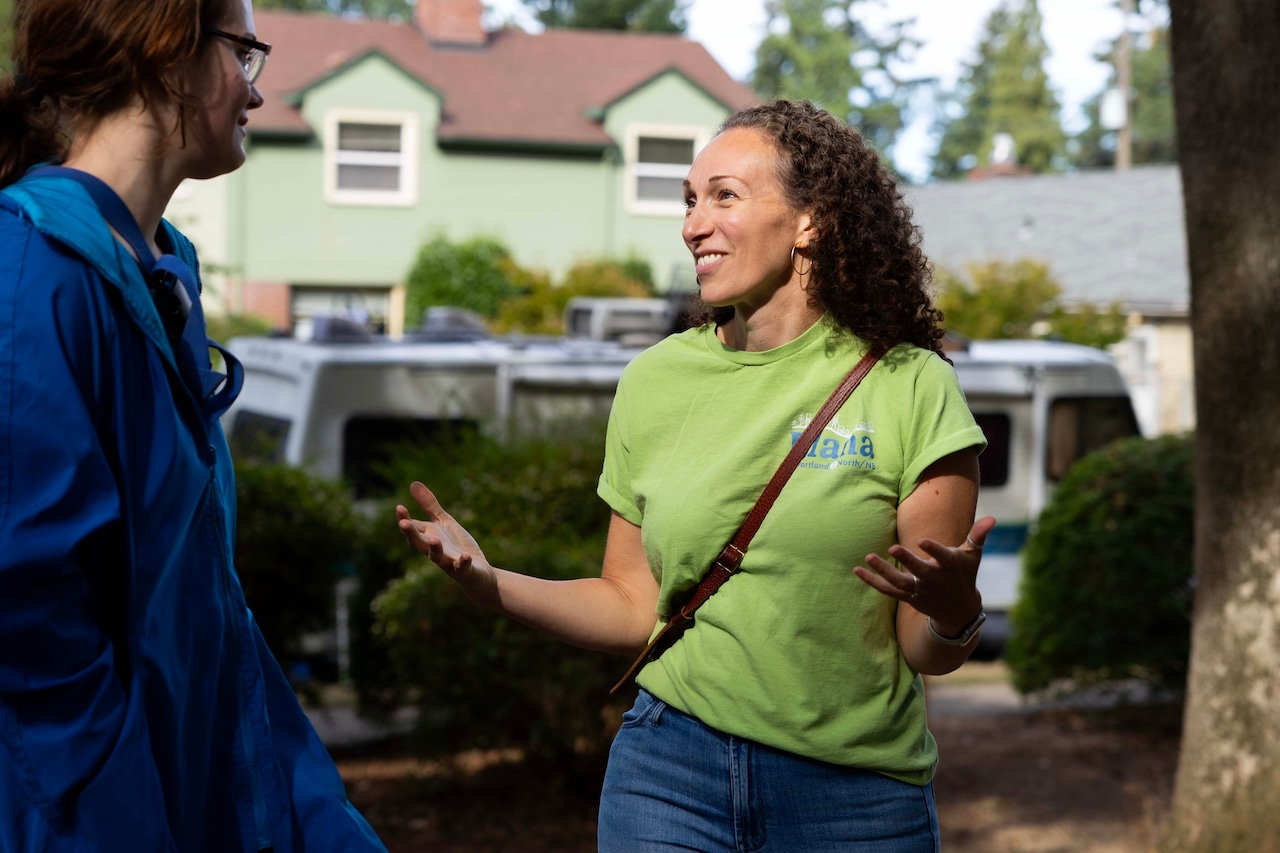 “Good policy takes a lot of work,” says Council President Elana Pirtle-Guiney, 40, who represents North and Northeast Portland. “I am always going to try to find places where we can bring more people into the tent. Unapologetically.”Allison Barr | The Oregonian/OregonLive
Often, that has not translated into achievements easily recognized by those outside City Hall.
“It’s been a weaker council than I would have predicted a year ago and I honestly don’t know what the council president’s job is,” said Portland pollster John Horvick, senior vice president at DHM Research.
By contrast, Horvick said, Mayor Keith Wilson has managed to mold himself into a stronger political figure than most envisioned he could, given the limitations of the job established in the government remake.
“Mayor Wilson has the benefit of staying focused on fewer things and has shown success in a way the council hasn’t been able to. The council doesn’t appear to be setting an agenda,” Horvick said.
Councilor Steve Novick, who would like to see Pirtle-Guiney remain council president, said the body’s members have shown little appetite for cohesion to date.
“This isn’t a council that follows leaders,” Novick said. “I think it’s pretty much 12 independent actors.”
Some of that appears to be by design.
Even before they voted during their first meeting to elect a leader, council members decided how much power they wanted to instill in that role. Ultimately, they landed on a compromise between opposing camps that were split on the level of authority the council president should have over other members.
Under the adopted rules, the council president sets meeting agendas but is required to bring forth any item proposed by a councilor or committee within 90 days. The president doesn’t unilaterally appoint committee chairs or vice chairs like the House Speaker or Senate President in the Oregon Legislature.
Meanwhile, any councilor can send a proposal to the committee of their choosing for discussion. And a group of four councilors can send an item to the full council if it does not make its way out of committee.
“Certain people did everything they could to dilute the power of the council president,” said Laurie Wimmer, executive secretary-treasurer of the Northwest Oregon Labor Council, referring to a handful of progressive members who wished to see as little hierarchy within the body as possible.
Afterward, a divided council chose Pirtle Guiney to serve as council president in a 7-5 vote on a ninth round of voting. The council’s large, strongly progressive bloc had pushed for Councilor Candace Avalos while other members had originally supported moderate Councilor Olivia Clark before throwing their support to Pirtle-Guiney.
“I’m not alone in saying thank God they picked Elana,” said Wimmer, whose group represents the largest coalition of labor unions in the state. “Her temperament and values in terms of general fairness is about as close to the middle of that madness that one person could possibly get as far as outcomes Portlanders want.”
‘More work to do’
Should she serve another year as council president, Pirtle-Guiney said she’d shake a few things up.
Those include creating a streamlined set of council priorities and a paired-down committee structure that she’d prop up with a formal executive leadership team composed of her and the new committee chairs. She also wants to ensure a less messy budget process and aim to hold a tighter grip on council meetings.
“There is more work to do to make sure that we are really up and running,” Pirtle-Guiney said. “If my colleagues agree that continuity is helpful in our first two years, I would be honored to continue doing this work.”
Her fellow councilors, all of whom spoke with The Oregonian/OregonLive on the record or on background, with the exception of Avalos and Councilor Angelita Morillo who declined to comment, appear as split on that question as they were a year ago.
“Has she done everything I wanted her to do? Nope. Not at all,” Councilor Loretta Smith said. “But she has a fairness lens that makes sure everybody is getting served on council. She understands how to make things move. She’s a steady hand and that’s what we need right now.”
Yet others, namely those who did not support Pirtle-Guiney as council president last year, have concerns about her continuing in the role. They believe she’s not been even-handed toward progressive members and been too deferential to Wilson and the city administration at the expense of council.
“The council president is ideally someone who empowers colleagues as councilors, someone who strengthens the role of council as an institution and pushes back against attempts to make this an advisory body to the mayor,” Councilor Sameer Kanal said.
“I think there’s a lot of room for improvement and I’m looking for a council president who will do all those things in 2026,” Kanal said.
Thus far, nobody has publicly raised their hand to do so. Nor have those looking to unseat Pirtle-Guiney coalesced around a single alternative.
“It’s a s*** job,” said Councilor Mitch Green, who cast the deciding vote in favor of Pirtle-Guiney last year. “I don’t want to do it. And I think we’re stuck in a situation where no one wants to do it but there is a real discomfort with the council president running unopposed.”
Jordan, the city administrator, said Pirtle-Guiney faced a steep challenge stepping into a new role with no precedent to draw on. While he said it might be easy to criticize her approach, he praised her leadership under difficult circumstances.
“You can argue she should have more rules in place and been more strict on her colleagues,” Jordan said. “You can argue she should have let them do more things that they wanted to do. You can argue both sides of it.”
“Just the fact that she’s still in the saddle and everybody is still kind of marching — I think it’s a big win in year one.”