
The traditional consensus model enjoyed by Luxembourg’s established trade unions, the government and employers had rarely seemed so fragile, I wrote at the start of 2025. By the end of the year, those relations had somehow even worsened.
But despite a show of unprecedented unity from the country’s two biggest private sector unions, it was only a change of labour minister at the end of the year that has offered a glimmer of hope that the situation could be improved in 2026.
This year saw the OGBL and LCGB take the unprecedented step of forming an alliance to put on a united front against the government and employers
This year saw the OGBL and LCGB take the unprecedented step of forming an alliance to put on a united front against the government and employers. “Politicians keep trying to divide us. They wanted to destroy us and they achieved the opposite. They made us stronger,” OGBL leader Nora Back said at the signing ceremony for the formation of the Union des syndicats OGBL et LCGB in June.
Also read:Unions form official alliance to ramp up pressure on government
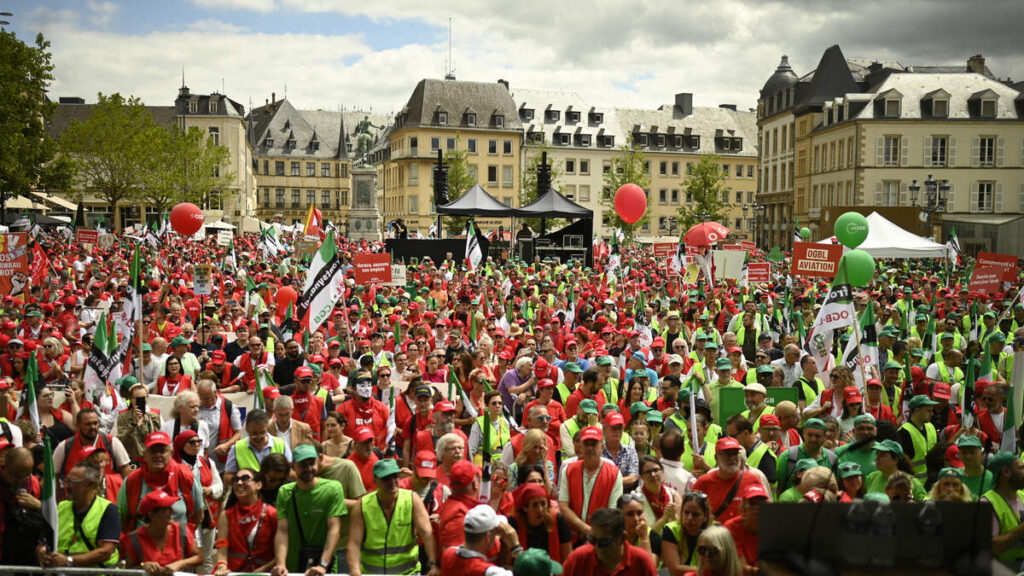
Just over a week later, the alliance led thousands of union members on a march in the capital city to demonstrate against a series of government reforms on issues including pensions and shop opening hours. According to police estimates, between 12,000 and 14,000 people took part, though the unions put the number at closer to 25,000.
Call for moratorium ignored
That effort may have been the catalyst that led the government to succumbing to union demands on maintaining control over collective bargaining agreements. But a call by the two unions just before Christmas for a moratorium on the government’s plans for longer opening hours, and Sunday working, while a social impact assessment is conducted was summarily ignored. Parliament adopted the law on 18 December that allows shops to be open Monday to Friday from 05:00 to 21:00 without specific authorisation.
Retailers with fewer than 30 employees will also be able to have staff work up to eight hours on Sundays, up from the current four hours.
The unions had argued that there was no evidence that the majority of consumers want to shop at what it called “extreme” hours. “If, as is claimed, society demands services that are available until 21:00, how do we explain the fact that no public administration is being asked to follow this logic?”
But the unions have also faced a series of isolated challenges as Luxembourg companies faced bankruptcy or undertook mass layoffs in 2025. Staff delegations have criticised Amazon’s plans to make 370 staff in Luxembourg redundant, claiming that the company could have done more. The LCGB’s Dury said that Amazon’s business model includes “a hire and fire logic” but added that he was “revolted” by the fact that instruments such as a Plan de maintien dans l’emploi job retention plan have not been used to seek alternatives to unemployment for Amazon staff.
And the long-running saga of the failed Liberty Steel plant in Dudelange has left 150 employees in limbo.
The year had started well for one union at least. The CGFP representing public employees managed to get the government to agree to a new working conditions package that included a two-stage salary increase. Civil servant pay grades were increased by 2% in 2025 and will rise a further 0.5% in 2026.
The civil service agreement was criticised by both private sector employers and other trade unions
The civil service agreement was criticised by both private sector employers and other trade unions. Marc Wagener, the director of Luxembourg’s employer associations umbrella organisation UEL, argued that the pay rise would make it even more difficult for the private sector to find qualified talent in an already tight labour market.
Public and private sector gap grows
“We have to ask whether we want the gap between public and private sector pay to grow even more, or whether we want to have a serious discussion about it,” Wagener told the Luxembourg Times in an interview in February.
Also read:Public sector pay deal puts efficiency and size of civil service in the spotlight
Patrick Dury of the LCGB union went even further, reiterating his metaphor of “social apartheid” and saying in an interview with RTL in December that the gap between the public and private sector is still widening.
Civil servants even had the audacity, via a public petition that quickly met the threshold of 5,500 signatures, to call on the government to increase their daily meal allowance from €10.80 to €15. That would represent roughly €128 more per month, on top of the pay rise they received in January, according to civil service minister Serge Wilmes.
But it was Wilmes’ former cabinet colleague, Georges Mischo, with whom the country’s two biggest private sector unions had the most beef.
Both the OGBL and LCGB unions had long been critical of Mischo, accusing him of intransigence (for which they also blamed Prime Minister Luc Frieden), but by November their patience with the labour minister had reached breaking point. They sent a letter to Frieden accusing Mischo of undermining social dialogue and being “unfit” for his cabinet post.
Just over four weeks later, Mischo resigned, though according to Frieden that was not solely because of the unions’ letter – there was also controversy surrounding plans for a national sport museum which he was in charge of as the Minister of Sport.
Marc Spautz has consistently been one of the few CSV backbenchers who has spoken with understanding of the unions’ demands
Mischo’s successor, Marc Spautz, has consistently been one of the few CSV backbenchers who has spoken with understanding of the unions’ demands on things like Sunday working, extending shop opening hours and having a seat at the table on pensions reform talks.
Indeed, Spautz has long been a vociferous supporter of the trade unions. He was a member of and former secretary general of the LCGB and his father Jean was a former president of the union. In June he was the only CSV politician invited to the OGBL’s annual congress. So, maybe he will be able to forge a better relationship with the unions.
“You shouldn’t talk about people, but with them. That is my top priority,” Spautz said after his appointment was confirmed, signalling a change in tack to the top-down approach that the unions said was a hallmark of Mischo’s time in office.
Dury was in a positive mood when interviewed by RTL in December. “It’s no secret that we had a difficult relationship with the [previous] minister,” he said. Dury knows Spautz well enough to call him by his first name and said he was sure that talks with his former boss at the LCGB would be constructive.
Yet Dury added a note of caution. “The goal is to achieve results for the people, not just to have constructive negotiations.” There may still be several months of tough talking to come at the start of 2026.