
“These decisions perhaps blur the line of what was thought to be clear cut, conventional wisdom.”
 This year started with a district court decision defining the parameters of parody and trademark infringement and ended with a case that could have taken the overlap of parody and political free speech to a new level, had it not settled. That can of soup has not yet been opened.
While brand owners expect that their trademarks and trade dress are federally protected properties under the Lanham Act, political figures, satirists and manufacturers of parody products expect their activities to be protected under the First Amendment and other carved out, fair use exclusions. Sometimes, these respective worlds collide. In 2025, this became abundantly clear.
The Saga of Jack Daniels v. Bad Spaniels Continues
The issues raised by Jack Daniel’s Properties, Inc. v. VIP Products LLC, 59 U.S. 140 (2023) continued into early 2025.
In 2014, in response to Jack Daniel’s cease-and-desist letter, VIP sued for a declaratory judgment that its BAD SPANIELS dog toy neither infringed nor diluted the famed JACK DANIEL’S bottle. VIP argued that under the standard developed by the Second Circuit in Rogers v. Grimaldi 875 F. 2d 994 (2d Cir. 1980), an infringement claim against an expressive work must be dismissed unless a complainant proves the work “(1) has no artistic relevance to the underlying work and (2) explicitly misleads as to the source or content of the work.”
VIP lost at the Arizona district court level, but on appeal, the Ninth Circuit reversed, finding that VIP’s use did fall under Rogers and that BAD SPANIELS was parody falling under the non-commercial use exclusion allowing for parody.
Jack Daniel’s took the case to the Supreme Court. In its January 2023, decision, the Court offered clarification only with infringement and dilution causes of action when the allegedly infringing parody marks are used in a pure trademark sense, i.e., as a source identifier.
The Court held that Rogers does not apply when the accused infringer uses a trademark owner’s mark (identical or confusingly similar) to identify its own goods or services. Regarding dilution, the Court similarly held that if an accused uses its mark to identify the source of its own goods, that the mark is parody is an insufficient defense to shield the mark from liability for dilution. The noncommercial parody exclusion is limited to noncommercial use of marks, not marks that are trademarks in and of their own right.
On remand, the U.S. District Court for the District of Arizona was tasked with considering (1) whether VIP’s BAD SPANIELS squeaky toy tarnishes Jack Daniel’s trademarks and (2) whether BAD SPANIELS infringes JACK DANIEL’S trademarks. VIP Products LLC v. Jack Daniel’s Incorporated. 2025 WL 275909 (D. Arizona) (January 21, 2025).
On the tarnishment by dilution question, the district court assessed:
- The fame of JACK DANIEL’S;
- The similarity of the marks and
- Reputational harm.
Fame and similarity of the mark were not disputed. As to reputational harm, “the relevant inquiry is how the junior mark affects he consumer’s positive impressions of the famous mark.” Expert testimony from a Stanford University marketing professor relying on consumer psychology research, disclosed that that BAD SPANIELS created “disgusting associations” with feces that negatively impacted JACK DANIEL’S carefully cultivated image of authenticity, integrity and quality. Since Jack Daniel’s produces a product intended for human consumption, association with something like dog feces is particularly detrimental.”
As for infringement, the court emphasized that parody plays a key role in assessing likelihood of confusion since successful parody evokes the original mark and creates contrast with humor to clarify that it is not the original. The court, weighing similarity of the marks, strength and intent, weighed against likelihood of confusion, favorable to VIP.
The court noted that although similarity is typically a strong factor in a finding of likelihood of confusion, it recognized there must be some level or resemblance or similarity for parody to be effective. BAD SPANIELS did borrow key elements of JACK DANIEL’S trademarks and trade dress, but the addition of the humorous contrasts signaled to consumers that the intent was parody, thus decreasing the likelihood of confusion.
In addition, in view of the fame of the JACK DANIEL’S trademarks and trade dress, it was easy for the consuming public to distinguish JACK DANIEL’S from BAD SPANIELS and to understand that the latter is parody. As VIP intended to mimic JACK DANIEL’S, the Court recognized that the product was produced in jest, rather than deception.
When parody was thrown into the mix, the factors are analyzed differently, here, resulting in a finding against infringement.
In finding that BAD SPANIELS was not confusingly similar to JACK DANIEL’S, the district court noted “the qualities on which BAD SPANIELS runs afoul of the Lanham Act’s cause of action for dilution by tarnishment are the very qualities that help BAD SPANIELS prevail on the trademark infringement claim as they are the qualities that create contrast with the JACK DANIEL’S marks by way of irreverent juxtaposition.” (2025 275909 at 22).
Pass the Soup
More recently, on October 10, 2025, Campbell’s Soup Company filed a trademark infringement suit against Shelby Nicole Campbell, a congressional candidate in Michigan’s 13th District in the Eastern District Court of Michigan. The dispute is based on Ms. Campbell’s use of an iconic red and white CAMPBELL’S Soup Can and the flavor, SOUP FOR CHANGE 2026 on promotional materials nearly identical to the soup can that is a source of comfort to so many:
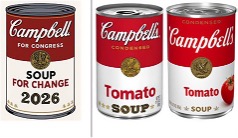
Prior to filing suit, Campbell’s Co. sentMs. Campbell a cease-and-desist letter. She refused to comply, asserting that such use is protected parody and political free speech under the First Amendment.
Political speech is protected under the First Amendment. However, under the Lanham Act, use of a mark that in some way creates a false or misleading impression of affiliation or endorsement can give rise to liability. In addition, use by another of a registered trademark in commerce without the consent of the trademark owner does give rise a cause of action for infringement.

Moreover, First Amendment protections have been held to be limited when a political candidate’s imagery is used to trade on a commercial brand’s reputation. (see, Hershey Co. v. Friends of Steve Hershey, 33 F. Supp. 3d 588, 595-85 (D. Md. 2014).
Thus, the question in the Campbell’s case would have been whether voters would be led to believe that Campbell’s Co. sponsors, endorsed or was affiliated with a political campaign (the public did question whether there was such an association). Did use of the Campbell’s Soup can by Ms. Campbell create a false designation of origin or suggest a false endorsement? Could such a false belief that Campbell’s Co. endorsed Ms. Campbell result in reputational harm to the company?
On the other hand, was Ms. Campbell’s use acceptable political satire? Was Campbell’s Co. using its vast resources to intimidate Ms. Campbell into giving up use of the images she was entitled to use under the First Amendment and fair use? Did the fact that Ms. Campbell’s childhood nickname was “Soup” come into play in her defense, or that the Campbell name in her family line dated back further in history than Campbell’s Soup? Perhaps use of “soup” and her family name are acceptable, but not use of those in conjunction with the famous Campbell’s soup can?
The answers to these questions won’t be decided in this case. The matter was settled by a stipulated order under which Ms. Campbell agreed to cease all use of the soup can trademarks and trade dress and never to make or imply that Campbell’s Co. sponsored, endorsed, authorized or was in any other way affiliated with her campaign.
Although this case was not ultimately tested in court, the takeaway for now is that a defense of politically protected speech under the First Amendment does not necessarily provide protection against a claim of trademark infringement if such use does create a likelihood of confusion under the Lanham Act.
The Overlap of Whiskey and Soup
In Jack Daniel’s, the district court held that parody is not protected under the First Amendment or a fair use exclusion if the allegedly infringing product uses another’s mark as a source identifier, as a trademark. Under that scenario, a parody is subject to standard likelihood of confusion analysis under the Lanham Act.
Under the Campbell’s Soup set of facts, although the First Amendment protects political discourse, a plaintiff can still seek relief under the Lanham Act for use that creates a likelihood of confusion as to source, sponsorship and political affiliation.
These decisions perhaps blur the line of what was thought to be clear cut, conventional wisdom. How these issues are decided in 2026 and beyond remains to be seen.
Image Source: Deposit Photos
Author: stanciuc1
Image ID: 74355197